

6-3 The DNA of the Employee Stock Ownership Plan—The Power of Freedom—
In Europe and the United States, laws prohibit external capital from being invested in architectural design firms.
There are two fundamental ethical principles that should underpin architectural design. The first, of course, is to serve the interests of the client; the second is that, since architecture exists within society, it must serve the interests of that society.
In publicly traded corporations, it is inevitable that management will prioritize shareholders. Indeed, respect for shareholders is a fundamental principle of corporate management. However, if a specific shareholder were to own an architectural design firm for their own economic gain, they could potentially exert control over architectural projects that serve various social purposes.
In Europe and the United States, the “professional corporation” model was established through legislation to protect “architecture with social significance” and prevent such situations from occurring in principle. In Japan, however, there are no specific legal provisions of this kind. If such legislation were implemented in Japan regarding architectural design services—given the current prevalence of design-build practices by construction companies and general contractors—it could lead to some delicate issues.
At Nikken Sekkei Construction, right from the time of its establishment, the organizational structure was designed as a “professional corporation”—a model so highly valued in the West that it is enshrined in law—as the ideal form an architectural design firm should take. Although this fact is not widely known, we believe it was a groundbreaking move in Japan.
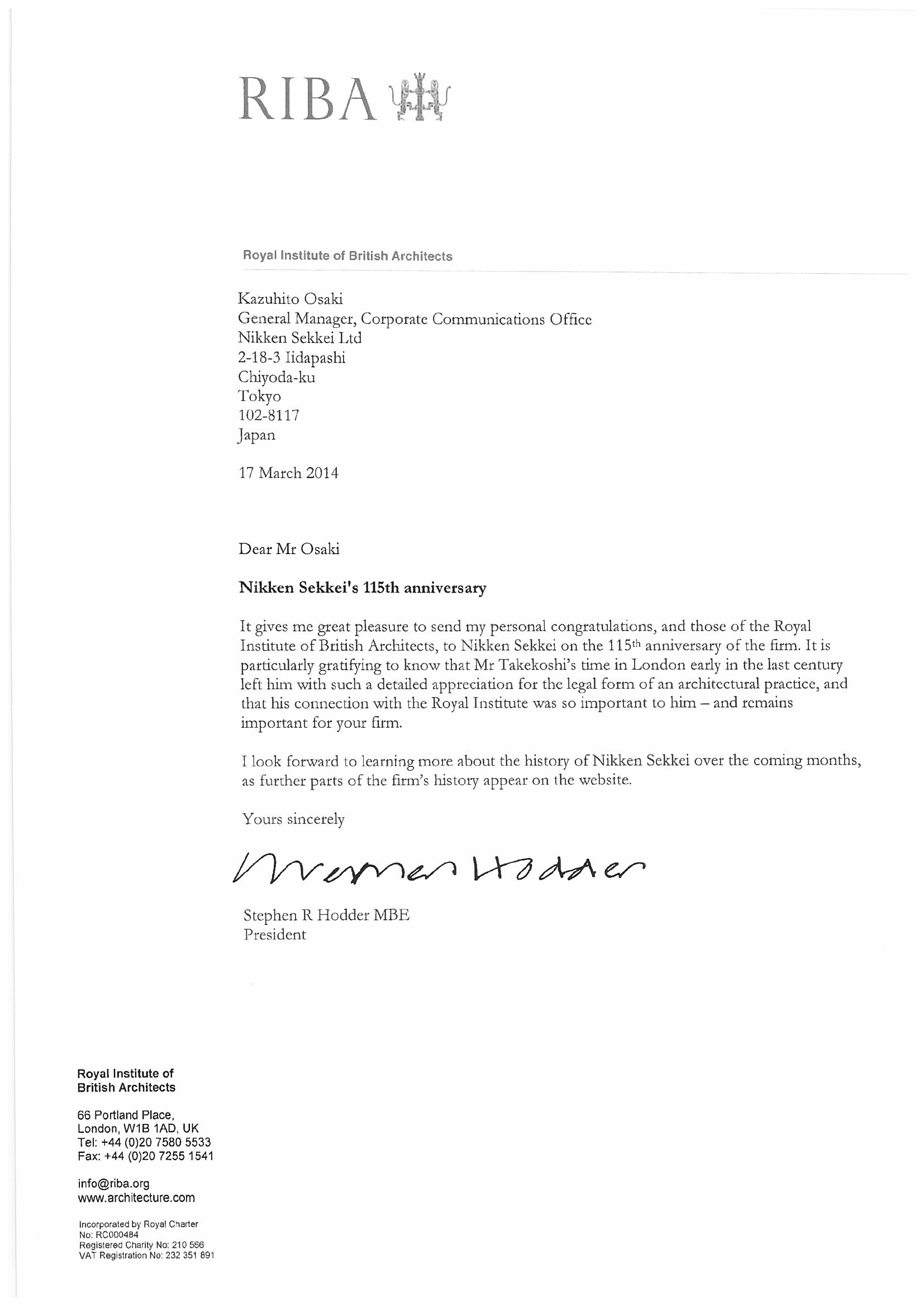 6-16 A letter from the RIBA President, sent on RIBA letterhead, conveying congratulations on Nikken Sekkei’s upcoming 115th anniversary next year. Nikken Sekkei had requested permission to use the RIBA coat of arms in light of the relationship between RIBA and Kenzo Takekoshi, and this is the letter they received in response.
The Hasebe & Takekoshi Architectural Office was a professional corporation.
The Hasebe & Takekoshi Architectural Office already employed Kusuke Ozaki, who would later become the first President and CEO of Nikken Sekkei Construction; Koichi Ito, who would become the second President and CEO; and Takeshi Tsukamoto, who would become the third President and CEO.These individuals—including the three who would later become executives at Nikken Sekkei Construction—were greatly mentored by Hasebe and Takekoshi and were strongly influenced by their vision of what an architectural firm should be. The professional ethics that staff members of an architectural firm should uphold, clearly articulated in the “Staff Code of Conduct,” were also carried forward to Nikken Sekkei Construction.
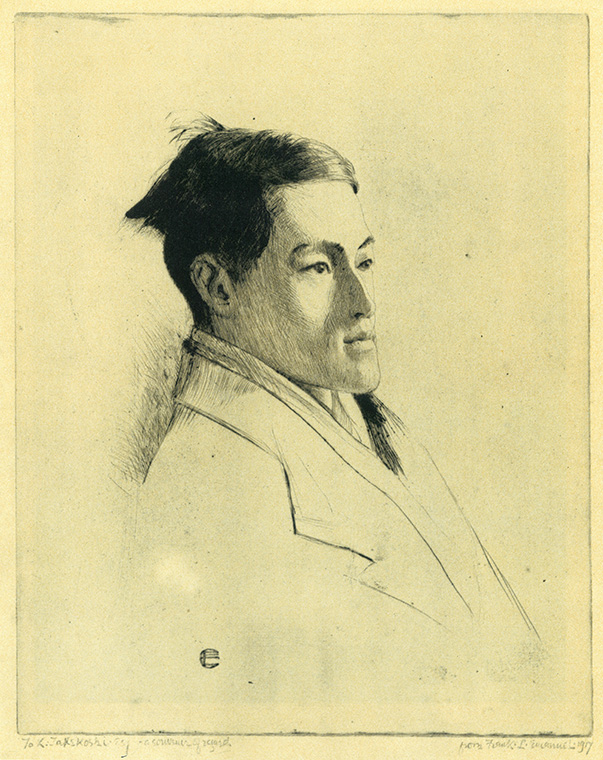 6-17: Kenzo Takekoshi, age 29, as depicted by his etching teacher upon his departure from London in 1917
The Spin-Off of Nikken Sekkei Construction and the Establishment of an Employee Stock Ownership Plan
In Showa 25 (1950), the design division Construction Administration Department spun off from Nippon Construction Industry, and Nikken Sekkei Construction Co., Ltd. was established. Its first President and CEO was Hisasuke Ozaki.Initially, all shares were held by Nippon Construction Industries, but two years later, just as Nikken Sekkei Construction Co., Ltd. was barely beginning to get on track, all shares were transferred from Nippon Construction Industries to Kusuke Ozaki and 14 others.At that time, Kusuke Ozaki and his colleagues—who had long been mentored by Kenzo Takekoshi—established a policy of not transferring any shares outside the company. This marked the beginning of the internal shareholder system. The key figures involved in the founding of Nikken Sekkei Construction carried forward Takekoshi’s convictions regarding the ideal corporate structure for an architectural design firm.
Since gaining independence, Nikken Sekkei and the various companies within the Nikken Group—which continue to this day—have firmly upheld the internal shareholder system, using it as the foundation for autonomous and independent management, free from the influence of external capital provided by outside shareholders. Rather than being a company that generates profits for external shareholders, it has remained a corporate organization dedicated to carrying out the professional work it believes an architectural design firm should perform.
The Power of Freedom
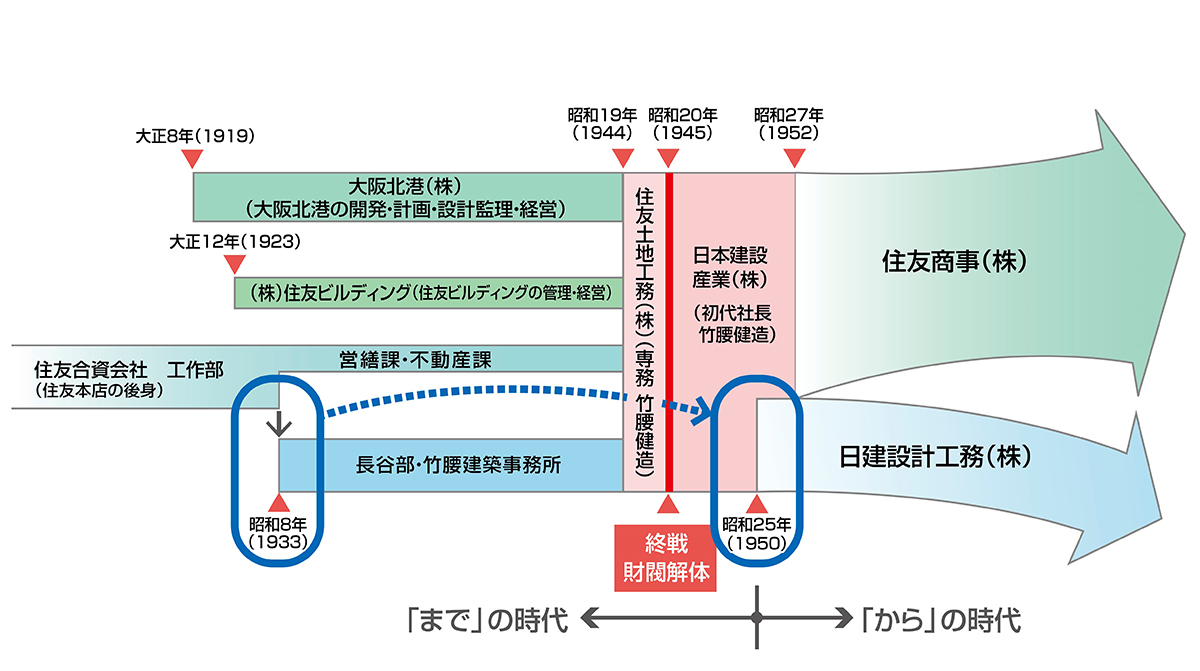 6-18 In Showa 8 (1933), the Hasebe & Takekoshi Architectural Office broke away from the Engineering Division of Sumitomo Joint-Stock Company, setting out on its own like a small boat braving the storm of the Great Depression. It was precisely because of the independence of the Hasebe & Takekoshi Architectural Office that, in 1950, Nikken Sekkei Construction—led by individuals who had been mentored by Hasebe and Takekoshi—was able to achieve independence from the Japanese construction industry, despite the postwar chaos and fears about the future. Without this decision, the current Nikken Sekkei and Nikken Group would not exist. The “in-house shareholder system” is the fundamental philosophy underlying this independence. The diagram above shows the circumstances surrounding this period, with two blue ovals and dotted lines added to the diagram presented earlier in “Sumitomo Corporation and Nikken Sekkei Construction.”
Kenzo Takekoshi (1980), *Yuusen Jijo* (Autobiography of Yuusen), Sogensha
Takao Konishi (1991), *To 13-chome, Kitahama 5-chome*, Sōgensha
Takayuki Hashimoto (1999), *From 13 Kitahama 5-chome*, Sōgensha
Nikken Sekkei (1970), *Twenty-Year History*, Nikken Sekkei
6-17: Kenzo Takekoshi (1977), *Nostalgic Melodies*, Kenzo Takekoshi