

9-2 What Is the Universe Made Of? —Super-Kamiokande and J-PARC—
As children, we’ve all probably looked up at the stars in the night sky and asked ourselves that simple question: “What lies beyond this universe?” While we’ve long since forgotten that sense of wonder, there are people who have held onto that innocent curiosity and continue to tackle the “mysteries of the universe” through particle physics. Just as Galileo Galilei observed celestial bodies 400 years ago with his homemade telescope, modern researchers are unraveling the mysteries of the universe and matter using large-scale observation facilities such as Super-Kamiokande, which detects elementary particles, and J-PARC (Japan Proton Accelerator Research Complex), which accelerates them.
The discovery that neutrinos have mass will advance current particle physics theory and bring us closer to unraveling the "mysteries of the universe."
Neutrinos are one of the countless elementary particles swirling through the universe, and they hold the key to unlocking the mysteries of the universe and matter. They are also extremely difficult to observe because they pass right through matter.In 1996, Super-Kamiokande was completed, featuring a reservoir of 50,000 metric tons of ultrapure water and 11,146 photomultiplier tubes.Super-Kamiokande is a device that detects neutrinos by using photomultiplier tubes to detect the bluish-white rings of light emitted when a neutrino strikes charged particles—such as electrons—in the water tank.To avoid cosmic rays that would interfere with observations, it was installed 1,000 meters underground in Kamioka, Gifu Prefecture. Furthermore, since it is extremely rare for neutrinos to trigger such reactions, a large volume of water is stored to lie in wait for them.
In 1998, observations using Super-Kamiokande revealed that neutrinos—which had previously been thought to have zero mass—actually do have mass. This discovery significantly advanced current particle physics theory, bringing us closer to unraveling the “mysteries of the universe,” and was widely reported around the world.
In 1998, observations using Super-Kamiokande revealed that neutrinos—which had previously been thought to have zero mass—actually do have mass. This discovery significantly advanced current particle physics theory, bringing us closer to unraveling the “mysteries of the universe,” and was widely reported around the world.
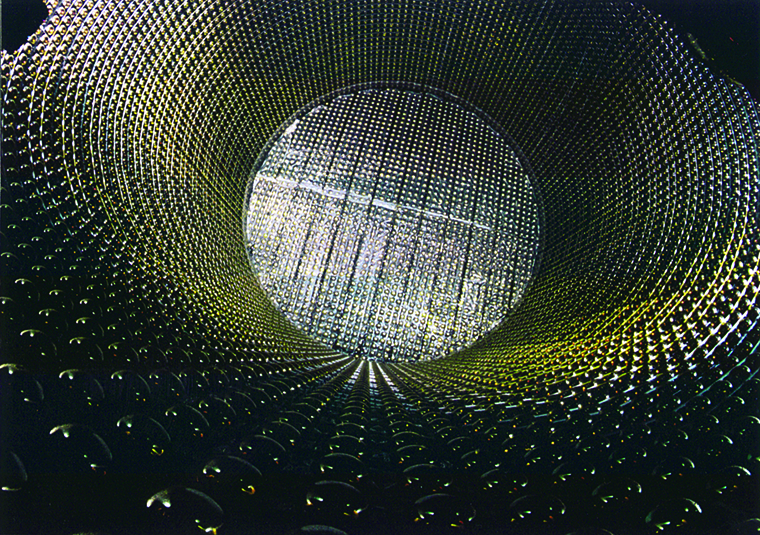 9-10 Super-Kamiokande, Heisei 8 (1996)
A total of 11,146 photomultiplier tubes are mounted on the interior floor, walls, and ceiling.
In 1987, using Kamiokande—the predecessor to Super-Kamiokande—neutrinos from a supernova explosion in the Large Magellanic Cloud were observed for the first time in the world.This achievement is well known in connection with Dr. Masatoshi Koshiba’s Nobel Prize. Eleven neutrino events were detected at that time, but the details of the explosion remained unclear.However, great expectations are placed on Super-Kamiokande, which was built subsequently; if a supernova explosion were to occur near the center of our galaxy, it would be capable of detecting as many as 10,000 neutrino events, allowing for a detailed investigation of the mechanisms behind supernova explosions—and thereby shedding light on the “mysteries of the universe.”
Nikken Sekkei designed the stainless steel lining of Super-Kamiokande’s large water tank and the support structures for the photomultiplier tubes.
Super-Kamiokande, which was constructed by excavating the ground, consists of a large cavity (tank) 39 meters in diameter and 42 meters deep, lined with stainless steel. It comprises an inner tank, densely packed with photomultiplier tubes up to a height of 40 meters, and an outer tank surrounding it.
Nikken Sekkei designed the stainless steel lining of Super-Kamiokande’s large water tank and the support structures for the photomultiplier tubes.
Super-Kamiokande, which was constructed by excavating the ground, consists of a large cavity (tank) 39 meters in diameter and 42 meters deep, lined with stainless steel. It comprises an inner tank, densely packed with photomultiplier tubes up to a height of 40 meters, and an outer tank surrounding it.
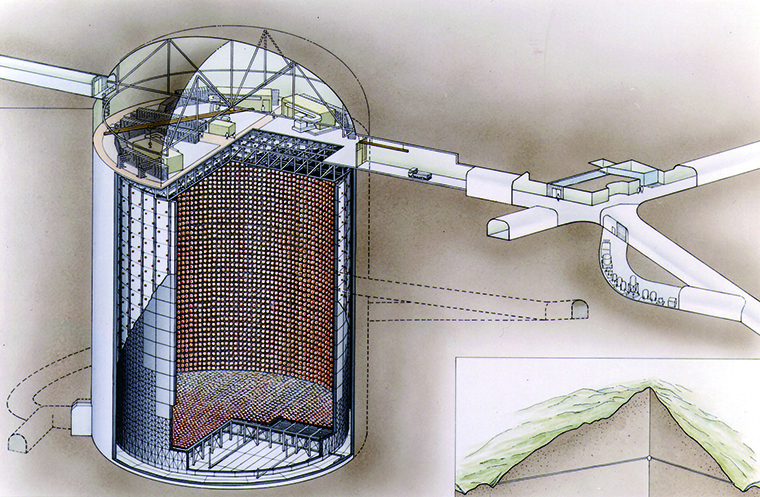 9-11: The world’s largest neutrino detector, built 1,000 meters underground inside the Kamioka Mine in Gifu Prefecture.
It is officially known as the Large Water Cherenkov Cosmic Particle Detector.
Sending neutrinos 295 km underground from Tokai Village to Kamioka
The Japan Proton Accelerator Research Complex (J-PARC) was established in Tokai Village, Ibaraki Prefecture. This complex houses the world’s highest-intensity proton beam accelerator and serves as a hub for cutting-edge research across a wide range of fields—from fundamental science, including particle physics, to industrial applications. Protons are accelerated by a 330-meter linear accelerator, a 350-meter-circumference 3 GeV synchrotron, and a 1,600-meter-circumference 50 GeV (gigaelectronvolt) synchrotron, reaching 99.98% of the speed of light. These accelerated protons are made to collide with metal or graphite, and the secondary particle beams generated during these collisions are utilized in various experiments.
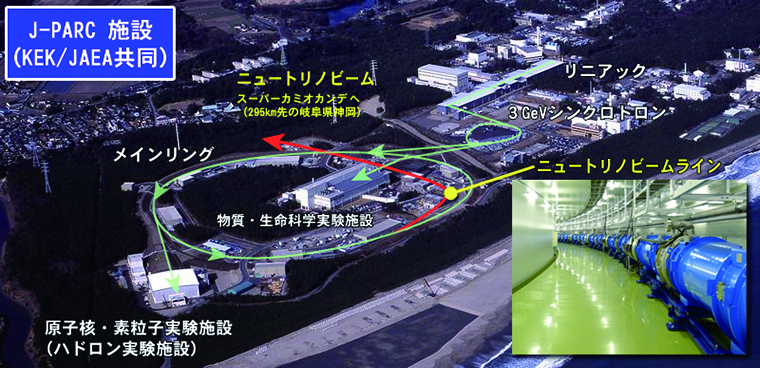 9-12 J-PARC Facilities
One of these secondary particle beams consists of neutrinos. By firing these mysterious particles—which can even pass right through the Earth—toward the Super-Kamiokande facility in Kamioka, Gifu Prefecture, 295 km away, and observing the changes in their state, researchers are reportedly making progress in studying the origins of the universe and the mysteries of mass. Since the Earth is round, the launch device is angled slightly downward to fire the neutrino beam into the ground; the neutrino beam (which is harmless) then passes through the Earth and emerges back onto the surface somewhere around South Korea.
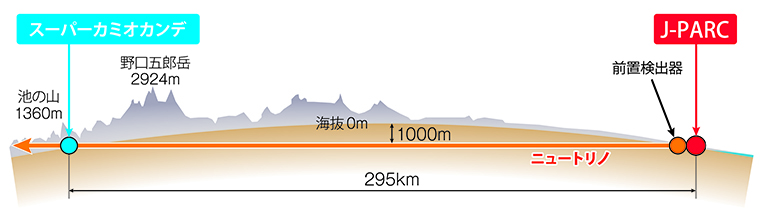 9-13 Super-Kamiokande and Neutrinos
J-PARC is a facility that accelerates high-current protons to high energies. Due to factors such as the intense radiation generated, numerous challenges arose at each stage of facility planning, design, and construction. The accelerator tunnel is constructed of reinforced concrete with walls ranging from 2 to 5 meters thick to shield against radiation.We also tackled a variety of difficult challenges, including addressing thermal expansion stresses and deformation in the tunnel structure caused by changes in room temperature during accelerator operation and maintenance; controlling micro-vibrations and floor settlement to accommodate the installation of precision equipment; ensuring floor rigidity; and implementing waterproofing and leak prevention measures for the underground facilities.
Although it is not widely known, Nikken Sekkei has been involved in the design and supervision of many world-class scientific facilities in addition to Super-Kamiokande and J-PARC.For example, we have provided design supervision for the RIKEN Center for Computational Science, which houses the world-class “K computer,” as well as for the Earth Simulator facility at the Japan Agency for Marine-Earth Science and Technology (JAMSTEC), which plays a major role in analyzing the mechanisms of crustal movements and meteorological and oceanographic phenomena.
Although it is not widely known, Nikken Sekkei has been involved in the design and supervision of many world-class scientific facilities in addition to Super-Kamiokande and J-PARC.For example, we have provided design supervision for the RIKEN Center for Computational Science, which houses the world-class “K computer,” as well as for the Earth Simulator facility at the Japan Agency for Marine-Earth Science and Technology (JAMSTEC), which plays a major role in analyzing the mechanisms of crustal movements and meteorological and oceanographic phenomena.
(References)
Kamioka Observatory Website
Japan Atomic Energy Agency Press Release
Hitoshi Murayama (2013), *What Is the Universe Made Of?—Solving the Mysteries of the Universe with Particle Physics*, Gentosha
Nikken Sekkei (2009), *NIKKEN SEKKEI Quarterly, Vol. 24*, “World-Leading Science and Technology Facilities and Nikken Sekkei,” Nikken Sekkei
Kamioka Observatory Website
Japan Atomic Energy Agency Press Release
Hitoshi Murayama (2013), *What Is the Universe Made Of?—Solving the Mysteries of the Universe with Particle Physics*, Gentosha
Nikken Sekkei (2009), *NIKKEN SEKKEI Quarterly, Vol. 24*, “World-Leading Science and Technology Facilities and Nikken Sekkei,” Nikken Sekkei
Source
9-10–11: Courtesy of the Institute for Cosmic Ray Research, The University of Tokyo; Kamioka Observatory
9-12: Courtesy of the Japan Atomic Energy Agency
9-13: Courtesy of the T2K International Collaboration
9-10–11: Courtesy of the Institute for Cosmic Ray Research, The University of Tokyo; Kamioka Observatory
9-12: Courtesy of the Japan Atomic Energy Agency
9-13: Courtesy of the T2K International Collaboration