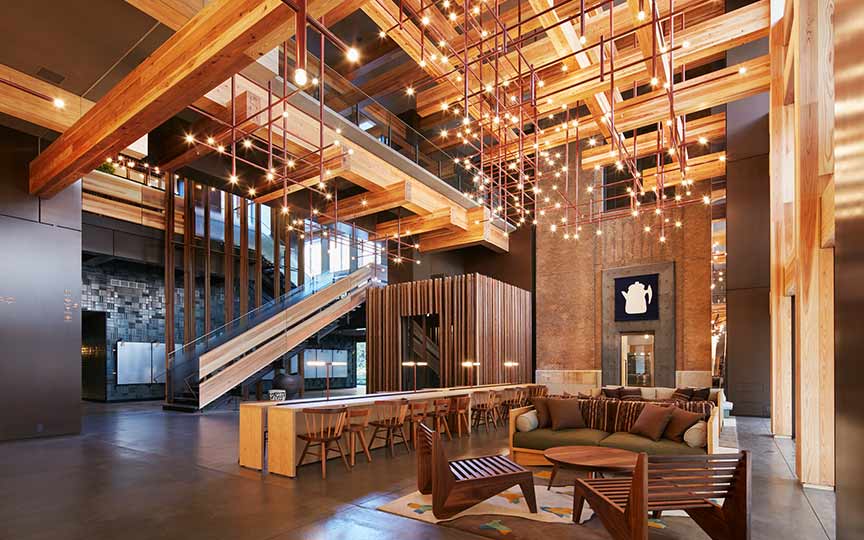

Lifecycle advisory services supporting large-scale mixed-use buildings that are loved for a long time.
SCROLL DOWN
To ensure that a building retains its value over the long term, it is necessary not only to address physical deterioration due to aging but also to comprehensively address environmental considerations, regulatory compliance, seismic resistance, business continuity planning (BCP), social demands, and technological innovations.Furthermore, the environment surrounding large-scale mixed-use buildings is becoming increasingly complex and diverse, and the challenges in building management and operations are more wide-ranging than ever before.
In recent years, Nikken Sekkei’s scope of work in the development of large-scale mixed-use buildings has expanded beyond design and supervision to include project management for the entire development and start-up support for the operational phase, such as the formulation of management and operation plans, allowing us to be involved in the construction process from various angles.Even after completion, we leverage our data and experience to provide ongoing support to building owners throughout the building’s lifecycle.



A Partner Supporting the Steady Operation of Large-Scale Mixed-Use Buildings
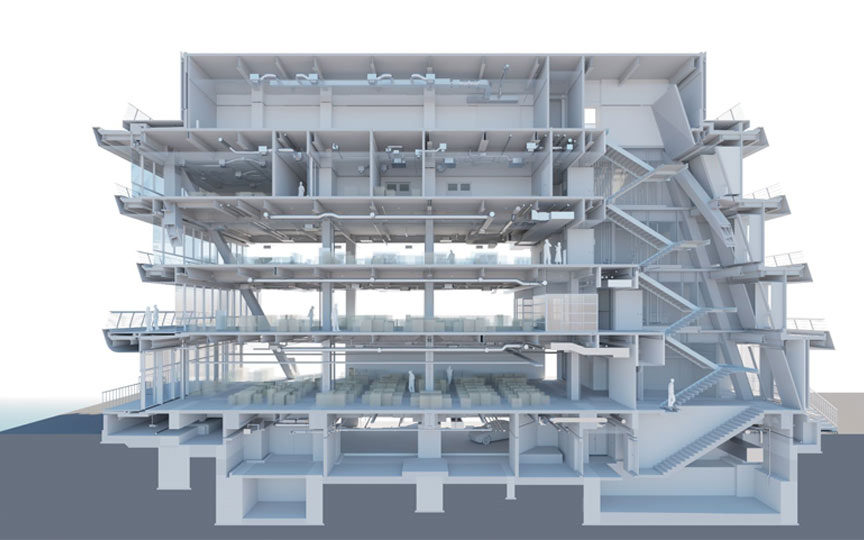
In this article, we present a case study of our Life Cycle Advisory services at St. Luke’s Garden.
Programming for Successful Large-Scale Renovation Projects
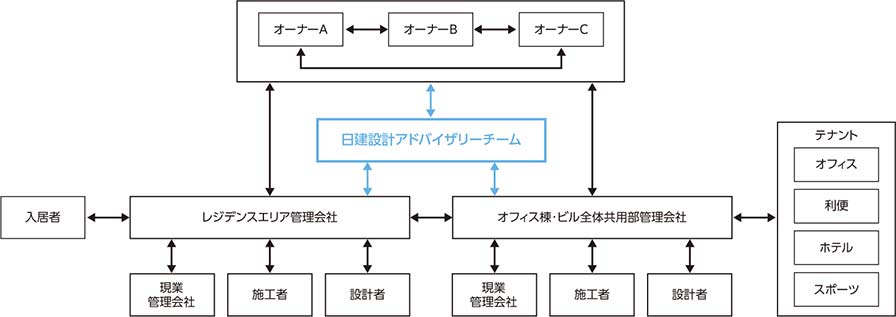 Organizational Chart for the St. Luke's Garden Operations Phase
As part of our advisory services for St. Luke’s Garden, we formulated medium- to long-term renovation plans in the 13th and 20th years after completion to assess the property’s condition in preparation for future large-scale renovation work.Now, with the building approaching its 30th anniversary—a milestone at which much of its equipment and systems are reaching the end of their service life—Nikken Sekkei was responsible for the programming to launch a large-scale renovation project.
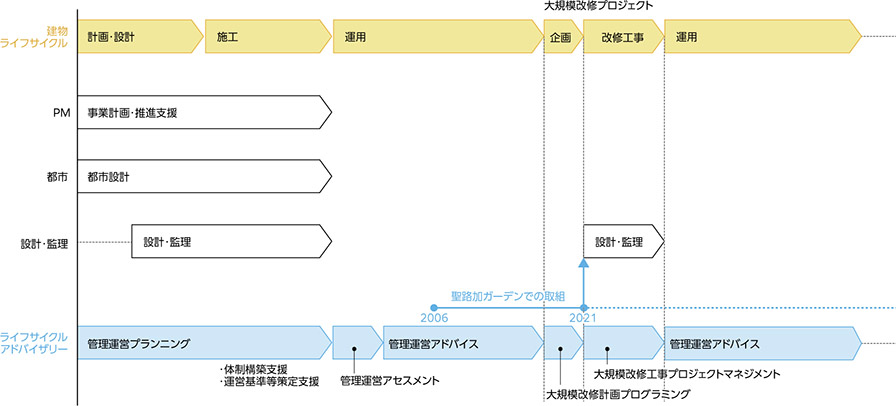 Nikken Sekkei’s Role in the Building Life Cycle (for Large-Scale Mixed-Use Buildings)
To successfully advance a large-scale renovation project within a complex building management framework, it is essential to establish a solid, unwavering foundation for the project by thoroughly organizing the program—including stakeholder requirements, visions, and decision-making processes—before proceeding to the detailed planning of specific construction work.By having Nikken Sekkei participate from the programming stage, it becomes possible to assess technical risks early on and systematically organize project requirements from a neutral standpoint, thereby ensuring the project’s success.
In launching the large-scale renovation project for St. Luke’s Garden, we proceeded with programming while sharing an understanding of the building’s current condition, the goals of the renovation project, and the roadmap for achieving them with all building management stakeholders.
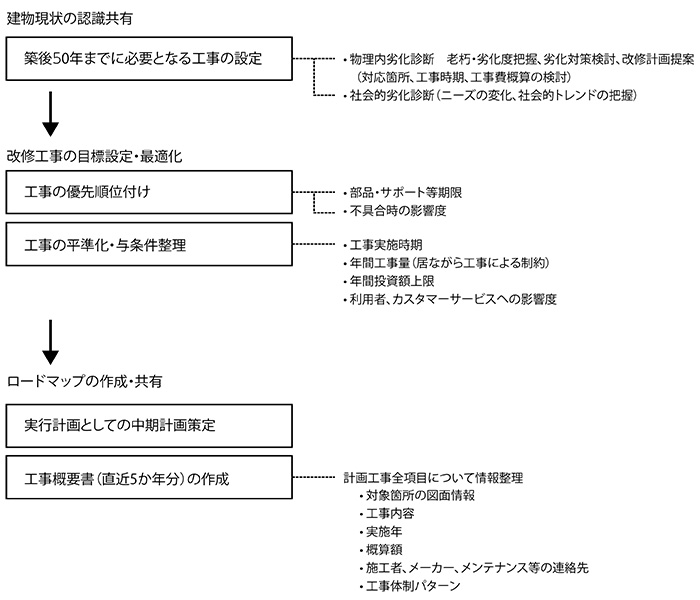 Large-Scale Renovation Plan: Programming Steps
Subsequently, as a concrete roadmap leading up to the start of construction, we created a project overview document summarizing all planned work required over the next five years—including drawings of the renovation areas, details of the work, estimated costs, and manufacturer information—and shared it with the building management company responsible for actual budget planning and project execution.
In this way, we supported the advancement of this large-scale renovation project by not only reporting on the building’s deterioration but also by establishing and managing the entire process leading up to construction—from fostering a shared understanding among stakeholders to organizing and providing information on construction orders.
Technical Support Following the Launch of a Large-Scale Renovation Project
In addition to addressing physical deterioration as described above, we will also regularly propose value-enhancement measures that take into account the building’s social deterioration—such as the latest building trends, information on competing buildings, and user evaluations.For example, effective value-enhancement projects—such as upgrading the specifications of equipment like HVAC systems, which directly impact user comfort, or renovating entrances and elevator lobbies, which significantly influence the building’s impression—lead to increased building value and improved profitability.By integrating our extensive database—built through numerous design projects—with our design expertise to propose cost-effective renovation plans, we support building owners in their property management efforts.
Shaping the Future of Buildings That Will Be Cherished for Generations
Furthermore, we recognize that our involvement in projects as an independent third party—rather than from the perspective of building operators or contractors—allows us to make fair and objective assessments of Q (Quality), C (Cost), and S (Schedule), which is a significant benefit for building owners.
To continue shaping the future of buildings that will be cherished for generations to come, we—as a team of engineers dedicated to supporting building owners—will continue to provide our full support for building operations by applying the know-how we have accumulated through the development and new construction design of large-scale mixed-use buildings throughout the building’s lifecycle.