

Cost Management Report
「Competitive conditions persist Rising materials prices to push up construction costs」
SCROLL DOWN
The “Cost Management Report” (quarterly) provides an overview of domestic and international economic conditions and, drawing on a wealth of cost data derived from our track record as the leading architectural firm in market share, delivers timely, independent analyses of the construction market from a neutral perspective.
*This report has been prepared by the Cost Management Group of the Engineering Dept. of Nikken Sekkei Ltd for information purposes. The information in this report is current as of the date of publication. Its completeness is not guaranteed, however. The contents are subject to change without notice. Unauthorized reproduction of this report is prohibited.



Competitive conditions persist Rising materials prices to push up construction costs
Orders received, work on hand steady
* Leading construction companies: Obayashi Corporation, Kajima Corporation, Shimizu Corporation, and Taisei Corporation. Takenaka Corporation is not included due to non-disclosure of quarterly financial results.
Difficult competitive environment continues
-
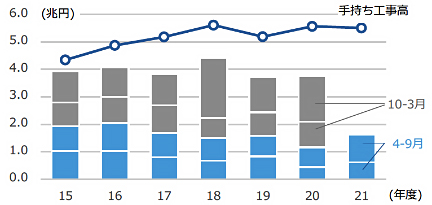 Fig. 1: Trends in orders received and work-on-hand at 4 major construction firms
Source: Compiled from the financial data of each firm.
The count for construction projects on hand in FY21 is as of September. -
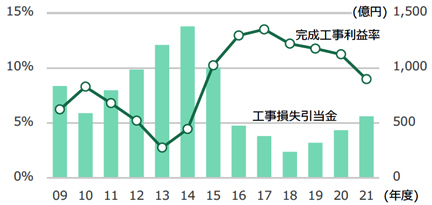 Fig. 2: Trends in profit margins & provisions for losses on construction contracts at 4 major construction firms
Source: Compiled from the financial data of each firm. The count for construction projects on hand in FY21 is as of Sept.
Figures for profit margin on completed construction & allowance for loss on construction = 4-company avg.
The increase in large construction projects is a competitive factor
Materials prices are increasing
Given the low likelihood of material prices returning to their original levels, it will be difficult for contractors to absorb the increased costs while accepting a decline in profitability at the time of contract signing, and therefore, construction prices are expected to rise.
-
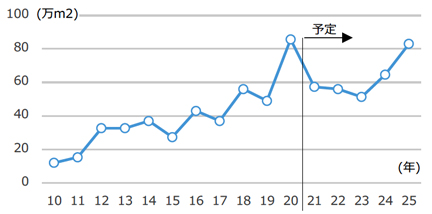 Fig. 3: Supply of office space of 100,000 sq.m. or more per unit in Tokyo's 23 wards / 3-year historical moving average
Source: Mori Building survey of large-scale office building market trends in Tokyo's 23 wards. -
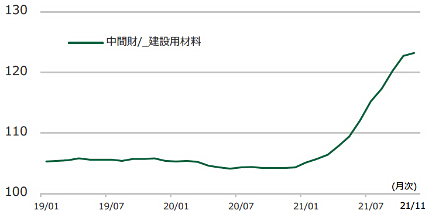 Fig. 4: Price index of construction materials
Source: Bank of Japan: Corporate Goods Price Index by Demand Level and Use.
NSBPI Rises Slightly in All Three Districts
Nikken Sekkei Standard Building Price Index
In both the construction and facility sectors, builders are increasingly unable to absorb the increase in materials prices. This is reflected in the quotations they submit.
-
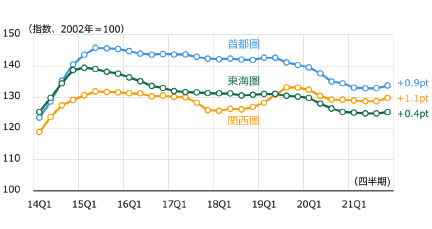 Fig. 5: Change in NSBPI
-
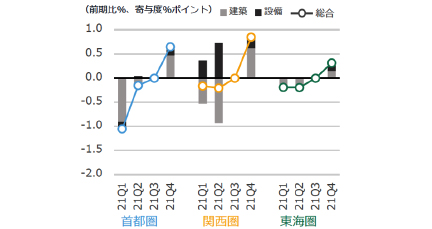 Fig. 6: Percent Change in NSBPI & Building Work, MEP Work Contributions
Steel prices continue to rise
Steel prices are therefore expected to remain high.
Labor shortage persists
-
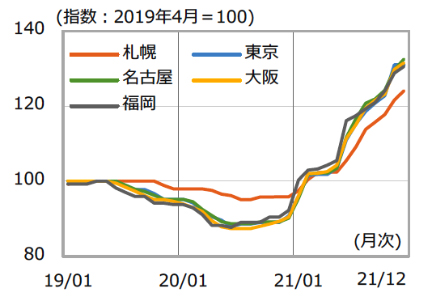 Fig.7: Change in steel prices (ordinary steel)
Source: Economic Research Institute “Construction Materials Price Index.” -
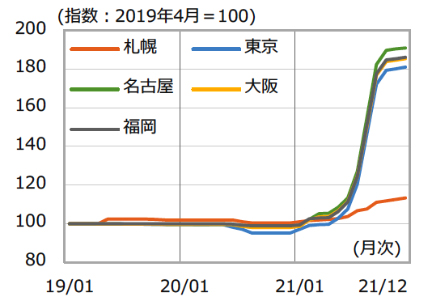 Fig. 8: Trends in timber prices
Source: Economic Research Council cost estimation data -
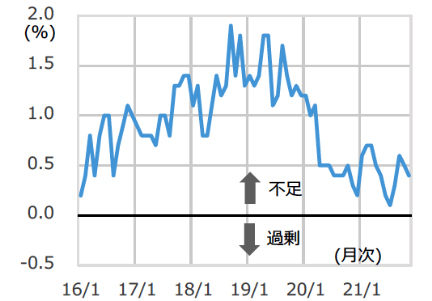 Fig.9: Trends in the Oversupply/Shortage Skilled Construction Worker Ratio
Source: Ministry of Land, Infrastructure, Transport and Tourism, "Survey of Construction Labor Supply and Demand” (total of 8 occupational categories, nationwide, seasonally adjusted).