

Results Announced for the “1st Tsunagi Competition,” a Student Idea Contest for Solving Social Issues Using Wood
~Three entries addressing the themes of “Foliage Damage Caused by Nara’s Deer,” “Neglected Plantations in Niigata’s Heavy Snowfall Areas,” and “Replacing Concrete Retaining Walls with Wood” Received Excellence Awards~

Background of the “Creating ‘Mochi’ (Forest + City)” Tsuna-gi Competition, Aimed at Promoting the Active Use of Wood
To advance sustainable forest management and timber utilization, it is crucial to consider “where and how timber is utilized.” Therefore, as an initiative to broaden the scope of timber use—conceived by Nikken Wood Lab at Nikken Sekkei—this competition was organized to solicit student-led ideas based on the “Mochi” philosophy, where forests and cities connect,share challenges together, and translate them into action. We have organized this competition to solicit student-led ideas based on this “Mochi” perspective and to collaborate on and support efforts to bring these ideas to fruition.
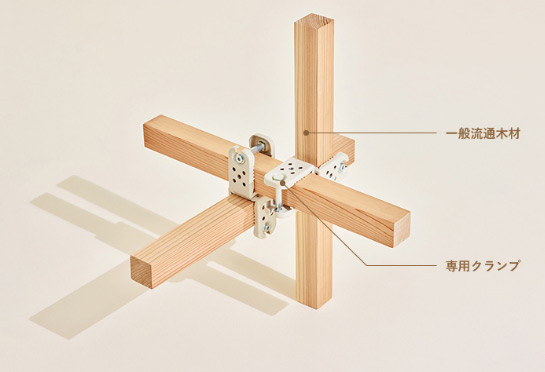
About "Tsunagi"
Winner of the Excellence Award
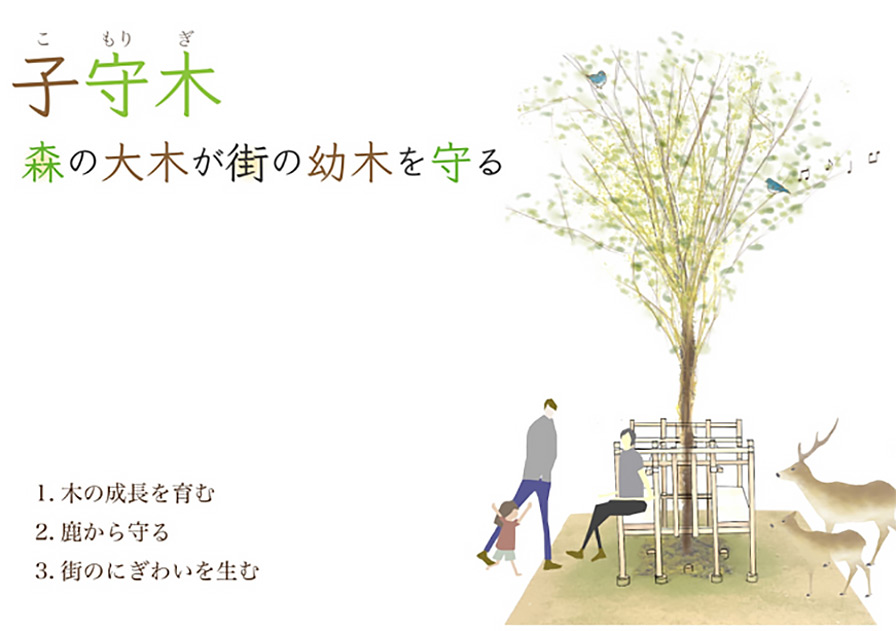
1. “Guardian Trees: Large Trees in the Forest Protect the City’s Young Trees” *An initiative focused on the trees in Nara Prefectural Nara Park*
-
 Nara Women's University, Department of Housing and Environmental Studies, 4th-year student
Kurumi Konishi (from Osaka Prefecture) -
 Nara Women's University, Department of Housing and Environment, 4th-year student
Fumiko Kawai (from Osaka Prefecture)
Winner's Comments:
As more “Child-Rearing Trees” are planted throughout the city, we hope that these small urban trees will grow healthily with the help of the forest’s trees and human care. Eventually, they will become large trees that serve as places of rest for people and bring vibrancy to the city. We aim to bring the “Child-Rearing Tree” project to life with the hope that the city will become a place overflowing with lush greenery and vitality.
Judge's Comments (Yasuhiro Kotomo, Representative Director, Kotomo Lumber Co., Ltd.):
Since it is almost certain to be less expensive than erecting sturdy metal supports, I believe this proposal offers cost benefits to those considering its adoption. First and foremost, I would like to support its implementation in Nara. After that, I can envision this concept spreading further as we identify challenges related to street trees and park trees nationwide and develop “Child-Guard Trees” designs tailored to address them.
As the operator of the Hanamaki Toy Museum—an experiential facility dedicated to wood education—I believe we can conduct workshops with local children and museum visitors through the National Toy Museum Network (scheduled to include 13 museums by 2023) to use these “Tsuna-gi” to protect street trees on museum grounds and in nearby areas.
I hope that in the near future, the idea that “we protect the trees in our own communities with ‘Tsuna-gi’” will become a new standard in Japan, and I am committed to working toward that goal.
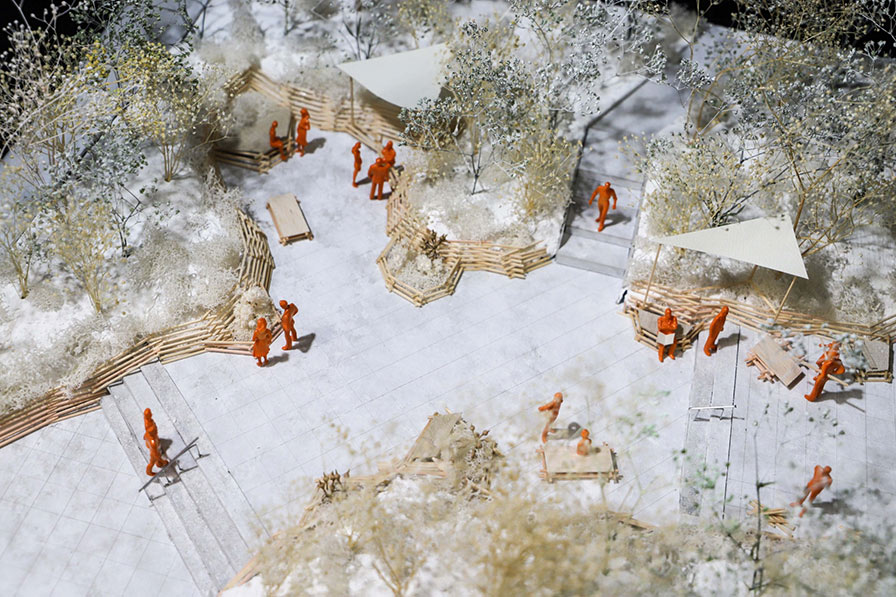
2. “A Street Corner Retaining Wall Woven from Earth and Wood”
-
 Waseda University Graduate School of Creative Science and Engineering, School of Science and Engineering
Takumi Yamamoto, Second-Year Master’s Student (from Tokyo)
-
 Waseda University Graduate School of Creative Science and Engineering, Faculty of Science and Engineering
First-year Master’s student Seiko Onuma (from Chiba Prefecture)
Winner's Comments:
We would also like to express our heartfelt gratitude to the judges for their practical feedback and comments acknowledging the project’s potential. We intend to refine the construction methods and structural design through repeated revisions to enhance the project’s feasibility. We were able to gain a broad range of insights about forests, forestry, and wood from the other entries as well; it was a competition that was enjoyable simply to participate in. Thank you very much.
Judges’ Comments (Hidetoshi Sawa, Design Environment / Representative of SAWADEE; Hidetoshi Sawa, Secretariat of the NPO Active Energy Academy):
Furthermore, by establishing logistics routes for timber from forestry sites, we can utilize large quantities of wood, making this a viable outlet for the effective use of forest resources. By using the offcuts from lumber production as planks for the base of retaining walls, it would be possible to utilize every part of a log without waste.I look forward to working with all of you to pool our wisdom and realize the potential of these street-corner retaining walls that connect the forest and the city.
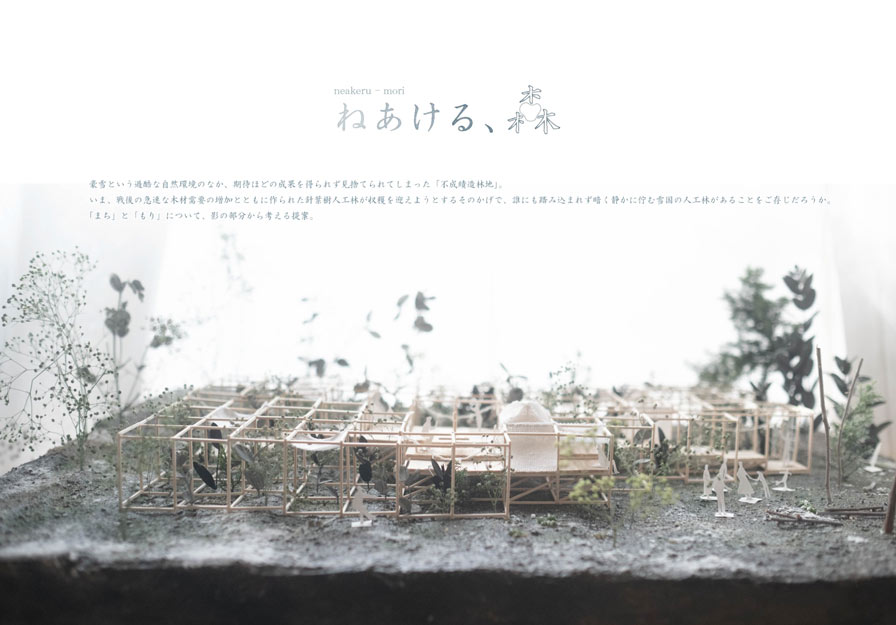
3. “Neakeru, Mori” * Niigata Prefecture An initiative focused on planted forests at the foot of Mt. Makihata in Minamiuonuma City
 Yuka Niwa (from Aichi Prefecture), second-year master’s student, Department of Architecture, Division of Creative Engineering, Graduate School of Interdisciplinary Engineering, Chiba University
Winner's Comments:
Compared to the proposals submitted by others, my proposal requires the cooperation of a wide variety of people in terms of feasibility, and I will need to further refine it by listening to the insights of experts. This is something I could never achieve on my own.Even if it takes a long time, I intend to continue working diligently to help create a foundation for a future where people help the forest just as the forest helps people—a future where people can visit the forest just as easily as they visit the city for recreation. Finally, I would like to express my heartfelt gratitude to the judges and the organizing committee for their dedicated efforts. Thank you very much.
Judge's Comments (Yamato Wa Co., Ltd. / Director, Yuji Okuda):
I believe this proposal, “Neakeru, Mori,” will serve as an opportunity to observe the current state of the forest and create a catalyst for people to venture into it. Moving forward, I hope that by taking even small steps toward putting this into practice and making it a reality, we can create spaces where people can gain a deeper understanding of the forest.
Other Award-Winning Works
| <Special Jury Prize> | |
| ・ | “Hugging Wall—Tsunagi-ki’s Temporary Fence That Connects and Envelops Forests, Cities, and Construction Sites” Rina Sugimoto and Noriko Okamoto, First-Year Graduate Students, The University of Tokyo |
| ・ | "Harmony with Wood: Designing Distribution Through Wood Drying and Saunas" Kosuke Okuhira and Meina Kobayashi, 4th-year students at Nihon University |
| <Tsuna-gi Award> | |
| ・ | "Re:Create Garage — The Origin That Connects the Town and the Forest" Tokai University, 4th-year students: Akihiro Iwata, Fumito Ohoshi, Yūsuke Sugaya, Kazumasa Ōgata |
| ・ | "To Love and Be Loved." First-year graduate students at Shibaura Institute of Technology: Motoki Mizoguchi, Yuki Kasai, Rena Matsudo, Miu Tanaka, Yuma Tamura, Yosuke Sugai, Hitomi Fukuniwa |
| ・ | "A Life Log of a House Recorded with Tsunagi" First-Year Graduate Students, Shibaura Institute of Technology: Takuto Kitagawa, Naoki Toyosaki, Shun Yoshida, Misaki Yonobe, Hayato Yoshimura, Kira Muto, Yuya Hasegawa |
| ・ | "Kiori-cho" First-year graduate student at Tokyo University of the Arts: Zhang Yao, Yō Shiyō |
| ・ | "The Calendar of Cycles" Wataru Kashiwagi and Eiki Yada, First-Year Graduate Students, Hosei University |
| ・ | "Desk Connection" Kana Watanabe, Junior, Showa Women’s University |
| ・ | "Connecting the Past: Preserving Forests and Towns Through Timber" Keisuke Imoto and Mizuho Endo, First-Year Graduate Students, Kyushu University |
"1st Tsunagi Competition" Overview
| Operations | : | Organized by: Tsunagi Competition Executive Committee (Nikken Sekkei Ltd. and ArchiTech Co., Ltd.) Supported by: Forestry Agency, Japan Federation of Young and Middle-Aged Timber Industry Organizations In cooperation with: Hirotsugu Ota, Full-time Lecturer, Musashino University |
|---|---|---|
| Judges | : | <Judges> Yasuhiro Kotomo (Representative Director, Kotomo Lumber Co., Ltd.) Yushi Okuda (Director, Yamato-wa Co., Ltd.) Hidetoshi Sawa (Representative, Sawa Hidetoshi Design & Environment / SAWADEE; Secretariat, NPO Katsu Energy Academy) Asako Nagano (Standing Executive Director, NPO Manufacturing, Life, and Civilization Organization; Former Director of the Timber Utilization Division, Forestry Agency) Tomohiko Yamanashi (Nikken Sekkei Ltd., Chief Design Officer, Senior Executive Officer) <Moderator> Takuya Oba (Lab Leader, Nikken Wood Lab, Nikken Sekkei Ltd.) |
| Eligibility Requirements | : | Students enrolled in universities, graduate schools, junior colleges, technical colleges, vocational schools (various types of schools), high schools, and other institutions as of April 1, 2021 |
About ArchiTech
About Nikken Sekkei
About Nikken Wood Lab, Nikken Sekkei
Wood Lab Representative: Takuya Oba (Innovation Design Group, New Business Development Division)