

Nikken Sekkei and Sumitomo Forestry
Jointly Develop “Composite Beam Construction Method” Combining Wooden Beams and Reinforced Concrete Slabs
~Supporting the Widespread Adoption of Medium- to Large-Scale Wooden Buildings~
PRESS RELEASE
2022.05.30
Nikken Sekkei Ltd. (Headquarters: Chiyoda-ku, Tokyo; Representative Director: President and CEO: Atsushi Omatsu) and Sumitomo Forestry Co., Ltd. (President and CEO: Toshiro Mitsuyoshi; Headquarters: Chiyoda-ku, Tokyo) have jointly developed a composite beam construction method that combines wooden beams with sawtooth-shaped grooves and reinforced concrete (RC) floor slabs.This construction method leverages the fact that wood and concrete have similar compressive strengths to firmly join the two materials, thereby enabling long spans. Since it allows for a reduced beam height, it facilitates the construction of taller buildings and will promote the widespread adoption of medium- to large-scale wooden structures such as offices, schools, and hospitals.
By combining wooden beams with reinforced concrete floor slabs, we have developed a “composite beam construction method” using “sawtooth joints.”
Wood is a lightweight yet strong material that is widely used as a common building material. When constructing medium- to large-scale buildings using wood, challenges include the fact that vibrations are easily transmitted through wooden floors, which can affect livability, and the need to increase the cross-sectional area of the wood to ensure sufficient strength, which can make spaces feel cramped.
To resolve these challenges and develop a versatile wooden beam suitable for medium- to large-scale buildings, Nikken Sekkei and Sumitomo Forestry established a project team in 2016 and conducted thorough experiments and verification.As a result, they developed the “composite beam construction method,” which utilizes a “sawtooth joint”—a connection that incorporates ridges and grooves directly into the wooden beam itself to join it with a reinforced concrete floor slab.
To resolve these challenges and develop a versatile wooden beam suitable for medium- to large-scale buildings, Nikken Sekkei and Sumitomo Forestry established a project team in 2016 and conducted thorough experiments and verification.As a result, they developed the “composite beam construction method,” which utilizes a “sawtooth joint”—a connection that incorporates ridges and grooves directly into the wooden beam itself to join it with a reinforced concrete floor slab.
Features of the “Composite Beam Construction Method”
This construction method takes advantage of the fact that the compressive strengths of wood and concrete are similar to create a strong bond between the two materials. Since the reinforced concrete (RC) floor slab enhances the rigidity of the wooden beams, the structure is highly resistant to vibration, resulting in a floor that is just as stable as those made with steel frames and concrete slabs.The beam length has been extended to approximately 12 meters—twice that of conventional beams—enabling long spans and making the system suitable for medium- to large-scale buildings with extensive floor areas. While the beam depth for non-composite beams is typically around 120 cm, this system reduces it to 90 cm—about three-quarters of that—allowing for lower floor-to-floor heights and an increase in the number of stories when constructing high-rise buildings.Reducing the beam height decreases the area requiring fire-resistant cladding and lowers the overall building height, thereby reducing construction costs. The system allows for the use of engineered wood products such as laminated timber and LVL, with few restrictions on wood species, offering high versatility and contributing to the promotion of medium- to large-scale non-residential timber construction.
The “Composite Beam Construction Method” received structural performance evaluation*1 from Japan ERI Co., Ltd. in April 2022. It offers a high degree of flexibility when combined with flooring methods, can be utilized with conventional formwork methods*2, and is compatible with various formwork types, such as deck plates*3.
The “Composite Beam Construction Method” received structural performance evaluation*1 from Japan ERI Co., Ltd. in April 2022. It offers a high degree of flexibility when combined with flooring methods, can be utilized with conventional formwork methods*2, and is compatible with various formwork types, such as deck plates*3.
-
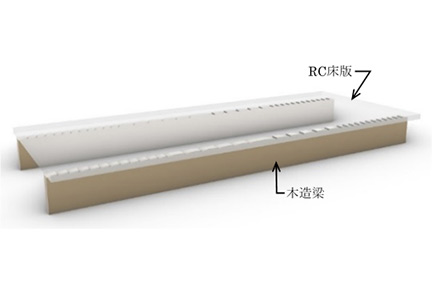 Figure: Composite Beam
-
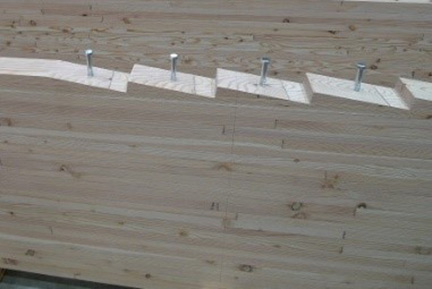 Photo: Sawtooth Joint
This construction method can also be applied to fire-resistant wooden beams, such as those in Sumitomo Forestry’s “Kigurumi” series*4. The “Composite Beam Construction Method” can be used regardless of a building’s structural type, height, or number of stories—including high-rise buildings, which typically present significant challenges for wooden structures.
-
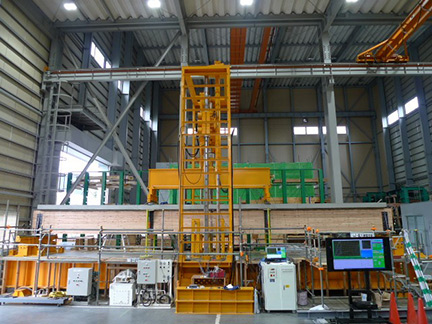 Figure: Full-scale bending test on a 12-meter span
-
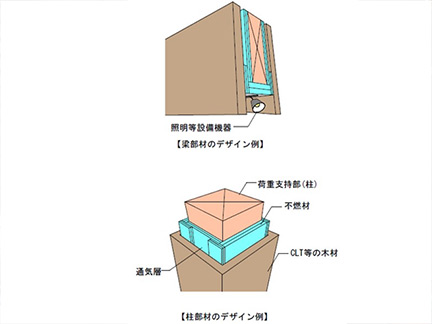 Figure: Cross-section of a wood-encased CT member
W350 Plan Technology Development Aimed at
In 2018, Sumitomo Forestry announced “W350 Plan,” a research and technology development initiative aimed at realizing “environmentally wood-based cities” that transform urban areas into forests, with a view toward 2041—the 350th anniversary of the company’s founding in 1691. Nikken Sekkei designed a wooden skyscraper to serve as a model building for this initiative.The composite beam construction method recently developed is one of the technologies that can be applied to medium- and large-scale buildings.
Nikken Sekkei and Sumitomo Forestry will promote the development and adoption of wood-based construction technologies, with the goal of achieving net-zero greenhouse gas emissions by 2050, while also working to popularize the composite beam construction method so that it is accessible to everyone.
Nikken Sekkei and Sumitomo Forestry will promote the development and adoption of wood-based construction technologies, with the goal of achieving net-zero greenhouse gas emissions by 2050, while also working to popularize the composite beam construction method so that it is accessible to everyone.
Toward the Realization of a Decarbonized Society
In Japan, where two-thirds of the land is covered by forests, the artificial forests planted after World War II are now reaching maturity, and there is a growing need to actively utilize domestically produced timber from the perspectives of sustainable forest resource management and land conservation.The rate of wood construction in the non-residential market remains at just under 10 percent; therefore, promoting the use of wood in medium- to large-scale projects and in non-residential buildings is crucial to increasing demand for timber, including domestically produced wood.With the enforcement in October 2021 of the “Amended Act on the Promotion of Wood Utilization”*5—which promotes the use of wood in general construction—the need for forest sustainability through the active use of wood has become even more pressing.
| ※1 | Structural Performance Evaluation: An evaluation system that reviews and assesses “buildings or construction methods using special structural techniques” not specified in the Building Standards Act, thereby allowing them to be applied through the standard building permit application process without the need for complex procedures. |
|---|---|
| ※2 | Conventional formwork method: A method of pouring reinforced concrete floor slabs using formwork composed of plywood, formwork studs, and other materials. |
| ※3 | Deck plate: Temporary formwork used to construct reinforced concrete floor slabs, consisting of thin steel plates. |
| ※4 | 「木ぐるみFR®」および「木ぐるみCT®」があります。 木ぐるみFR®:1時間耐火構造の大臣認定を取得。難燃処理した木材で荷重支持部を被覆して耐火性能を確保した純木質構造部材で、木を現しにした耐火木造建築を実現。(https://sfc.jp/treecycle/value/kigurumi_fr.html) 木ぐるみCT®:耐火被覆材に一般流通品であるCLTや不燃材などを使用した耐火部材で、1時間および2時間、3時間耐火構造の大臣認定をそれぞれ取得。(https://sfc.jp/information/news/2021/2021-03-31-02.html) |
| ※5 | Act on the Promotion of the Use of Wood in Buildings and Other Structures to Contribute to the Realization of a Decarbonized Society, etc. |
About Nikken Sekkei
Nikken Sekkei is a professional services firm engaged in architectural design and supervision, urban design, and related research, planning, and consulting services.For 120 years since our founding in 1900, we have been committed to creating value through “Social and Environmental Design,” which seeks solutions to both apparent and latent social issues, in order to meet the needs of society and the diverse requests of our clients.We have been involved in a wide range of projects in Japan, China, ASEAN, and the Middle East, and in recent years have expanded our operations to India and Europe. In March 2021, we issued a “Climate Emergency Declaration” as part of our efforts toward a decarbonized society.
About Sumitomo Forestry
Sumitomo Forestry conducts wood-centered business operations both in Japan and overseas, ranging from forest management to the procurement and manufacturing of timber and building materials, wood-frame construction, and wood biomass power generation.In February of this year, with an eye toward 2030—the target year for the SDGs—we announced “Mission TREEING 2030,” a long-term vision that incorporates our ideal future for a decarbonized society into our business strategy.By maintaining Sumitomo Forestry’s “Wood Cycle”—which encompasses logging, processing, utilization, reuse, and reforestation—we will increase the amount of CO₂ absorbed by forests and continue to sequester carbon over the long term through the use of wood. As a partner in the global shift toward a decarbonized society, we will provide our Group’s unique “Wood Solutions” and contribute to the realization of a sustainable society.
Contact information regarding this matter
株式会社日建設計 広報室 Tel. 03-5226-3030(代表) e-mail:webmaster@nikken.jp
住友林業株式会社 コーポレート・コミュニケーション部 Tel. 03-3214-2270 e-mail:ccom@sfc.co.jp
住友林業株式会社 コーポレート・コミュニケーション部 Tel. 03-3214-2270 e-mail:ccom@sfc.co.jp
SHARE