

The second "Zenove" project involves nine financial institutions and other companies.
Environmental renovation work begins on a 34-year-old office building.
— Promoting Zenove Finance and establishing implementation models for environmental renovation of existing buildings —
PRESS RELEASE
2026.02.27
Development Bank of Japan, Inc. (hereinafter “DBJ”), DBJ Asset Management Co., Ltd. (hereinafter “DBJAM”), Nikken Sekkei Ltd. (hereinafter “Nikken Sekkei”), Kyushu Electric Power Co., Inc., Fuyo General Lease Co., Ltd., Mizuho Lease Co., Ltd., Sumitomo Mitsui Banking Corporation, Sumitomo Mitsui Trust Bank, Ltd., and The Bank of Mitsubishi UFJ, Ltd. (hereinafter collectively referred to as the “Participating Companies”) have launched the “Zenobe (Zero-Energy Renovation)” project※As Project No. 2 (hereinafter “this project”), we will carry out environmental retrofitting of the Nikken Sekkei Korakuen Building (1-4-27 Koraku, Bunkyo Ward, Tokyo).
Through this renovation, we will strive to achieve the ZEB-Oriented standard (BEI ≤ 0.6) in the office areas and realize “Operational ZEB” (the term used for this project), which aims to reduce net energy consumption during operation by at least 50%, thereby balancing the decarbonization of the existing building with its commercial viability.
In addition, the participating financial institutions are working to visualize the effects of environmental retrofits and clarify practical financial issues through study sessions for financial practitioners aimed at promoting the adoption of ZENOVE Finance. Based on these findings, they will support the implementation of the environmental retrofit from a financial perspective by participating in this project as lenders and investors.
* A project aimed at establishing an environmental retrofit model to achieve net-zero in the real estate industry, as well as promoting its adoption and widespread implementation.
Through this renovation, we will strive to achieve the ZEB-Oriented standard (BEI ≤ 0.6) in the office areas and realize “Operational ZEB” (the term used for this project), which aims to reduce net energy consumption during operation by at least 50%, thereby balancing the decarbonization of the existing building with its commercial viability.
In addition, the participating financial institutions are working to visualize the effects of environmental retrofits and clarify practical financial issues through study sessions for financial practitioners aimed at promoting the adoption of ZENOVE Finance. Based on these findings, they will support the implementation of the environmental retrofit from a financial perspective by participating in this project as lenders and investors.
* A project aimed at establishing an environmental retrofit model to achieve net-zero in the real estate industry, as well as promoting its adoption and widespread implementation.
1. Promote financing methods that support Zenove's initiatives (hereinafter referred to as "Zenove Finance").
In order to achieve net-zero emissions by 2050, the real estate industry is also required to reduce greenhouse gas emissions. Japan's CO₂ emission reduction target by 2030 is 46% compared to 2013 levels, and improving the environmental performance of existing buildings, which make up the majority of the office building stock nationwide, is an essential effort to achieve net-zero emissions.
On the other hand, the difficulty in fully visualizing the effects of environmental improvements in terms of property value and investment economics has been a "barrier to implementation." As the transition to a decarbonized society progresses, financial institutions are expected to update their criteria for evaluating the future value of real estate, starting with the visualization of accurate information such as environmental performance and the greenhouse gas reduction effects of improvements, and to support environmental improvements through the provision of funds.
Based on this awareness of the issues, DBJ, DBJAM, and Nikken Sekkei are promoting the "Zenove" project, which aims to build and disseminate an environmental renovation model that balances environmental performance and economic value, in order to achieve net-zero emissions in the real estate industry. In 2024, the first phase of this project, "Nikken Building No. 1" (Chuo-ku, Osaka), was completed. In addition, together with private financial institutions, they have held study sessions for financial practitioners to promote Zenove Finance, clarifying practical issues and examining the framework for financial institutions, and forming a common understanding to make environmental renovation a viable investment.
In this project, in addition to DBJ, DBJAM, and Nikken Sekkei, who are participants in the first Zenove Project, lenders/investors including private financial institutions will also participate, thereby supporting the formation of a market where environmental renovation is considered an "investment" rather than a "cost," and promoting the further development of Zenove. DBJ has provided funding for this project using the "Green Investment Promotion Fund (Note 2)," a type of "Specific Investment Business (Note 1)," as it is an initiative that will contribute to the revitalization of environmental renovation investment in the real estate investment market through collaboration with Nikken Sekkei and the participating companies, and to the realization of net-zero emissions in the real estate industry.
(Note 1) This is a project that utilizes a portion of government investment (industrial investment) to provide growth capital on a temporary and concentrated basis, in order to promote the supply of growth capital by the private sector, revitalize regional economies, and strengthen the competitiveness of Japanese companies.
(Note 2) This is a priority area established with the aim of broadly supporting initiatives that contribute to the realization of a green society, taking into account the government's policy of aiming for net-zero emissions by 2050.
On the other hand, the difficulty in fully visualizing the effects of environmental improvements in terms of property value and investment economics has been a "barrier to implementation." As the transition to a decarbonized society progresses, financial institutions are expected to update their criteria for evaluating the future value of real estate, starting with the visualization of accurate information such as environmental performance and the greenhouse gas reduction effects of improvements, and to support environmental improvements through the provision of funds.
Based on this awareness of the issues, DBJ, DBJAM, and Nikken Sekkei are promoting the "Zenove" project, which aims to build and disseminate an environmental renovation model that balances environmental performance and economic value, in order to achieve net-zero emissions in the real estate industry. In 2024, the first phase of this project, "Nikken Building No. 1" (Chuo-ku, Osaka), was completed. In addition, together with private financial institutions, they have held study sessions for financial practitioners to promote Zenove Finance, clarifying practical issues and examining the framework for financial institutions, and forming a common understanding to make environmental renovation a viable investment.
In this project, in addition to DBJ, DBJAM, and Nikken Sekkei, who are participants in the first Zenove Project, lenders/investors including private financial institutions will also participate, thereby supporting the formation of a market where environmental renovation is considered an "investment" rather than a "cost," and promoting the further development of Zenove. DBJ has provided funding for this project using the "Green Investment Promotion Fund (Note 2)," a type of "Specific Investment Business (Note 1)," as it is an initiative that will contribute to the revitalization of environmental renovation investment in the real estate investment market through collaboration with Nikken Sekkei and the participating companies, and to the realization of net-zero emissions in the real estate industry.
(Note 1) This is a project that utilizes a portion of government investment (industrial investment) to provide growth capital on a temporary and concentrated basis, in order to promote the supply of growth capital by the private sector, revitalize regional economies, and strengthen the competitiveness of Japanese companies.
(Note 2) This is a priority area established with the aim of broadly supporting initiatives that contribute to the realization of a green society, taking into account the government's policy of aiming for net-zero emissions by 2050.
2. The second project of the "Zenove" series: Nikken Sekkei Korakuen Building in Tokyo.
About the Nikken Sekkei Korakuen Building
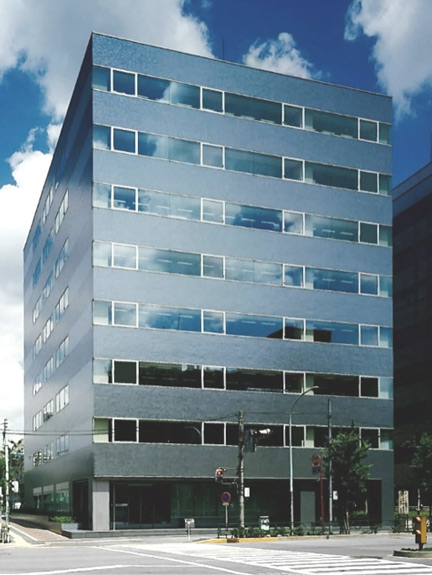
The Nikken Sekkei Korakuen Building is an eight-story above ground, one-story underground office building located very close to Iidabashi Station. This renovation aims to achieve ZEB-Oriented standards (BEI = 0.6 or less) in the office area and to realize "operational ZEB," which aims to reduce actual energy consumption during operation by more than 50%. In addition, consideration will be given to the comfort and well-being of the building's users, and efforts will be made to improve the value of the space, including the common areas.
Property overview
| LOCATION | 1-4-27 Koraku, Bunkyo-ku, Tokyo |
|---|---|
| Structure/scale | SRC construction, 1st floor underground, 8th floor above ground Main amenities: Parking for 15 cars |
| Total floor area | 6,283.04㎡ (1,900.62 tsubo) |
| Standard floor rental area | 565.8㎡ (171.15 tsubo) |
| Completion date | March 1992 |
| Construction scheduled to be completed | May 2027 |
| Design/Supervision | Nikken Sekkei |
| Earthquake-resistant | New seismic standards |
Renovation image
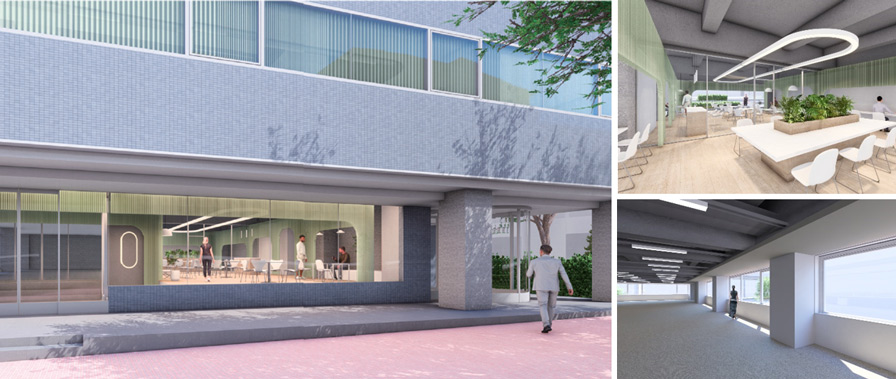
As a highly versatile energy-saving technology, we will reduce the air conditioning load through building envelope renovations, primarily focusing on improving the thermal insulation performance of windows. In addition, we will reduce energy consumption during operation by optimizing load conditions based on operational circumstances.
Furthermore, in order to realize "operational ZEB (Zero Energy Building)," natural ventilation will be encouraged by manually opening ventilation windows during cooler seasons, and users will be encouraged to take environmentally conscious actions through indicator lights and other means that alert for natural ventilation.
Furthermore, the first floor will be planned to include tenant spaces and an office-only lounge, with functions separated by partitions. The office-only lounge will be developed as a shared hub that can accommodate diverse uses, such as a place to concentrate on work, an eat-in space, meetings with external guests, and event hosting, thereby contributing to improved tenant well-being, productivity, and convenience.
Furthermore, in order to realize "operational ZEB (Zero Energy Building)," natural ventilation will be encouraged by manually opening ventilation windows during cooler seasons, and users will be encouraged to take environmentally conscious actions through indicator lights and other means that alert for natural ventilation.
Furthermore, the first floor will be planned to include tenant spaces and an office-only lounge, with functions separated by partitions. The office-only lounge will be developed as a shared hub that can accommodate diverse uses, such as a place to concentrate on work, an eat-in space, meetings with external guests, and event hosting, thereby contributing to improved tenant well-being, productivity, and convenience.
Related press releases
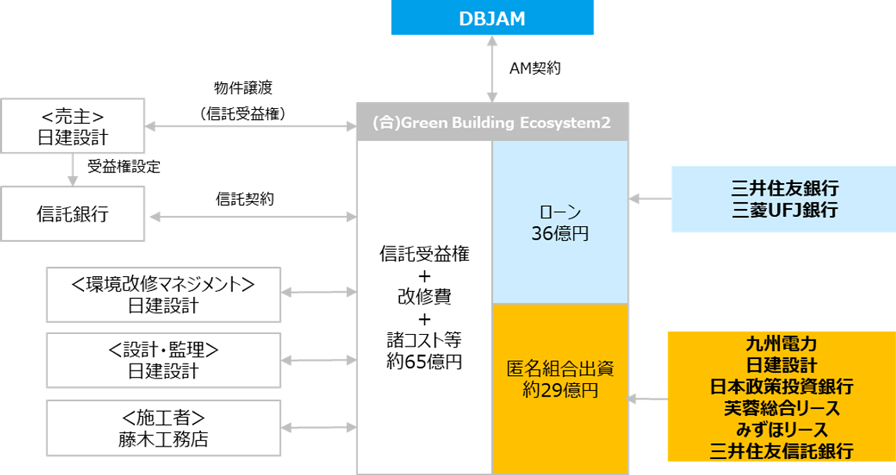
Fund Overview
 You can scroll horizontally.
| NAME | (G)Green Building Ecosystem2 |
|---|---|
| Total fund amount | Approximately 6.5 billion yen |
| Render | Sumitomo Mitsui Banking Corporation, Mitsubishi UFJ Bank |
| investor | Kyushu Electric Power, Nikken Sekkei, Development Bank of Japan, Fuyo General Leasing, Mizuho Leasing, Sumitomo Mitsui Trust Bank |
Contact information for inquiries regarding this press release
株式会社日本政策投資銀行 アセットファイナンス部 電話番号 03-3244-1714
DBJアセットマネジメント株式会社 不動産運用部 電話番号 03-3241-5387
株式会社日建設計 広報室 電話番号 03-5226-3030
DBJアセットマネジメント株式会社 不動産運用部 電話番号 03-3241-5387
株式会社日建設計 広報室 電話番号 03-5226-3030
Contact information for tenant leasing inquiries
シービーアールイー株式会社 プロパティマネジメント部 電話番号 03-5288-9750
SHARE