

Announcement of the 30th NSRI Forum
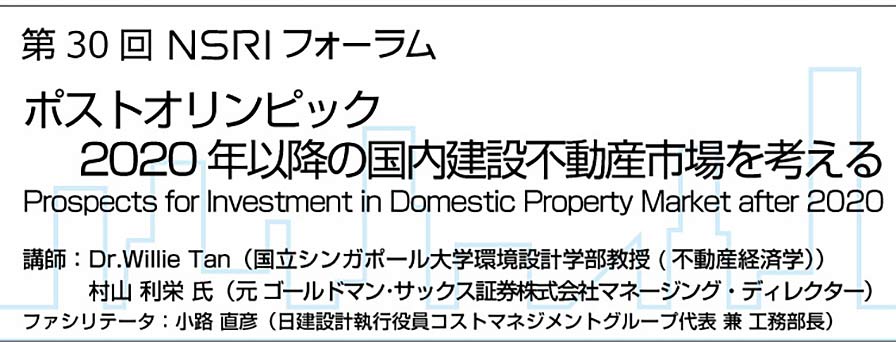
It is believed that excess capital continues to undergo “geographical expansion” on a global scale. Since profit margins tend to be lower in countries with high capital intensity, capital tends to flow to countries with lower capital intensity; consequently, it is thought that cross-border investment from abroad and domestic private construction and real estate investment will decline in countries with high capital intensity.
Currently, domestic construction and real estate investment is surging due to bold monetary easing and expansionary fiscal policies. Furthermore, domestic construction and real estate investment is expected to receive a boost from the Tokyo Olympic and Paralympic Games scheduled for 2020; although the real growth rate forecast has been revised downward, domestic construction and real estate investment is projected to increase for the time being.
On the other hand, a decline in domestic construction and real estate demand is anticipated from 2020 onward due to factors such as a shrinking labor force resulting from a low birthrate and an aging population, raising questions about the future direction of construction and real estate investment beyond 2020. It is believed that as monetary easing expands, investment in financial assets tends to increase, crowding out investment in real assets.Since the market favors short-term, highly liquid assets, investment in tangible assets such as construction and real estate tends to be put on the back burner; consequently, while monetary easing may provide a short-term boost to investment, it is considered unlikely to contribute to a sustained increase in construction and real estate demand.
Establishing a sustainable construction and real estate investment environment from a long-term perspective during the pre-2020 period is expected to contribute to a sustained increase in construction and real estate demand in the post-2020 period.
Through case studies of cities such as London and Singapore—which have successfully increased demand for construction real estate, including through cross-border investment—we will explore ways to revitalize the construction real estate market from 2020 onward. (Facilitator: Naohiko Koji)
Date and Time: Tuesday, September 29, 2015, 3:00 PM – 5:00 PM
Venue: NSRI Hall (2nd Floor, Meiji Yasuda Life Iidabashi Building, 2-7-5 Iidabashi, Chiyoda-ku, Tokyo) → Map
Capacity: 100 people
Registration: Please send your name, affiliation, and contact phone number to the email address or fax number below.
toshikei@nikken.jp
03-5259-0180
*The lecture will be delivered in English, with consecutive interpretation provided.
Dr. Willie Tan
Professor, School of Environmental Design, National University of Singapore (Real Estate Economics)
Graduated from the University of Newcastle, Australia, in 1984;
Earned his Ph.D. from the National University of Singapore and the University of Sydney in 1989.
His specialty is real estate economics, focusing on the interaction between real estate and the economy.
Rie Murayama
Former Managing Director, Investment Banking Division, Goldman Sachs Securities Co., Ltd.
1988: Graduated from San Francisco State University
1988–1993: CS First Boston Securities, Tokyo Branch
1993–: Goldman Sachs & Co., Tokyo Branch; after serving in roles including Head of the Equity Research Department and Head of the Management Control Office,
Managing Director of the Investment Banking Division.
Oversaw sales operations for the real estate, housing, and construction sectors within the Investment Banking Division.
2005–2007: Outside Director, Fujita Corporation
Served as a member of the Ministry of Land, Infrastructure, Transport and Tourism, and as a member of the Comprehensive Regulatory Reform Council (Cabinet Office), among other positions
Naohiko Koji
Nikken Sekkei Executive Officer Head of Management Group and General Manager of Construction Director