

The first year report meeting for "FUTURE LENS" was held at PYNT Takebashi.
~Proposing a new approach to solving social issues~
SEMINAR/EVENT
2026.05.21
Nikken Sekkei Ltd. (Headquarters: Chiyoda-ku, Tokyo; Representative Director President and CEO: Atsushi Omatsu; hereinafter “Nikken Sekkei”) held on Friday, April 24, 2026,held the first-year report meeting for the first cohort of “FUTURE LENS,” a co-creation-based social and environmental design program designed to collaborate with “Zebra Companies”—organizations that balance solving social issues with sustainable management—at the Takebashi location of its co-creation platform “PYNT.”
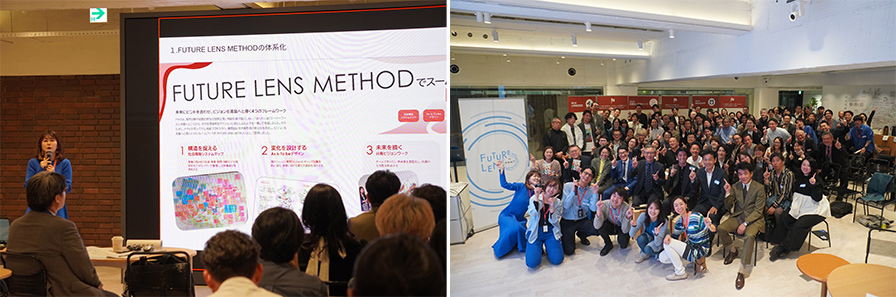
This program is jointly operated with Zebras and Company (hereinafter referred to as Z&C). It combines the expertise of Nikken Sekkei with that of local social entrepreneurs who are proactively addressing future urban challenges such as population decline and aging infrastructure, to jointly research the future of cities. In the first phase, Nikken Sekkei's co-creation employees are supporting the three companies selected in April 2025.
The value proposition of FUTURE LENS
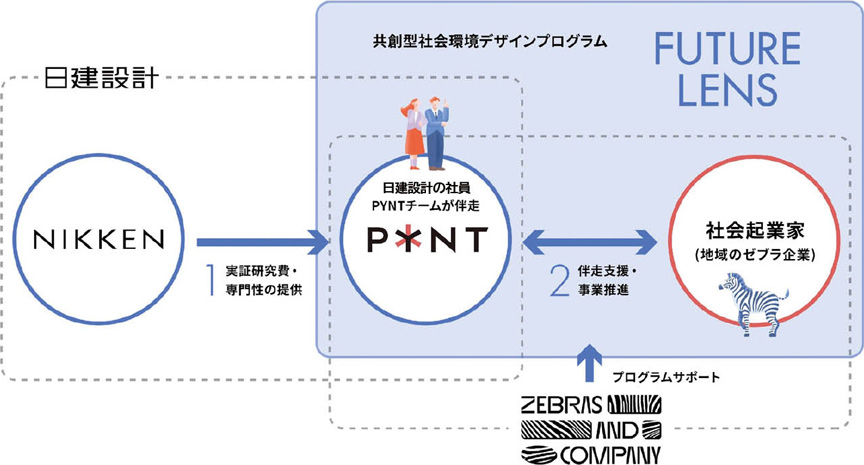
Through workshops and site visits, we will work to "visualize" the challenges and "quantify/systematize" the business value, and jointly research and develop methods for "expanding to other cities and towns."
Demonstration research funding: Up to 5 million yen per company per year, generally continuing for two years.
Support and mentorship: Nikken Sekkei's co-creation employees, PYNT and Z&C, will provide support as part of the operational team.
Demonstration research funding: Up to 5 million yen per company per year, generally continuing for two years.
Support and mentorship: Nikken Sekkei's co-creation employees, PYNT and Z&C, will provide support as part of the operational team.
"FUTURE LENS ANNUAL REPORT 2025-2026" released.
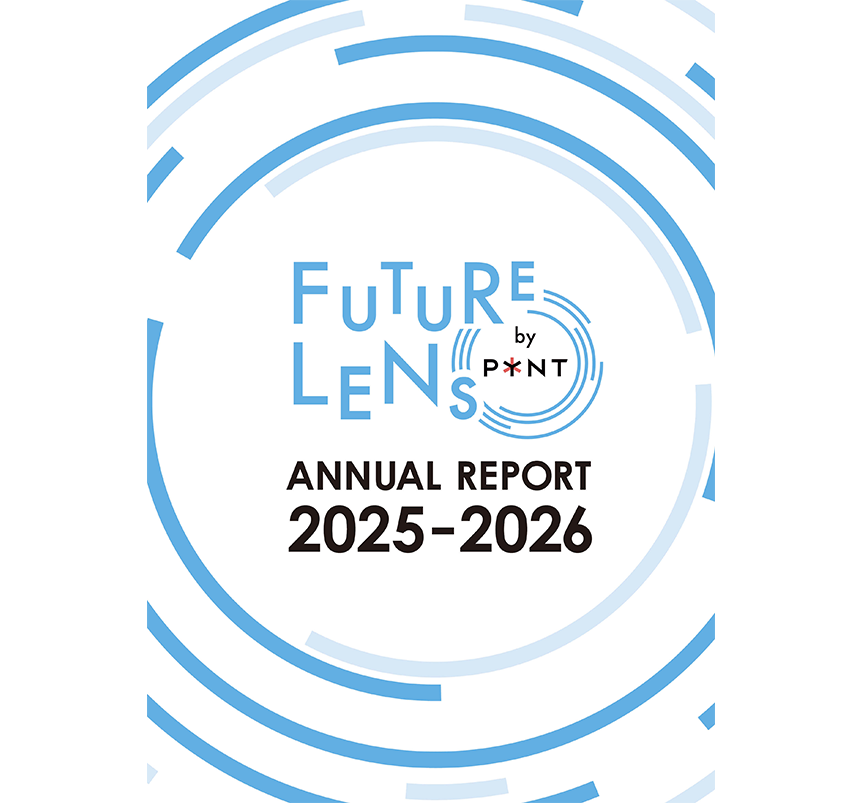
Nikken Sekkei has released the "FUTURE LENS ANNUAL REPORT 2025-2026" on its website. This report summarizes the initiatives of the three companies selected in the first year of the program, the significance of FUTURE LENS as seen through these activities, key points for co-creation that generate system change, and four frameworks called "FUTURE LENS METHOD" that systematize conceptual design and consensus-building methods to guide the vision towards implementation. The report also includes a roundtable discussion between Nikken Sekkei's program director and Z&C, as well as spin-off projects related to FUTURE LENS.
You can also see the reasons why the three selected companies applied to FUTURE LENS, the changes that resulted from their initiatives, and the insights and growth of Nikken Sekkei's co-creation employees.
You can also see the reasons why the three selected companies applied to FUTURE LENS, the changes that resulted from their initiatives, and the insights and growth of Nikken Sekkei's co-creation employees.
The three selected companies presented their results from the first year and their plans and outlook for the second year.
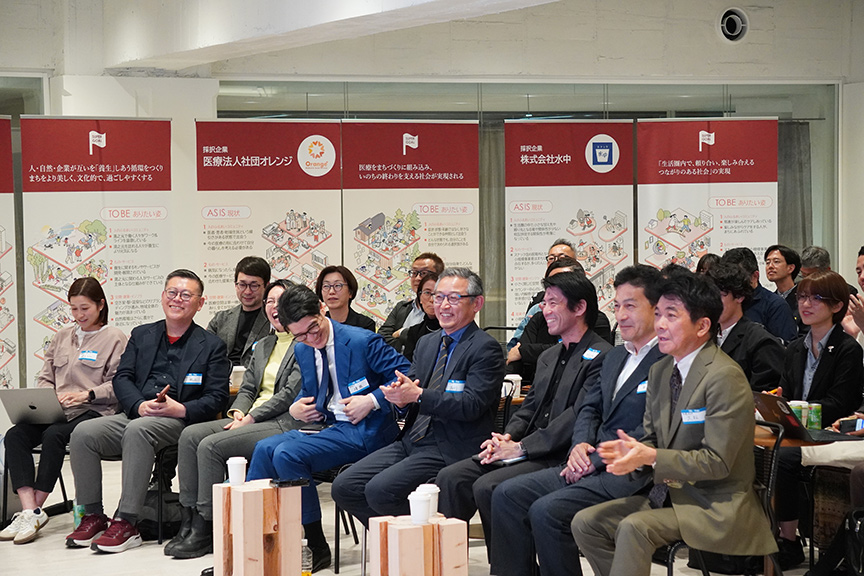
In the first year of FUTURE LENS, we received entries from 111 companies and 56 formal applications. After a final selection process involving document review and pitches, three companies were selected. Subsequently, Nikken Sekkei's co-creation employees visited the sites and engaged in dialogue with the selected companies and key players in the region to understand the background of the region and business, as well as the aspirations of those involved. Based on this, each team set a "desired state (super goal)" and translated it into concrete actions over two years. In the first year, we verified and updated hypotheses by accumulating small practical actions. In addition, we regularly shared progress and insights as a whole, and provided feedback to each other's empirical research. In the first year, we organized the "desired state" based on the current situation in each region from the perspective of social environmental design. In the second year, we will further accumulate concrete actions to realize the "desired state."
1. Kodaira Co., Ltd. (Hioki City, Kagoshima Prefecture)
Development of the regional management model "Yunomoto Model"
This long-established company, founded 114 years ago, operates in the energy and IT sectors. In 2024, it relocated its headquarters to Yunomoto in Hioki City. It is striving to create a circular regional management model where people, nature, and the company mutually support and nurture each other.
【assignment】
The Yunomoto district of Hioki City, Kagoshima Prefecture, possesses a unique history and resources, including a hot spring therapy culture and wisdom in resource recycling. However, with the ongoing population decline and hollowing out of the area, the challenge lies in how to reconnect the value of these local resources to modern life and industry. If this challenge is left unaddressed, employment opportunities in the region will be limited, and the growth potential of businesses will shrink. The hot spring resort town will decline further. Hollowing out and aging will accelerate even more. Natural resources will not be fully utilized, and their value will decrease. The foundation of mutual support between people, nature, and businesses will weaken, making sustainable development of the region difficult.
[Results of the first year of demonstration]
- Developed a concept and actions for "new regional management" with "health maintenance" as the key word. Organized the hypothesis of the "Yunomoto Model," in which a region is managed through a cycle of mutual support among people, nature, and businesses.
Nikken Sekkei provided support for the planning and development of the new complex facility, "Nekoma no Mori."
[Plans and Outlook for Year 2]
- Construct and operate "Neko Kitsune Uma no Mori" and make it function as a hub for actions related to "health maintenance".
- We will demonstrate the development of building materials utilizing local resources at a "lab" and a "nature school" that improves the natural environment through human intervention. We will compile guidelines for creating a cycle in which people, nature, and businesses mutually support each other into a "village code" and express it in an "active perspective" of the future vision of Yunomoto.
【assignment】
The Yunomoto district of Hioki City, Kagoshima Prefecture, possesses a unique history and resources, including a hot spring therapy culture and wisdom in resource recycling. However, with the ongoing population decline and hollowing out of the area, the challenge lies in how to reconnect the value of these local resources to modern life and industry. If this challenge is left unaddressed, employment opportunities in the region will be limited, and the growth potential of businesses will shrink. The hot spring resort town will decline further. Hollowing out and aging will accelerate even more. Natural resources will not be fully utilized, and their value will decrease. The foundation of mutual support between people, nature, and businesses will weaken, making sustainable development of the region difficult.
[Results of the first year of demonstration]
- Developed a concept and actions for "new regional management" with "health maintenance" as the key word. Organized the hypothesis of the "Yunomoto Model," in which a region is managed through a cycle of mutual support among people, nature, and businesses.
Nikken Sekkei provided support for the planning and development of the new complex facility, "Nekoma no Mori."
[Plans and Outlook for Year 2]
- Construct and operate "Neko Kitsune Uma no Mori" and make it function as a hub for actions related to "health maintenance".
- We will demonstrate the development of building materials utilizing local resources at a "lab" and a "nature school" that improves the natural environment through human intervention. We will compile guidelines for creating a cycle in which people, nature, and businesses mutually support each other into a "village code" and express it in an "active perspective" of the future vision of Yunomoto.
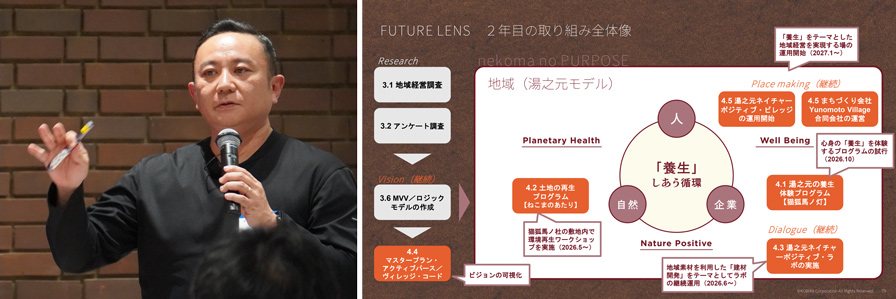 (Left) Mr. Kanta Kodaira, Representative Director of Kodaira Co., Ltd. President and CEO
(Right) Yunomoto Model
2. Orange Medical Corporation (Karuizawa Town, Nagano Prefecture)
We aim to create a society that integrates healthcare into community development and supports people at the end of their lives.
Based at "Hocchi's Lodge," a place with a clinic and a large kitchen, they are working to create an environment where the entire community supports one another at the end of life, stepping outside the confines of the medical "box."
【assignment】
In rural areas, while the aging population is leading to increased medical needs, a shortage of personnel to support these services is a significant challenge. Furthermore, chronic frailty and social isolation among the elderly are causing them to give up on continuing to live independently within their familiar communities and surrounding areas.
[Results of the first year of demonstration]
By creating a logic model, Orange was able to organize the process of urban development it aims to achieve. In addition, through the pre-curriculum "Liberal Arts-based urban development for doctors," they successfully recruited two new doctors.
- Nikken Sekkei's co-creation employees accompanied the lodge on home visits and observed the space of Hotchi no Lodge and the people involved, thereby articulating what makes Hotchi no Lodge unique.
[Plans and Outlook for Year 2]
To learn about and implement the process of creating a society that supports the end of life from all angles, we will invite practitioners from abroad (Netherlands and India) and increase opportunities for dialogue among medical professionals, government officials, and residents.
- By re-examining the hospital design process and preconceived notions about medical spaces themselves, we aim to systematize how to integrate healthcare into urban development.
【assignment】
In rural areas, while the aging population is leading to increased medical needs, a shortage of personnel to support these services is a significant challenge. Furthermore, chronic frailty and social isolation among the elderly are causing them to give up on continuing to live independently within their familiar communities and surrounding areas.
[Results of the first year of demonstration]
By creating a logic model, Orange was able to organize the process of urban development it aims to achieve. In addition, through the pre-curriculum "Liberal Arts-based urban development for doctors," they successfully recruited two new doctors.
- Nikken Sekkei's co-creation employees accompanied the lodge on home visits and observed the space of Hotchi no Lodge and the people involved, thereby articulating what makes Hotchi no Lodge unique.
[Plans and Outlook for Year 2]
To learn about and implement the process of creating a society that supports the end of life from all angles, we will invite practitioners from abroad (Netherlands and India) and increase opportunities for dialogue among medical professionals, government officials, and residents.
- By re-examining the hospital design process and preconceived notions about medical spaces themselves, we aim to systematize how to integrate healthcare into urban development.
-
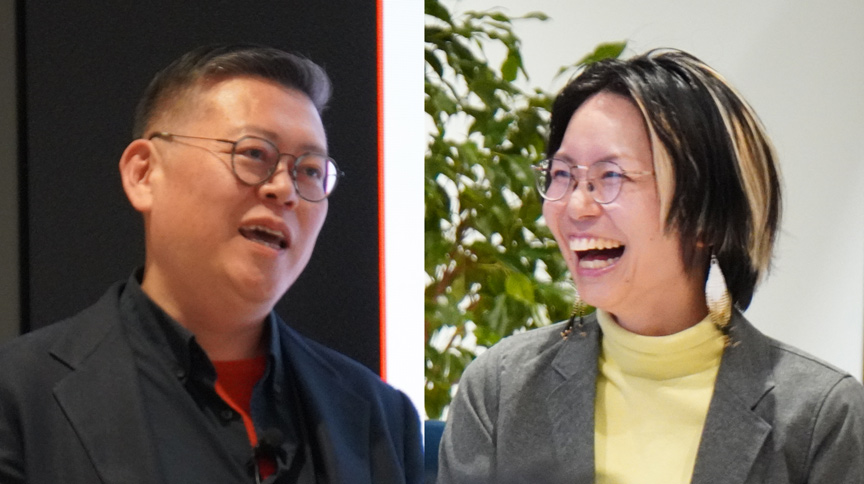 Orange Medical Corporation
(Left) Chairman Hiroyuki Kureya (Right) Board Member Satoko Fujioka -
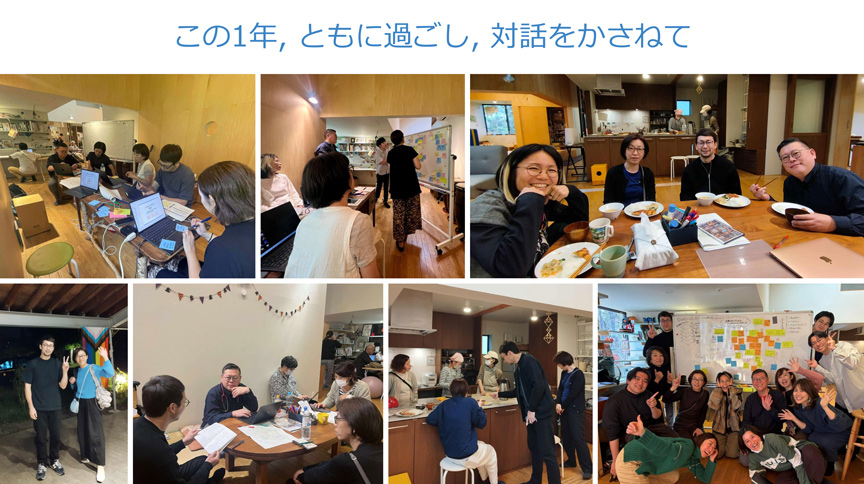 Hotchi's Lodge
3. Suichu Co., Ltd. (Kunitachi City, Tokyo)
The linguistic development and systematization of "mutual assistance" starting from snack bars.
We aim to redefine snack bars as a form of spiritual infrastructure, creating a society where people can enjoy themselves and rely on each other within their local communities.
【assignment】
In the past, local communities overlapped with living spaces and personal relationships, and mutual assistance was commonplace. However, this mutual assistance, once a part of daily life, has transformed into a service, and the expansion of personal relationships has shifted towards prioritizing efficiency and results. If this continues, people will abandon their geographical ties, and a value system that discourages helping others, along with a profound sense of loneliness despite living together, will become widespread.
[Results of the first year of demonstration]
- The mechanisms of self-disclosure and mutual support in snack bars were systematized as a "recipe for connection." Using Nikken Sekkei's expertise in spatial design, the common elements of spaces that foster relationships were put into words.
Starting with a snack bar as a place for connection, and taking into account examples from other industries, we used Nikken Sekkei's expertise in spatial design to organize the common elements of spaces that foster relationships.
[Plans and Outlook for Year 2]
- A new store (Kunitachi No. 2) has opened, embodying "Snack 2.0," which offers a variety of ways to spend time. In order to make snacks a place where people can rely on and enjoy themselves more, the "Recipe for Connection" will be utilized and put into practice.
To expand opportunities for mutual support and enjoyment within local communities, we will provide transportation assistance between stores and hold events in collaboration with businesses that share our expertise and initiatives.
【assignment】
In the past, local communities overlapped with living spaces and personal relationships, and mutual assistance was commonplace. However, this mutual assistance, once a part of daily life, has transformed into a service, and the expansion of personal relationships has shifted towards prioritizing efficiency and results. If this continues, people will abandon their geographical ties, and a value system that discourages helping others, along with a profound sense of loneliness despite living together, will become widespread.
[Results of the first year of demonstration]
- The mechanisms of self-disclosure and mutual support in snack bars were systematized as a "recipe for connection." Using Nikken Sekkei's expertise in spatial design, the common elements of spaces that foster relationships were put into words.
Starting with a snack bar as a place for connection, and taking into account examples from other industries, we used Nikken Sekkei's expertise in spatial design to organize the common elements of spaces that foster relationships.
[Plans and Outlook for Year 2]
- A new store (Kunitachi No. 2) has opened, embodying "Snack 2.0," which offers a variety of ways to spend time. In order to make snacks a place where people can rely on and enjoy themselves more, the "Recipe for Connection" will be utilized and put into practice.
To expand opportunities for mutual support and enjoyment within local communities, we will provide transportation assistance between stores and hold events in collaboration with businesses that share our expertise and initiatives.
-
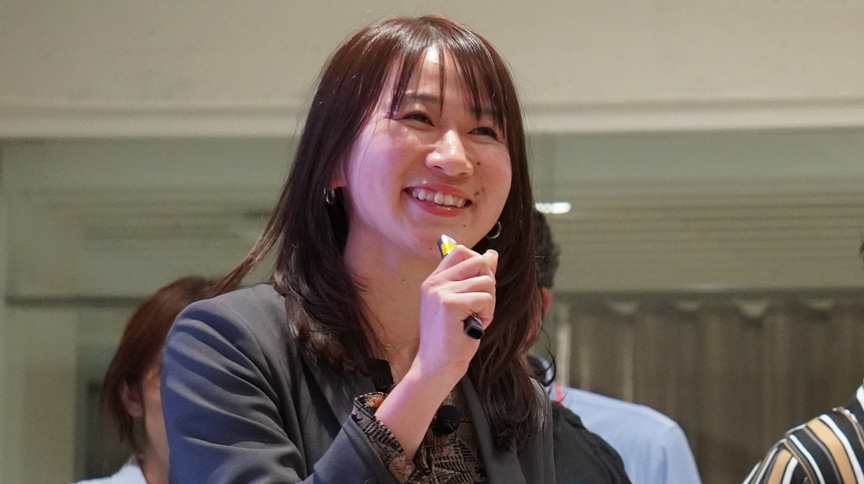 Chisato Sakane, Representative Director, Suichu Co., Ltd.
-
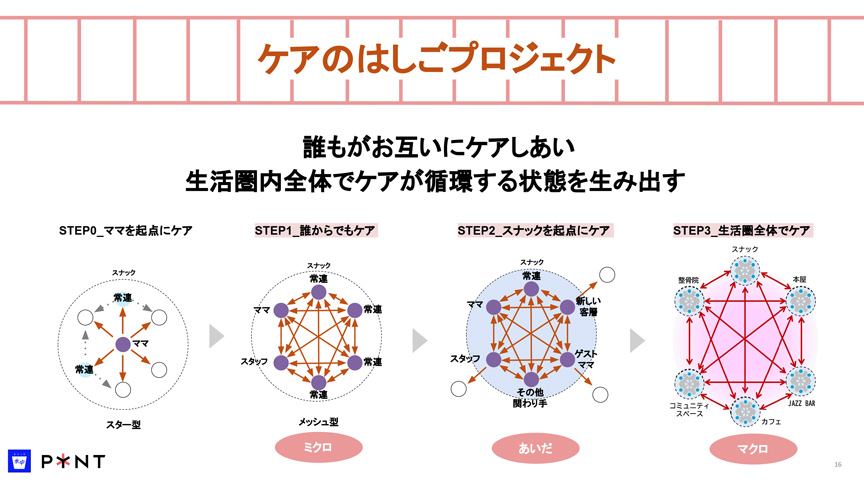 Care cycle
Regarding the second round of applications for FUTURE LENS
We will begin accepting applications for "FUTURE LENS Phase 2" from July of this year.
Nikken Sekkei will address the challenges faced by Zebra companies in their community problem-solving projects, such as "not being able to quantify the value of the project," "wanting to structure the challenges to move the project forward," and "not knowing how to implement it in the community," by leveraging its perspective on social and environmental design. This includes the ability to connect diverse expertise and build consensus among stakeholders, the ability to implement concrete steps in the community, the ability to visualize and quantify, and the ability to interpret systems and create mechanisms. Details such as application guidelines will be published on a special site within the Nikken Sekkei website in July 2026.
Nikken Sekkei will address the challenges faced by Zebra companies in their community problem-solving projects, such as "not being able to quantify the value of the project," "wanting to structure the challenges to move the project forward," and "not knowing how to implement it in the community," by leveraging its perspective on social and environmental design. This includes the ability to connect diverse expertise and build consensus among stakeholders, the ability to implement concrete steps in the community, the ability to visualize and quantify, and the ability to interpret systems and create mechanisms. Details such as application guidelines will be published on a special site within the Nikken Sekkei website in July 2026.
 For inquiries, please contact: FUTURE LENS 2nd Term Application Office pynt@nikken.jp
Related releases list
About Nikken Sekkei
Nikken Sekkei is a professional services firm specializing in architectural and civil engineering design and supervision, urban design, and related research, planning, and consulting services. For 125 years since its founding in 1900, Nikken Sekkei has been committed to creating value through "social environment design," which aims to solve both explicit and implicit social issues, in order to meet the demands of society and the diverse needs of its clients. To date, it has been involved in various projects in Japan, China, ASEAN, and the Middle East, and in recent years has expanded into India and Europe.
Contact information regarding this matter
株式会社日建設計 広報室 Tel. 03-5226-3030 e-mail:webmaster@nikken.jp
SHARE