
Towards a new society brought about by the coronavirus
~Future designs for the post-COVID era originating from China~
Zhong Xiao Lu
(Titles are as of the time of publication)
SCROLL DOWN
What will this new virus bring us?
In June 2020, I traveled to China for the first time in about six months and was amazed by the vibrant daily life there. In late September, I participated as a panelist in the "High-Rise Buildings & High-Density Cities" International Forum hosted by the Architectural Institute of China, which gave me the opportunity to interact with people from various industries.
I would like to share some insights from China regarding trends in cities and architecture in the post-COVID era.



 Nikken Sekkei Executive Officer Global Business Division, China Group, Principal Architectural Design Department Principal
Zhong Xiao Lu
(Titles are as of the time of publication)
China's current situation in the post-COVID era
I feel that behind the containment of the novel coronavirus and the economy’s V-shaped recovery lie messages for the future across various fields.
Urban spaces in the accelerating digital age
Furthermore, the entry of major IT companies into architecture and urban space design is a very interesting trend. Huawei has introduced ICT technology to campuses across the country, and Tencent has created a platform for BIM and CIM (City Information Modeling) on its cloud, venturing into the efficient operation and maintenance of buildings and public spaces, and into unmanned operations. It seems certain that the future of the architecture market will require a major transformation as these companies enter the market, leveraging big data and AI technology.
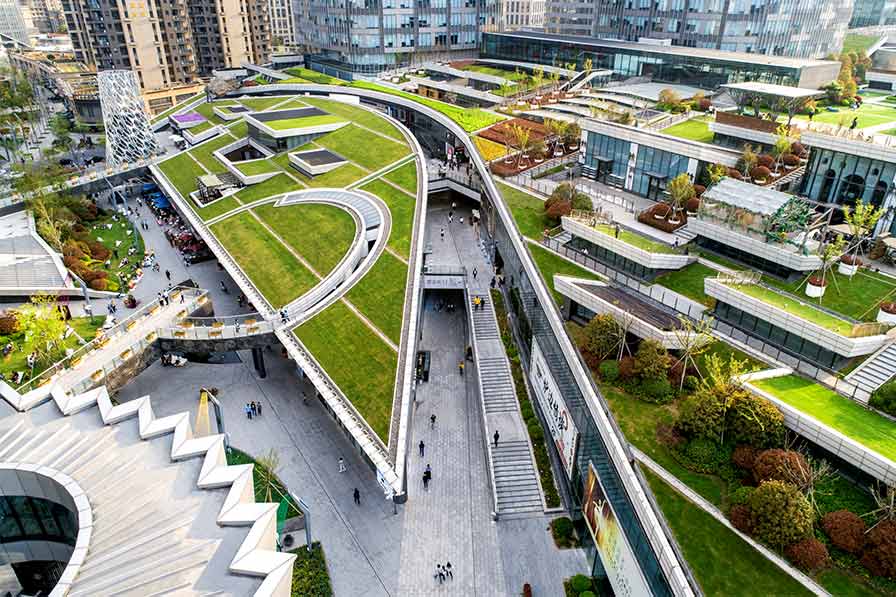 Actively opening the rooftops of subway stations and commercial facilities as public spaces: Shanghai Greenland Center (Completed in 2017)
Resilience of high-density cities
Mobility and Green TOD
Stations, which serve as mobility hubs, are not only designed to enhance the convenience and mobility of travel, but also to create environments that prioritize enriching user experiences by incorporating open parks, commercial facilities, and cultural facilities. Furthermore, the transfer networks for railways, buses, and car sharing are being integrated with more comfortable and open shared bikes and slow transportation systems centered on walking, attracting attention as a new urban infrastructure in the post-COVID era. The success of TOD (Transition-Oriented Development), which transcends the silos between railways and local governments, is also supported by the spread of various sharing apps powered by digital technology that underpins safety and security.
Crisis presents opportunity
Amidst the ongoing teleworking situation, a group of volunteers from Nikken Sekkei's design team have launched Future Lab. Using various information gathered from overseas as inspiration, we are currently prototyping a technology map to position the strengths of our technologies from a global perspective and aim for the future.
The road ahead may still be long, but I want to begin my journey in the post-COVID era by first finding my compass. (October 16, 2020)
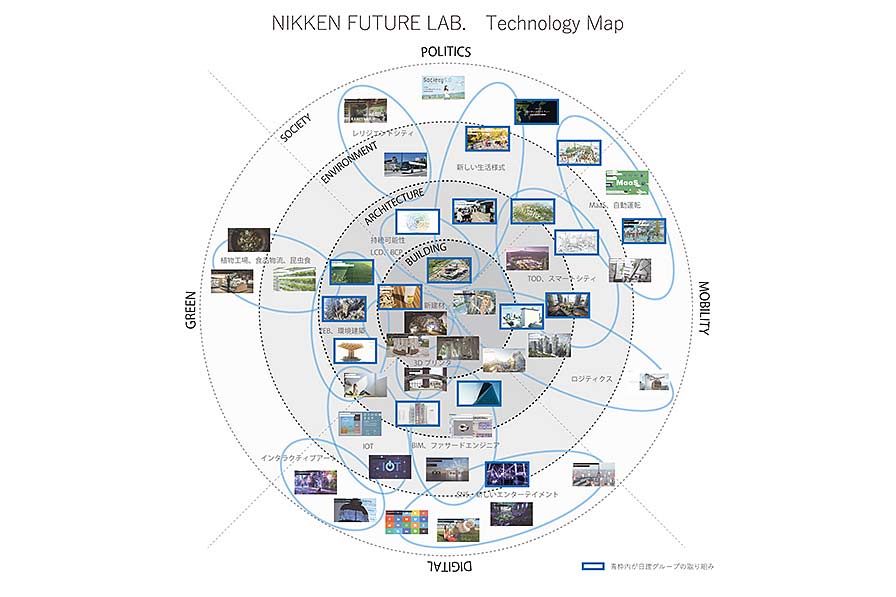 A global technology map related to cities and architecture