

"YKK 80 Building," for which Nikken Sekkei was responsible for design and construction supervision, has received the highest 5-star rating in the BELS evaluation.
On August 29, the “YKK 80 Building” (completed in June 2015), for which Nikken Sekkei was responsible for the design, received the highest rating—five stars (“☆☆☆☆☆”)—under the BELS (Building Energy Efficiency Labeling System)* evaluation program established by the Japan Housing Performance Evaluation and Labeling Association.
The building owner, YKK Real Estate, actively promotes environmentally conscious management and business activities. In the “YKK80 Building,” which houses the headquarters of the global corporations YKK Corporation and YKK AP Corporation, the company not only created a comfortable and pleasant working environment but also proactively implemented advanced systems that excel in energy and resource conservation.
YKK 80 Building In addition to this BELS evaluation, the building also received “Platinum Certification” under LEED-CS—a global certification system for environmentally conscious buildings and area development developed and administered by the U.S. Green Building Council (USGBC)—in February of this year, marking the first time an office building in Japan has achieved this distinction.
Nikken Sekkei has long been promoting the design and supervision of environmentally conscious buildings, and we remain committed to creating environments, cities, and buildings that are even more environmentally friendly and contribute to society.
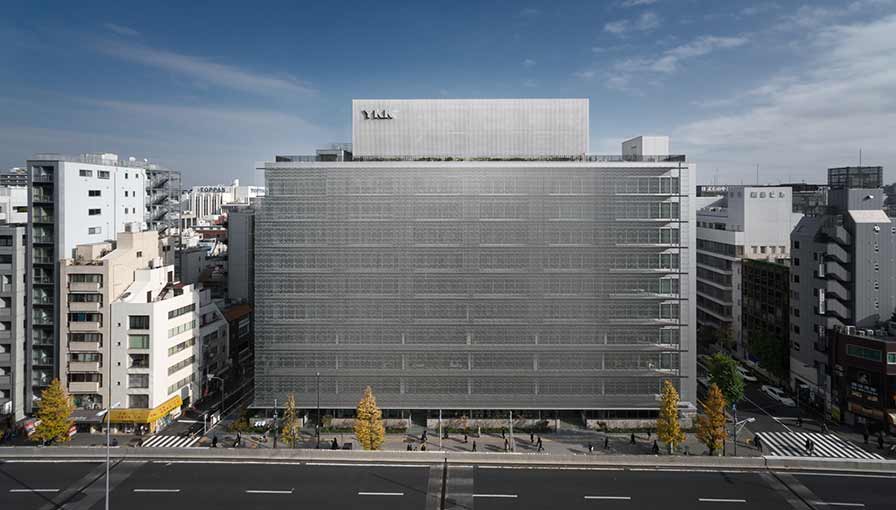 ©Rainer Viertlböck
■ About “YKK 80 Building ”
YKK 80 Building was designed as a long-life building that is disaster-resistant and prioritizes energy efficiency and enhanced comfort. Aiming for an energy reduction of approximately 60% compared to typical offices, the building incorporates advanced energy- and resource-saving systems such as “brightness- and motion-sensor-controlled LED lighting combined with a task and ambient lighting system,”a “centralized heating and cooling system,” “outdoor air cooling combined with misting systems in exterior shafts,” and “high-performance electrical outlets.”
Furthermore, it employs a seismic isolation structure to minimize earthquake damage; this isolated space is also utilized as a “cool-heat trench” to effectively harness geothermal energy.
Furthermore, the building features a symbolic, striking, and functional design that incorporates various ideas—such as creating a comfortable working environment through “radiant panels + desiccant air conditioning + micro-airflow” and fostering an open, employee-friendly workplace.
≪Main Building Features≫
1. Disaster-Resilient Structure and Facilities
2. Aims to reduce energy consumption by approximately 60% compared to typical office buildings
3. A comfortable working environment achieved through radiant panels, desiccant air conditioning, and micro-airflow
4. An open, user-friendly workspace
5. Functional façade design that creates a new “face” for the building
■ Overview of the “YKK80 Building”
Name: YKK80 Building
Client: YKK Fudosan Co., Ltd.
Location: 1 Kanda Izumi-cho, Chiyoda-ku, Tokyo
Design and Supervision: Nikken Sekkei, Ltd.
Contractor: Kajima, Toda, and Daiwa House Industry Construction Joint Venture
Scale: Gross Floor Area 20,919.85 m²
Building Height: 39.95 m; Maximum Height: 51.05 m
2 basement levels, 10 above-ground floors, 2 penthouse floors
Structure: SRC, Steel (S), Reinforced Concrete (RC), and Seismic Isolation
Construction Period: March 2013 – June 2015
*BELS (Building-Housing Energy-efficiency Labeling System):
This is one of the third-party certification systems established under Ministry of Land, Infrastructure, Transport and Tourism (MLIT) Notification No. 489 of Heisei 28, “Guidelines for the Labeling of Energy Consumption Performance of Buildings” (hereinafter referred to as the “Guidelines”), which is based on Article 7 of the Act on the Improvement of Energy Consumption Performance of Buildings (Building Energy Conservation Act).
Under this system, registered BELS organizations (65 organizations as of September 1, 2016) registered with the Housing Performance Evaluation and Labeling Association, a general incorporated association, evaluate and label energy-saving performance. The number of stars is displayed based on the BEI value(short for Building Energy Index; a value calculated by dividing the designed primary energy consumption by the standard primary energy consumption, serving as an index relative to energy conservation standards) are displayed.
YKK 80 Building For office buildings such as this, if the BEI is ≤0.6—meaning energy consumption is at least 40% below the energy conservation standard—the building receives the highest rating of “☆☆☆☆☆” (five stars).