

Ministry of Education, Culture, Sports, Science and Technology Super Eco-School Demonstration Project
Mizunami Municipal Mizunami North Junior High School: ZEB Achieved—101% in the First Year, 97% in the Second Year
Despite being located in one of Japan’s regions with the most extreme temperature fluctuations and facing the impact of the COVID-19 pandemic,
the school achieved outstanding ZEB results through the “Mizunami North Model,” in which students enjoy practicing energy conservation.
PRESS RELEASE
2021.12.01
Mizunami City, Gifu Prefecture, and Nikken Sekkei Ltd. (Headquarters: Chiyoda Ward, Tokyo; Representative Director President and CEO:Atsushi Omatsu) announced that Mizunami Municipal Mizunami North Junior High School—designed by Nikken Sekkei and certified under the Ministry of Education, Culture, Sports, Science and Technology’s Super Eco-School Demonstration Project—achieved 101% Net Zero Energy Building (ZEB)* in its first year, the school has achieved a 97% reduction in energy consumption during the second year, from September 2020 to August 2021.
*ZEB (pronounced “Zeb”):
A building that aims to balance the annual primary energy consumption of the building to zero while maintaining a comfortable indoor environment (from the Ministry of the Environment website)
The Super Eco-School Demonstration Project is a pilot program being implemented at seven schools nationwide (as of November 2021) to promote the transition to zero-energy status—where annual energy consumption is effectively reduced to zero—by utilizing technologies such as energy conservation, energy generation, and energy storage in public school facilities.Mizunami North Junior High School, which opened in April 2019, was the first among the seven schools to achieve ZEB status in its first year (September 2019 to August 2020) and continued to make significant progress toward ZEB even during its second year, which was marked by the COVID-19 pandemic.
*ZEB (pronounced “Zeb”):
A building that aims to balance the annual primary energy consumption of the building to zero while maintaining a comfortable indoor environment (from the Ministry of the Environment website)
The Super Eco-School Demonstration Project is a pilot program being implemented at seven schools nationwide (as of November 2021) to promote the transition to zero-energy status—where annual energy consumption is effectively reduced to zero—by utilizing technologies such as energy conservation, energy generation, and energy storage in public school facilities.Mizunami North Junior High School, which opened in April 2019, was the first among the seven schools to achieve ZEB status in its first year (September 2019 to August 2020) and continued to make significant progress toward ZEB even during its second year, which was marked by the COVID-19 pandemic.
97% Reduction in Energy Consumption and the Impact of the COVID-19 Pandemic (Measurement Period: September 2020–August 2021)
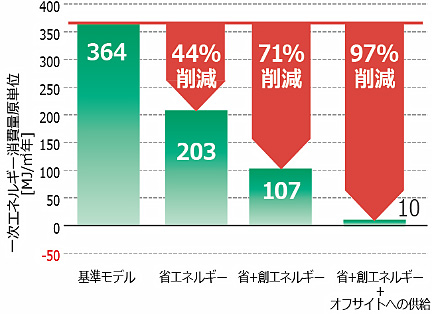
Compared to the typical energy consumption of 364 MJ/m² at junior high schools, we have achieved a 44% reduction through various energy-saving measures, and a 71% reduction by consuming the electricity generated on-site through solar power. Excess electricity that cannot be fully consumed on campus is sold to the power company and used off-site, contributing to energy conservation in the local community. Taking this effect into account, the school has achieved an energy savings rate of 97 percent. (See figure on the right.)
Mizunami City has a climate with extreme temperature fluctuations—hot summers and cold winters—but during the winter months from December 2020 to January 2021, air conditioners were operated with windows open as a measure to prevent the spread of COVID-19. We believe this resulted in higher electricity purchases compared to the same period the previous year, which was the reason we fell short of the 100% target. However, Even if the COVID-19 pandemic had not occurred, a 97% achievement rate is generally considered sufficient.
Design Considerations for Achieving ZEB Status
Design to Encourage Students' Voluntary Energy-Saving Behavior
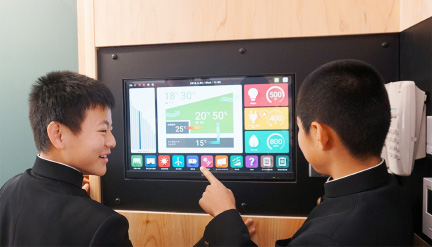
This middle school was designed with the goal of achieving net-zero energy consumption, including energy savings generated by student initiatives. The “Eco Monitors” located in each classroom allow students to monitor real-time environmental conditions throughout the school—such as temperature, humidity, and carbon dioxide levels within their classrooms—and adjust settings accordingly.
For example, the system allows students to compare the temperature in their classroom with that inside the cooling trench and decide for themselves whether to bring in fresh air.
An “energy-saving ranking” that compares their classroom to others is also displayed, which helps boost students’ motivation to conserve energy.
For example, the system allows students to compare the temperature in their classroom with that inside the cooling trench and decide for themselves whether to bring in fresh air.
An “energy-saving ranking” that compares their classroom to others is also displayed, which helps boost students’ motivation to conserve energy.
The very design of the school building, which embodies the spirit of Mizunami, naturally promotes energy conservation.
The design of this middle school building is specifically engineered to regulate air temperature and airflow.To ensure a comfortable environment while minimizing the use of heating and cooling systems, the school’s layout and airflow were simulated with consideration for the surrounding topography, resulting in an optimal building configuration. The system is designed so that air drawn in passes through “cool trenches” (underground channels beneath the building), allowing cooled air to circulate to each classroom during the summer.
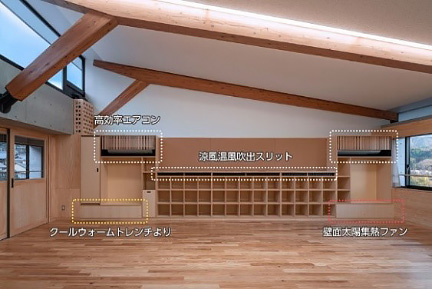
A groundbreaking ventilation feature unique to this school is the “Cool-Warm Locker” found in the classrooms. The back wall of each classroom consists of a unit that integrates lockers, natural ventilation, and air conditioning equipment.In addition to the cool and warm air vents at the top of the lockers, fans on the left and right circulate cooled air from the Cool Trench and blow warm air collected by the classroom walls via solar heating, respectively. These highly efficient ventilation features blend seamlessly into the classroom through their natural design.
A groundbreaking ventilation feature unique to this school is the “Cool-Warm Locker” found in the classrooms. The back wall of each classroom consists of a unit that integrates lockers, natural ventilation, and air conditioning equipment.In addition to the cool and warm air vents at the top of the lockers, fans on the left and right circulate cooled air from the Cool Trench and blow warm air collected by the classroom walls via solar heating, respectively. These highly efficient ventilation features blend seamlessly into the classroom through their natural design.
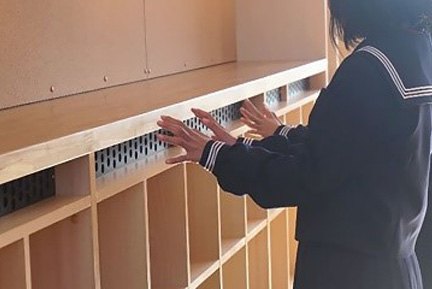
In addition, the entire school building serves as a teaching tool for environmental education, featuring elements such as a glass floor that allows students to see the temperature and flow of air inside the “Cool Trench,” a wall where students can touch the insulation material to feel its effectiveness, and a science lab ceiling sign—resembling a ruler—that indicates the sun’s altitude based on the reflection of natural light from the light shelves.
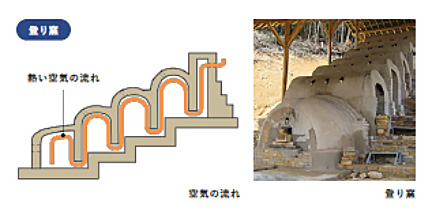
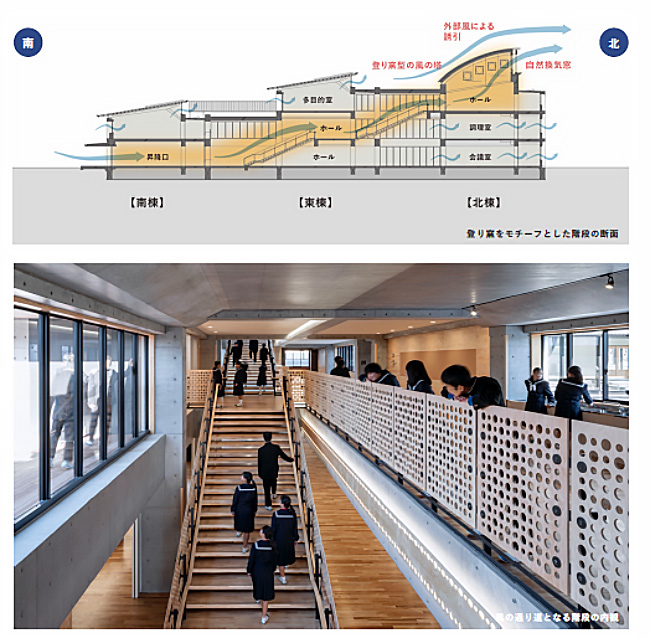
The building was designed with a cross-sectional shape that extends the stairwell hall continuously from north to south, and by creating a system that exhausts air at the very top, it utilizes gravity ventilation to draw warm air upward, thereby promoting natural ventilation throughout the school building. This idea was inspired by the mechanism of the “climbing kiln” found in Mizunami City, a town renowned for its pottery.
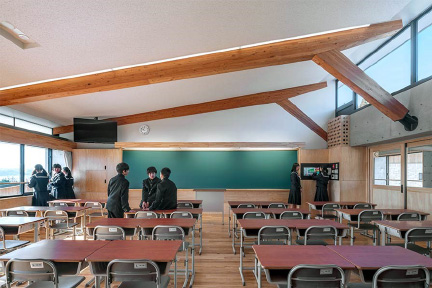
Another key design feature is the ability to ensure adequate brightness using natural light while minimizing the use of artificial lighting. Classrooms for all grade levels are located on the top floor, which offers the best views, and the building features a sloped wooden roof that slopes from north to south. This design allows the school to achieve the standard desk-surface illuminance of 500 lx using natural light alone.
Furthermore, the lower walls of the classrooms and the gymnasium roof are constructed as steel-plate “solar thermal panels,” which capture solar heat to warm the air and provide heating during the winter months.
Furthermore, the lower walls of the classrooms and the gymnasium roof are constructed as steel-plate “solar thermal panels,” which capture solar heat to warm the air and provide heating during the winter months.
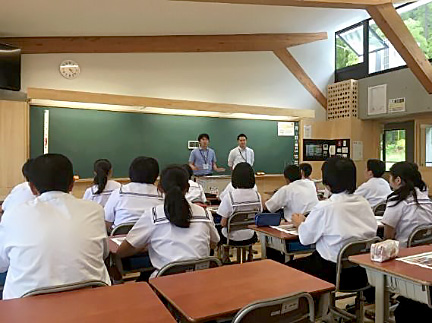
From the design phase onward, teachers and architects jointly conducted workshops on environmental education. Furthermore, since the school opened, architects from Nikken Sekkei have been providing regular on-site lessons on “how to use the school,” thereby supporting the school’s ongoing commitment to ZEB.
Students’ environmental awareness is enhanced through “environmental experiences that engage the five senses”
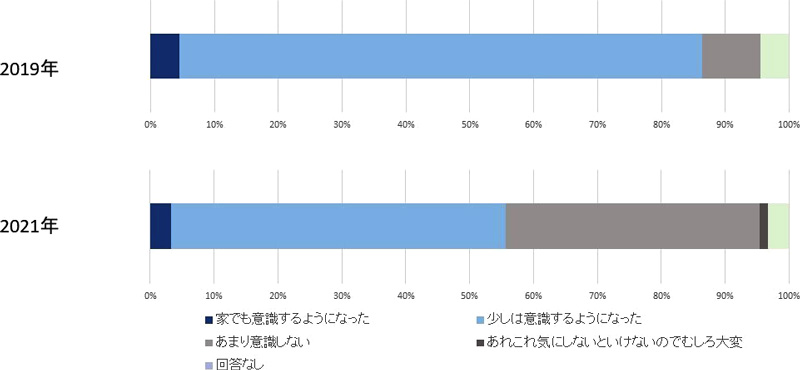
According to a survey, more than 80 percent of students in the first year—and even this year, when school operations were overwhelmed by the COVID-19 pandemic—reported that the Eco-Monitor program had made them “more aware of environmental issues.” Furthermore, the open-ended responses revealed that some students were able to use the Eco-Monitor to gather information and apply that knowledge to their daily actions, such as ensuring proper ventilation. Through “environmental experiences nurtured by the five senses”—where students think for themselves and adjust environmental conditions—the program is helping to transform the next generation’s environmental awareness.
The Super Eco-School Demonstration Project is a major initiative aimed at promoting the realization of a decarbonized society. Through the achievement of ZEB status at Mizunami North Junior High School, Mizunami City and Nikken Sekkei will provide support from both educational and architectural design perspectives so that the children who study here can go on to play active roles throughout Japan and even around the world, becoming leaders who spread awareness of environmental stewardship. In this way, we will contribute to solving societal challenges and improving the social and environmental landscape.
About Mizunami North Junior High School
Mizunami North Junior High School was established as part of the consolidation and reorganization of public junior high schools in Mizunami City. It is a “Super Eco School” that opened in April 2019 as the first newly constructed school of its kind in Japan. A “Super Eco School” is a school that rigorously implements energy-saving measures to reduce electricity consumption and achieves net-zero energy consumption through energy-generation and energy-storage technologies, as well as various innovative approaches. As public school facilities across the country continue to age, there is a growing need to reduce environmental impact and promote environmental education and conservation efforts. In response, the Ministry of Education, Culture, Sports, Science and Technology (MEXT) launched the “Super Eco-School Demonstration Project,” and this school is the seventh to be certified under this initiative.
About Nikken Sekkei
Nikken Sekkei is a professional services firm engaged in architectural design and supervision, urban design, and related research, planning, and consulting services. Upholding our fundamental philosophy of “contributing to society through valuable work,” we have been committed to creating a better social environment for 120 years since our founding in 1900, striving to meet the needs of society and the diverse requests of our clients. We have been involved in a wide range of projects in Japan, China, ASEAN, and the Middle East, and in recent years have expanded our operations to India, Russia, and Europe.
Contact information regarding this matter
株式会社日建設計 広報室 Tel. 03-5226-3030(代表) e-mail:webmaster@nikken.jp
日建設計広報事務局(株式会社プラップジャパン):八重樫、加納、西
Tel. 03-4580-9107 FAX. 03-4580-9133 E-Mail:nikken-pr@prap.co.jp
日建設計広報事務局(株式会社プラップジャパン):八重樫、加納、西
Tel. 03-4580-9107 FAX. 03-4580-9133 E-Mail:nikken-pr@prap.co.jp
SHARE