

Produced and Published “BIM Uses Definitions Vol. 1,” a Handbook to Promote the Effective Use of BIM
Produced to address Japan’s unique circumstances, the handbook aims to promote digital transformation (DX) in the architecture sector through the use of BIM
PRESS RELEASE
2022.05.10
Nikken Sekkei Ltd. (Headquarters: Chiyoda-ku, Tokyo; Representative Director: President and CEO: Atsushi Omatsu) has produced a handbook titled “BIM Uses Definitions Vol. 1: Processes and Tasks for Utilizing BIM” to promote the effective use of BIM, amid growing demand for productivity improvements through the advancement of DX (Digital Transformation) in Japan’s architectural sector.This handbook will be made available on Nikken Sekkei’s website.
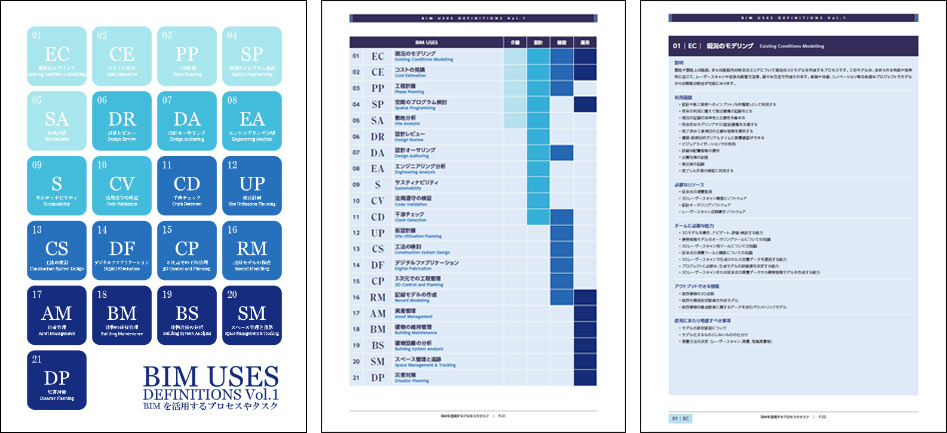
There are challenges to the effective use of BIM because the client and contractor have not been able to properly align on how to utilize it.
While BIM has been used in Japan as a tool for design and construction, in order to promote its adoption, it is now considered essential to organize useful information so that project owners can proactively utilize BIM from the perspective of a building’s entire lifecycle—from planning through maintenance and operation.
To enable clients to actively utilize BIM, they are required to prepare a document called “EIR (Employer’s Information Requirements)” that specifies, at each stage, “for what purposes and how BIM data will be used.”However, simply describing BIM usage requirements in writing makes it difficult to accurately convey the client’s intentions to the contractor, which can lead to misunderstandings between the client and the contractor, posing challenges to the effective use of BIM.
To enable clients to actively utilize BIM, they are required to prepare a document called “EIR (Employer’s Information Requirements)” that specifies, at each stage, “for what purposes and how BIM data will be used.”However, simply describing BIM usage requirements in writing makes it difficult to accurately convey the client’s intentions to the contractor, which can lead to misunderstandings between the client and the contractor, posing challenges to the effective use of BIM.
Nikken Sekkei Produces and Releases “BIM Uses Definitions Vol. 1: Processes and Tasks for Utilizing BIM”
Therefore, to support smooth communication between clients and contractors and to promote the use of BIM across the industry, Nikken Sekkei focused on “Appendix D: BIM Uses Definitions,” a supplementary document included in “The New Zealand BIM Handbook” created by BIMinNZ in New Zealand.
This appendix allows clients to select BIM uses from a list of 21 items and include them in the EIR, thereby accurately communicating the intended uses to contractors; it has been utilized not only in New Zealand but also in countries around the world. (The material was originally included in Pennsylvania State University’s “BIM Project Execution Planning Guide.”)
Nikken Sekkei analyzed the content of this New Zealand version of “Appendix D: BIM Uses Definitions” and produced a handbook titled “BIM USES Definitions Vol. 1: Processes and Tasks for Utilizing BIM,” which was translated to suit the Japanese context and published on our website.We hope that by making this handbook available to various stakeholders involved in facility development and management, clients and contractors will be able to accurately share their understanding of how to utilize BIM. We expect this to promote the adoption of BIM in Japan and contribute to the advancement of digital transformation (DX) in the architectural field.
This appendix allows clients to select BIM uses from a list of 21 items and include them in the EIR, thereby accurately communicating the intended uses to contractors; it has been utilized not only in New Zealand but also in countries around the world. (The material was originally included in Pennsylvania State University’s “BIM Project Execution Planning Guide.”)
Nikken Sekkei analyzed the content of this New Zealand version of “Appendix D: BIM Uses Definitions” and produced a handbook titled “BIM USES Definitions Vol. 1: Processes and Tasks for Utilizing BIM,” which was translated to suit the Japanese context and published on our website.We hope that by making this handbook available to various stakeholders involved in facility development and management, clients and contractors will be able to accurately share their understanding of how to utilize BIM. We expect this to promote the adoption of BIM in Japan and contribute to the advancement of digital transformation (DX) in the architectural field.
As part of the Ministry of Land, Infrastructure, Transport and Tourism’s BIM model project, “BIM Uses Definitions Vol. 1” was evaluated, and its effectiveness was confirmed.
In addition, “BIM Uses Definitions Vol. 1: Processes and Tasks for Utilizing BIM” was utilized and validated as part of the life cycle consulting services for the actual project “(Tentative Name) PLAFUS Kichijoji Main Street” under the Ministry of Land, Infrastructure, Transport and Tourism’s “Model Project for Streamlining Construction Production and Maintenance Processes Using BIM” initiative, specifically in the “Life Cycle Consulting: Verification of the Effects of BIM and LCC from the Client’s Perspective /Challenge Analysis,” which was selected for the Ministry of Land, Infrastructure, Transport and Tourism’s “Model Project for Streamlining Building Production and Maintenance Processes Using BIM.” It was utilized and verified as part of the life cycle consulting services for the actual project “(Tentative Name) Main Street,” confirming its effectiveness.
Reiwa 3 Fiscal Year BIM Model Project: Verification Results Report
Promoting Digital Transformation in the Construction Industry by Utilizing BIM Uses Definitions in Life Cycle Consulting Services
This handbook may be reused for the purpose of promoting the use of BIM in architectural design, construction, and facility management, provided that the source is clearly cited. We hope this handbook—which can be utilized in lifecycle consulting services that provide BIM consulting to clients from planning through design, construction, and maintenance—will contribute to the advancement of digital transformation (DX) in the architectural field.Nikken Sekkei will continue to contribute to the widespread adoption and promotion of BIM in order to advance digital transformation (DX) in Japan’s architectural sector.
Life Cycle Consulting: NIKKEN EXPERTISE
What is BIM?
BIM stands for Building Information Modeling. It is a system for constructing building information models that combine 3D geometric data created on a computer with attribute information about the building, such as room names and areas, material and component specifications and performance, and finishes.
BIM enables centralized management of information across all stages of a building project—from design through construction to maintenance—allowing for the smooth execution of various simulations. Furthermore, by facilitating the sharing of visual representations of the building, it streamlines communication among stakeholders. Additionally, the data—which remains usable even after the building is completed—enables more efficient operation and maintenance.In recent years, amid a shrinking labor force in the construction sector, the Ministry of Land, Infrastructure, Transport and Tourism has been leading efforts to promote the use of BIM to improve productivity through digital transformation (DX).
Furthermore, Nikken Sekkei Construction Management, a consulting firm within the Nikken Group, has proposed “Easy BIM®,” designed with the client’s ease of use in mind.
BIM enables centralized management of information across all stages of a building project—from design through construction to maintenance—allowing for the smooth execution of various simulations. Furthermore, by facilitating the sharing of visual representations of the building, it streamlines communication among stakeholders. Additionally, the data—which remains usable even after the building is completed—enables more efficient operation and maintenance.In recent years, amid a shrinking labor force in the construction sector, the Ministry of Land, Infrastructure, Transport and Tourism has been leading efforts to promote the use of BIM to improve productivity through digital transformation (DX).
Furthermore, Nikken Sekkei Construction Management, a consulting firm within the Nikken Group, has proposed “Easy BIM®,” designed with the client’s ease of use in mind.
About Nikken Sekkei
Nikken Sekkei is a professional services firm engaged in architectural design and supervision, urban design, and related research, planning, and consulting services.For 120 years since our founding in 1900, we have been committed to creating value through “Social and Environmental Design,” which seeks solutions to both apparent and latent social issues, in order to meet the needs of society and the diverse requests of our clients.We have been involved in a wide range of projects in Japan, China, ASEAN, and the Middle East, and in recent years have expanded our operations to India, Russia, and Europe. In March 2021, we issued a “Climate Emergency Declaration” as part of our efforts toward a decarbonized society.
Contact information regarding this matter
株式会社日建設計 広報室 Tel. 03-5226-3030(代表) e-mail:webmaster@nikken.jp
SHARE