

Using “Arc,” a tool for sustainable building operations, we are launching consulting services designed to enhance the environmental value of existing buildings, including support for obtaining LEED certification.
PRESS RELEASE
2022.06.21
Nikken Sekkei Ltd. (Headquarters: Chiyoda-ku, Tokyo; Representative Director President and CEO:Atsushi Omatsu) is launching consulting services designed to enhance environmental value by utilizing “Arc,” a tool for sustainable building operations. These services include support for obtaining certification under the international environmental performance rating system LEED (Leadership in Energy & Environmental Design) in the Operations & Maintenance (O+M) category for existing buildings.
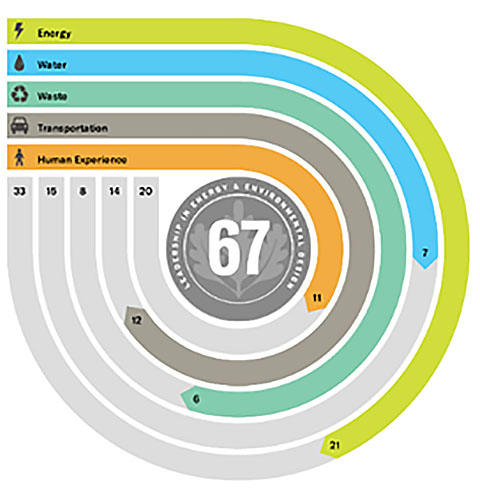 Results of the Environmental Performance Assessment of the Nikken Sekkei Tokyo Building Using Arc
(Quantification of energy consumption, water use, waste generation, greenhouse gas emissions from transportation, occupant comfort, etc.)
Benefits of Using Arc
Arc※1 is a web-based system that continuously evaluates a building’s environmental performance by comparing it to buildings around the world, based on operational data across five assessment categories: energy, water, waste, transportation, and people.The evaluation results are presented in easy-to-understand visuals, and its adoption has been increasing in recent years as a tool for monitoring ESG information and meeting the need for timely visualization. Furthermore, an Arc performance evaluation certificate can cover approximately 90% of the data required for LEED O+M certification.
LEED O+M is a green building*2 certification system that evaluates the environmental performance of existing buildings, including operational and management initiatives. While it is highly valued by companies worldwide aiming for sustainable building operations, the periodic certification renewal process places a significant administrative burden on applicants, and it is not uncommon for certifications to expire.
However, with LEED O+M v4.1—which became available for registration in 2019—utilizing Arc has made it possible to significantly reduce the burden associated with both initial certification and triennial renewals.
*1: A platform developed and operated by Arc Skoru Inc., a wholly owned subsidiary of GBCI (Green Business Certification Inc.), that provides a dynamic scoring model for real estate ESG performance on a global scale.
*2: Aiming to contribute to the realization of a sustainable environment and improved quality of life for future generations, this initiative focuses on building and operating a healthy and enriching built environment—including architecture and local communities—throughout the entire lifecycle, from site selection to design,construction, operation, maintenance, renovation, and demolition—with a focus on high resource efficiency and environmental and social responsibility.
LEED O+M is a green building*2 certification system that evaluates the environmental performance of existing buildings, including operational and management initiatives. While it is highly valued by companies worldwide aiming for sustainable building operations, the periodic certification renewal process places a significant administrative burden on applicants, and it is not uncommon for certifications to expire.
However, with LEED O+M v4.1—which became available for registration in 2019—utilizing Arc has made it possible to significantly reduce the burden associated with both initial certification and triennial renewals.
*1: A platform developed and operated by Arc Skoru Inc., a wholly owned subsidiary of GBCI (Green Business Certification Inc.), that provides a dynamic scoring model for real estate ESG performance on a global scale.
*2: Aiming to contribute to the realization of a sustainable environment and improved quality of life for future generations, this initiative focuses on building and operating a healthy and enriching built environment—including architecture and local communities—throughout the entire lifecycle, from site selection to design,construction, operation, maintenance, renovation, and demolition—with a focus on high resource efficiency and environmental and social responsibility.
Practical Applications of Arc
Nikken Sekkei was an early adopter of Arc and, on April 26, 2022, earned LEED O+M v4.1 Gold certification for its corporate headquarters, the Nikken Sekkei Tokyo Building (completed in 2003). This marks the fourth such certification in Japan.
As Nikken Sekkei’s headquarters, the Nikken Sekkei Tokyo Building received Japan’s first-ever Gold certification in the LEED O+M category in 2012.Subsequently, however, the time, labor, and cost burdens associated with renewal became challenges, leading to the certification’s expiration in 2017. By utilizing Arc, the company was able to significantly reduce these burdens compared to previous efforts, shorten the project duration to approximately half of what it had been, and successfully achieve recertification. Nikken Sekkei will leverage this expertise to enhance the environmental value of existing buildings and support building operators in their environmental initiatives.
As Nikken Sekkei’s headquarters, the Nikken Sekkei Tokyo Building received Japan’s first-ever Gold certification in the LEED O+M category in 2012.Subsequently, however, the time, labor, and cost burdens associated with renewal became challenges, leading to the certification’s expiration in 2017. By utilizing Arc, the company was able to significantly reduce these burdens compared to previous efforts, shorten the project duration to approximately half of what it had been, and successfully achieve recertification. Nikken Sekkei will leverage this expertise to enhance the environmental value of existing buildings and support building operators in their environmental initiatives.
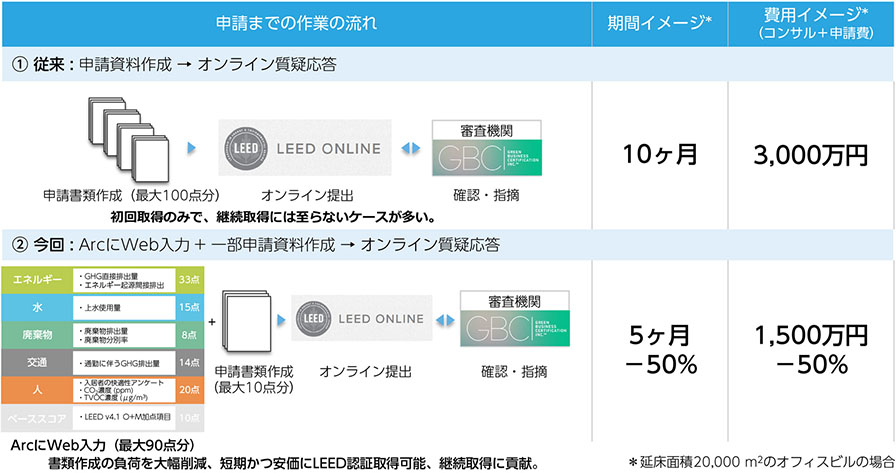 Illustration of Procedural Simplification and Cost Savings in Obtaining LEED Certification Through the Use of Arc
Note: The table above illustrates a scenario in which time and costs are significantly reduced; actual time and costs will vary depending on the building in question.
The Significance of LEED Certification and the Current Situation in Japan
LEED is an environmental performance rating system for the built environment (buildings and local communities) developed and administered by the nonprofit organization USGBC*3, with certification reviews conducted by GBCI. By evaluating strategies and measures aimed at creating the highest-quality built environment, LEED promotes the widespread adoption of buildings that reduce costs and resource consumption, consider the potential positive impact on human health, and foster the use of renewable clean energy.
Globally, ESG investing—which considers not only financial aspects but also environmental, social, and governance factors—is gaining traction in the real estate investment sector, and its expansion into the large stock of existing properties is anticipated.Amid this trend, interest in LEED O+M certification is growing as a method to enhance building asset value; the number of certifications worldwide stands at approximately 7,500, primarily in the United States (5,434), India (358), and China (337).In contrast, with only 27 certifications in Japan, the movement toward international environmental performance assessments for existing properties has been sluggish. This is causing Japan to miss opportunities to demonstrate asset value to investors, which could lead to a decline in international competitiveness in the future.
※3: U.S. Green Building Council
Globally, ESG investing—which considers not only financial aspects but also environmental, social, and governance factors—is gaining traction in the real estate investment sector, and its expansion into the large stock of existing properties is anticipated.Amid this trend, interest in LEED O+M certification is growing as a method to enhance building asset value; the number of certifications worldwide stands at approximately 7,500, primarily in the United States (5,434), India (358), and China (337).In contrast, with only 27 certifications in Japan, the movement toward international environmental performance assessments for existing properties has been sluggish. This is causing Japan to miss opportunities to demonstrate asset value to investors, which could lead to a decline in international competitiveness in the future.
※3: U.S. Green Building Council
SHARE