

Greenhouse Gas (GHG) Emissions from Construction
Development and Launch of an Estimation Simulation Tool
“GHG Estimate Tool*” Enables Easy Comparison of Greenhouse Gas Emissions from the Early Design Stages
PRESS RELEASE
2022.11.07
Nikken Sekkei Ltd. (Headquarters: Chiyoda-ku, Tokyo; Representative Director President and CEO: Atsushi Omatsu) has developed the “Kai-Tan Tool*”—which enables the simulation of estimated GHG emissions from construction—as part of its efforts to promote carbon neutrality, and has begun full-scale implementation of the tool in its architecture and design operations.
(*: Trademark registration pending)
(*: Trademark registration pending)

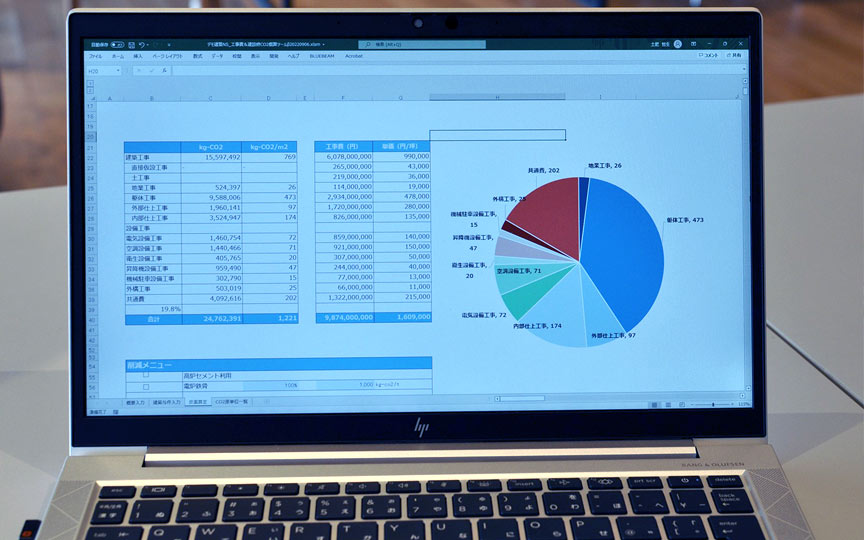
Challenges: Toward Corporate Disclosure of GHG Emissions
Efforts toward “Carbon Neutrality by 2050”—which aims to reduce greenhouse gas (GHG) emissions to zero by 2050—are now in full swing.Going forward, various companies will be required to disclose information on their GHG emissions, and efforts to reduce GHG emissions across the entire supply chain will be expected. Among these, understanding construction-related CO2 emissions—which are generated from the manufacturing of materials and equipment through to construction—is a particularly important issue.
Nikken Sekkei, which oversees design supervision for a wide range of projects and pioneers cutting-edge social and environmental design, has been exploring the development of tools related to “construction-related GHG emissions” as one of the key challenges to address.
Nikken Sekkei, which oversees design supervision for a wide range of projects and pioneers cutting-edge social and environmental design, has been exploring the development of tools related to “construction-related GHG emissions” as one of the key challenges to address.
Simulation of GHG Reductions from Construction Using the “Kaitan Tool*”
We have recently completed the development of the “Gai-Tan Tool*” and have begun full-scale implementation in our architecture and design operations.“Kaitan” refers to the estimation of carbon emissions. By utilizing this tool, it becomes possible to easily simulate construction-related GHG emissions alongside construction costs at any stage—from the initial planning phase through to the completion of design. It also enables designers to refine their designs while identifying GHG emissions that can be reduced.
Existing GHG emissions calculation tools include the “Mitsui Fudosan Co., Ltd.” and the “Manual for Calculating GHG Emissions During Construction (March 2022),” which our company developed as a practical tool for designers and contractors.While these tools are intended to provide highly accurate calculations for practical design and construction work, the new “Estimated Carbon Tool*” is designed to enable simulations—including cost estimates—during the basic planning and basic design phases.
As stated in the “Declaration of a Climate Emergency” announced in March 2021, Nikken Sekkei has accumulated extensive knowledge and experience in urban and architectural design and engineering, and has been granted the opportunity to co-create with numerous clients.With the full-scale implementation of the “Preliminary Carbon Tool*,” we will be able to proceed with projects by sharing and agreeing on design plans with clients—not only in terms of traditional construction costs but also from the perspective of environmental impact. We believe this will further accelerate the achievement of carbon neutrality in the architectural sector.
Existing GHG emissions calculation tools include the “Mitsui Fudosan Co., Ltd.” and the “Manual for Calculating GHG Emissions During Construction (March 2022),” which our company developed as a practical tool for designers and contractors.While these tools are intended to provide highly accurate calculations for practical design and construction work, the new “Estimated Carbon Tool*” is designed to enable simulations—including cost estimates—during the basic planning and basic design phases.
As stated in the “Declaration of a Climate Emergency” announced in March 2021, Nikken Sekkei has accumulated extensive knowledge and experience in urban and architectural design and engineering, and has been granted the opportunity to co-create with numerous clients.With the full-scale implementation of the “Preliminary Carbon Tool*,” we will be able to proceed with projects by sharing and agreeing on design plans with clients—not only in terms of traditional construction costs but also from the perspective of environmental impact. We believe this will further accelerate the achievement of carbon neutrality in the architectural sector.
Features of the General Carbon Tool*
1. GHG emissions resulting from construction can be calculated using virtual design from the early stages of the design process
・Even when details have not been finalized, specifications can be estimated using virtual design
・Accuracy can be improved incrementally by adding detailed or supplementary information
2. Outputs are provided in the form of a breakdown by “quantity × unit price (unit cost)” for both building and mechanical/electrical systems
• Based on these itemized breakdowns, it is easy to perform simulations based on differences in building shape, seismic performance, and environmental performance
• Since detailed item analysis is possible, it is possible to identify areas that have a significant impact on costs and GHG emissions
3. Simultaneously calculate construction costs and CO₂ emissions
・CO₂ emissions and construction costs can be tracked and adjusted simultaneously while conducting design studies
・The relationship between CO₂ emission reductions and construction costs can be quantitatively evaluated for each individual technical element
・Even when details have not been finalized, specifications can be estimated using virtual design
・Accuracy can be improved incrementally by adding detailed or supplementary information
2. Outputs are provided in the form of a breakdown by “quantity × unit price (unit cost)” for both building and mechanical/electrical systems
• Based on these itemized breakdowns, it is easy to perform simulations based on differences in building shape, seismic performance, and environmental performance
• Since detailed item analysis is possible, it is possible to identify areas that have a significant impact on costs and GHG emissions
3. Simultaneously calculate construction costs and CO₂ emissions
・CO₂ emissions and construction costs can be tracked and adjusted simultaneously while conducting design studies
・The relationship between CO₂ emission reductions and construction costs can be quantitatively evaluated for each individual technical element
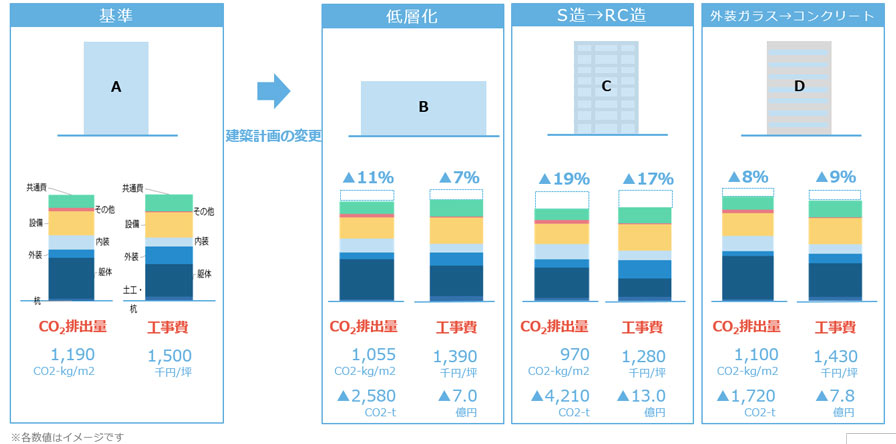 Simulation image using the Kai-Tan Tool*
(Allows for tracking changes in CO2 emissions and construction costs resulting from architectural design changes from the early planning stages onward)
Regarding Nikken Sekkei’s “Climate Emergency Declaration”
In March 2021, our company issued a “Climate Emergency Declaration” to explore ways to balance economic activity with the realization of a decarbonized society and to advocate for these goals as a private-sector company. This tool is designed in accordance with the “Climate Emergency Declaration.”
"Declaration of a Climate Emergency" (March 2021)
1. We will revolutionize the way we work and achieve net-zero greenhouse gas emissions from Nikken Sekkei’s business activities by 2050.
2. We will propose a carbon-neutral model for urban and architectural design and work styles by 2050, and using a backcasting approach, present the necessary measures for the period from 2021 to 2050 as an annual plan.
3. We will envision the future of communities—characterized by alternating cycles of centralization and decentralization—and propose accessible carbon-neutral solutions through flexible systems that integrate infrastructure and architectural functions.
4. We will support the development of a screening system to evaluate corporate environmental performance and contribute to the promotion of ESG real estate and urban infrastructure investments.
5. We will support clients in solving challenges by sharing the urgency of taking immediate action. Furthermore, we will communicate this message to society at large to foster public support.
2. We will propose a carbon-neutral model for urban and architectural design and work styles by 2050, and using a backcasting approach, present the necessary measures for the period from 2021 to 2050 as an annual plan.
3. We will envision the future of communities—characterized by alternating cycles of centralization and decentralization—and propose accessible carbon-neutral solutions through flexible systems that integrate infrastructure and architectural functions.
4. We will support the development of a screening system to evaluate corporate environmental performance and contribute to the promotion of ESG real estate and urban infrastructure investments.
5. We will support clients in solving challenges by sharing the urgency of taking immediate action. Furthermore, we will communicate this message to society at large to foster public support.
About Nikken Sekkei Ltd.
Nikken Sekkei is a professional services firm specializing in architectural and civil engineering design and supervision, urban design, and related research, planning, and consulting services. For 120 years since its founding in 1900, Nikken Sekkei has been committed to creating value through "social environment design," which aims to solve both explicit and implicit social issues, in order to meet the demands of society and the diverse needs of its clients. To date, it has been involved in various projects in Japan, China, ASEAN, and the Middle East, and in recent years has expanded into India and Europe.
inquiry
株式会社日建設計 広報室 Tel. 03-5226-3030 e-mail:webmaster@nikken.jp
SHARE