

Tokyu Land Corporation, Tokyu Community, SoftBank, and Nikken Sekkei Announce Results of Joint Research Aimed at Creating Robot-Friendly Environments
Identified challenges and effective measures for realizing a robot-friendly environment from the perspectives of facilities, people, and robots
PRESS RELEASE
2023.04.17
Tokyu Land Corporation (Headquarters: Shibuya-ku, Tokyo; Representative Director President and CEO: Hiroaki Hoshino; hereinafter “Tokyu Real Estate”), Tokyu Community Co., Ltd. (Headquarters: Setagaya-ku, Tokyo; Representative Director President and CEO:Shohei Kimura, hereinafter “Tokyu Community”), SoftBank Corp. (Headquarters: Minato-ku, Tokyo; President and CEO Executive Officer; CEO: Junichi Miyakawa, hereinafter “SoftBank”), and Nikken Sekkei Ltd. (Headquarters: Chiyoda-ku, Tokyo; Representative Director President and CEO: Atsushi Omatsu, hereinafter “Nikken Sekkei”) are pleased to announce that, as part of research aimed at creating a robot-friendly (hereinafter “Robofre”) environment that enables the smooth operation of robots, they have identified challenges affecting robot operations and compiled proposed countermeasures from the perspectives of facilities, people, and robots.This initiative was selected as part of the Ministry of Economy, Trade and Industry’s (METI) subsidy program, “Reiwa 4 Innovative Robot R&D Infrastructure Development Project,” and was carried out jointly by four companies.
Issues and Policy Directions Organized from the Perspectives of Facilities, People, and Robots
With growing concerns about severe labor shortages in a society characterized by a declining birthrate and aging population, and rising expectations for the use of service robots, there is a growing need to create “Robofre” environments—where people and robots can coexist safely and comfortably—within facilities such as office buildings.In this research project, we focused on the Tokyo Port City Takeshiba Office Tower, managed and operated by Tokyu Land Corporation. Using the “Robo-Friendly Level”—an evaluation metric proposed in the fiscal year Reiwa 3 version of this project—as our assessment standard, we identified challenges to achieving a “Robo-Friendly” environment and examined potential measures to promote the introduction of robots in response to each challenge.
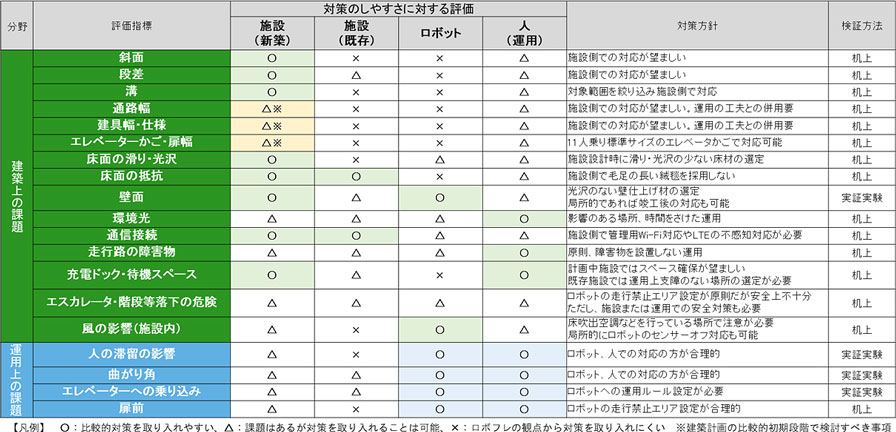 Table: Summary of Challenges in Creating a Robot-Friendly Environment and Evaluation of the Ease of Implementing Countermeasures
Evaluation of Specific Measures
We have broadly categorized the challenges into architectural issues (related to the physical environment), such as navigating tactile paving and light reflections, and operational issues (related to navigation within the facility), such as coming into contact with people at corners or in crowded hallways.We evaluated proposed solutions to these challenges—such as eliminating steps and ensuring sufficient space on the facility side; using warning sounds and adjusting route settings on the robot side; and restricting operating areas and establishing operational rules on the human (operational) side—from the perspective of ease of implementation and compiled them into a list, including our recommended strategies.In particular, “achieving coexistence between people and robots” in operational contexts was a major challenge; however, through demonstration experiments—such as those designed to prevent collisions between people and robots at turns—we were able to identify effective countermeasures. By compiling these countermeasures from multiple perspectives, we aim to facilitate the consideration of robot implementation even in existing buildings where it is difficult to modify the physical environment.
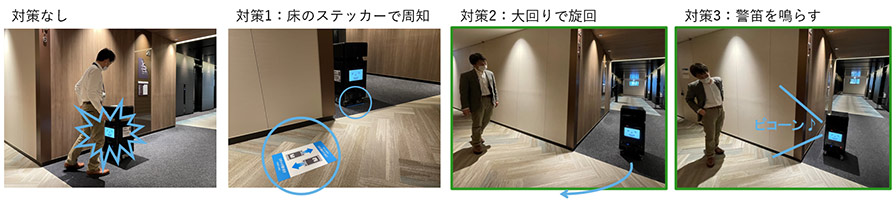 Figure: Example of a demonstration experiment to avoid collisions between people and robots at a corner
By comparing multiple countermeasures, the study confirmed that “audible warnings” and “taking a wider turn” are highly effective
Future developments
By further advancing this initiative and establishing guidelines and other measures, we expect to improve cost-effectiveness and lower barriers to entry when introducing robots.At the same time, since it is also important to standardize the specifications and operations of robot-friendly buildings, Tokyu Land Corporation, Tokyu Community, SoftBank, and Nikken Sekkei will continue to work with a wide range of stakeholders involved in robotics, as well as the Ministry of Economy, Trade and Industry (METI) and promotional organizations such as the Robot-Friendly Facilities Promotion Organization (RFA), to advance initiatives aimed at creating robot-friendly environments.
For details on this project, please also refer to the website of the Japan Machinery Manufacturers’ Association (the implementing organization for the subsidy program).
For details on this project, please also refer to the website of the Japan Machinery Manufacturers’ Association (the implementing organization for the subsidy program).
Business Overview
| Purpose | ・Conducting evaluations based on RoboFure’s level assessments ・Identifying operational challenges related to robots from the perspectives of user safety and facility management ・Examining solutions to these challenges from the perspectives of the facility, people, and robots |
|---|---|
| Location | Tokyo Port City Takeshiba Office Tower (1-7-1 Kaigan, Minato Ward, Tokyo) |
| Duration | September 2022–March 2023 |
| Roles of Each Company | ・Tokyu Real Estate Project management, provision of implementation sites, and evaluation of countermeasures from the operator’s perspective ・Tokyu Community Identifying operational challenges for cleaning and security robots; implementing solutions and verifying their effectiveness ・SoftBank (subcontracts certain operations to Asratec Corporation) Identifying operational challenges for delivery robots; implementing solutions and verifying their effectiveness ・Nikken Sekkei Evaluation of robot-friendly environments, analysis of physical environmental factors, and consideration of solutions to challenges |
About Tokyu Real Estate
As the core company of the Tokyu Land Corporation Holdings Group, Tokyu Land Corporation is a comprehensive real estate company engaged in urban development, residential development, infrastructure and industrial development, wellness, and overseas operations.Currently, leveraging its proven development capabilities and stable earnings power as its strengths, the company is promoting“Environmental Management” and “DX,” as outlined in the Tokyu Real Estate Holdings Group’s long-term vision “GROUP VISION 2030” and “Mid-Term Management Plan 2025,” and is addressing various challenges related to local communities, society, and the environment while expanding its operations. The company aims to maximize business value through co-creation with partner companies and local communities.
About Tokyu Community
As a core company of the Tokyu Real Estate Holdings Group, Tokyu Community is a comprehensive real estate management company that handles the maintenance and management of a wide range of buildings nationwide, including condominium management, building and facility management, the management and operation of public facilities such as cultural centers, and sports facilities and airport-related facilities.Building on our proven track record in property management, we provide services that leverage our expertise and contribute to enhancing our clients’ living environments and asset values by fostering a high-quality property portfolio. We have established a digital infrastructure that harnesses our extensive know-how, data, and customer touchpoints to provide our clients with data-driven solutions.
About SoftBank
Under its corporate philosophy of “Bringing Happiness to People Through the Information Revolution,” SoftBank is pursuing its “Beyond Carrier” strategy to transcend the traditional business model of the telecommunications industry and provide innovative services across a wide range of industrial sectors, aiming for further growth. SoftBank is also focusing its efforts on robotics-related research and development,In addition to research and development on autonomous robots such as “Cuboid,” the company is collaborating with SoftBank Group companies on various initiatives aimed at advancing the robotics industry and facilitating its societal implementation. These include experiments in indoor delivery utilizing coordination between office building elevators and robots, as well as Japan’s first successful experiment in outdoor delivery through coordination between autonomous robots and traffic lights.
About Nikken Sekkei
Nikken Sekkei is a professional services firm engaged in architectural and civil engineering design and supervision, urban design, and related survey, planning, and consulting services.For 120 years since our founding in 1900, we have been committed to creating value through “social and environmental design,” which seeks solutions to both apparent and latent social challenges, in order to meet the needs of society and the diverse requests of our clients.To date, we have been involved in a wide range of projects in Japan, China, ASEAN, and the Middle East, and in recent years have expanded our operations to India and Europe.In March 2021, we issued a “Climate Emergency Declaration” as part of our efforts toward a decarbonized society. To address the challenge of a shrinking workforce, we have proposed “Smart Operation Building,” a concept that reduces the burden of building management through architectural innovations and IoT technology, and are working toward the realization of “Robofle Building.”
Contact Information Regarding This Press Release
東急不動産株式会社 広報室 報道担当 上林・大鳥居 MAIL:tlc-hodo@tokyu-land.co.jp
株式会社東急コミュニティー 広報センター 小笠原・高村 MAIL:tc-kouhou@tokyu-com.co.jp
ソフトバンク株式会社 広報本部 TEL:03-6889-2301 MAIL:sbpr@g.softbank.co.jp
株式会社日建設計 広報室 長澤 TEL:03-5226-3030 MAIL:webmaster@nikken.jp
株式会社東急コミュニティー 広報センター 小笠原・高村 MAIL:tc-kouhou@tokyu-com.co.jp
ソフトバンク株式会社 広報本部 TEL:03-6889-2301 MAIL:sbpr@g.softbank.co.jp
株式会社日建設計 広報室 長澤 TEL:03-5226-3030 MAIL:webmaster@nikken.jp
SHARE