

Launching Initiatives to Realize “Circular Architecture” That Helps Address Resource Depletion and Waste Management Challenges
As a first step, the company is working to develop the “Circular Idea Catalog,” which compiles insights on the circular economy within the construction industry
PRESS RELEASE
2024.10.18
Nikken Sekkei Ltd. (Headquarters: Chiyoda-ku, Tokyo; Representative Director President and CEO: Atsushi Omatsu; hereinafter “Nikken Sekkei”) has launched the “Circular Design Collective,” an initiative to promote the circular economy in the construction industry, as part of its efforts to pursue social and economic sustainability.As the first phase of this initiative, Nikken Sekkei will begin developing the “Circular Idea Catalog,” which compiles ideas, design methods, and other expertise, with the aim of creating an environment where everyone involved in architecture and civil engineering can work toward realizing “Circular Architecture.”
Social Context—Why the Construction Industry Is Now Calling for “Circular Construction”—
Amid the transition to a circular society, we are seeing trends such as stricter global regulations, the launch of partnerships among industry, government, and academia, and the entry of companies into the business market; as a result, momentum for promoting the circular economy is growing both domestically and internationally.Meanwhile, the 2024 edition of the “Circularity Gap Report,” an annual report summarizing global trends in the circular economy,※1According to the report, although the volume of articles and discussions on the circular economy has increased approximately threefold compared to five years ago, there has been no improvement in the circularity of society and the economy, which continues to decline.
*Circular Economy: A cyclical system in which raw materials and products are reused as much as possible in economic activities, thereby reducing environmental impact and achieving sustainable resource use.
Approximately 40% of global greenhouse gas (GHG) emissions are attributable to the construction, operation, and demolition of buildings, and construction and demolition processes account for nearly one-third of all material consumption.※1. Furthermore, relative to the amount of available resources, this figure is 1.7 times the global average and 6.4 times the average for Japan※2It is projected that, based on current consumption rates, the remaining capacity of final disposal sites for construction and demolition waste is sufficient for 17 years; in the Tokyo metropolitan area alone, it is projected to be sufficient for 6 years.※3. Given the two pressing challenges—"resource depletion" and "shortage of final disposal sites"—that may arise in the not-too-distant future, there is an urgent need to establish systems for realizing "circular architecture" that reduces both "resources used" and "resources discarded" in the construction industry.
Against this backdrop, as part of efforts to promote the circular economy and carbon neutrality in the construction industry, Nikken Sekkei has launched the “Circular Design Collective”—a group dedicated to researching “people,” “things,” and “actions” and pooling collective knowledge—and has begun working toward the realization of circular architecture.and has launched the “Circular Design Collective,” an initiative to research “people,” “things,” and “processes” and pool collective knowledge, thereby taking the first steps toward realizing circular architecture.
*Circular Economy: A cyclical system in which raw materials and products are reused as much as possible in economic activities, thereby reducing environmental impact and achieving sustainable resource use.
Approximately 40% of global greenhouse gas (GHG) emissions are attributable to the construction, operation, and demolition of buildings, and construction and demolition processes account for nearly one-third of all material consumption.※1. Furthermore, relative to the amount of available resources, this figure is 1.7 times the global average and 6.4 times the average for Japan※2It is projected that, based on current consumption rates, the remaining capacity of final disposal sites for construction and demolition waste is sufficient for 17 years; in the Tokyo metropolitan area alone, it is projected to be sufficient for 6 years.※3. Given the two pressing challenges—"resource depletion" and "shortage of final disposal sites"—that may arise in the not-too-distant future, there is an urgent need to establish systems for realizing "circular architecture" that reduces both "resources used" and "resources discarded" in the construction industry.
Against this backdrop, as part of efforts to promote the circular economy and carbon neutrality in the construction industry, Nikken Sekkei has launched the “Circular Design Collective”—a group dedicated to researching “people,” “things,” and “actions” and pooling collective knowledge—and has begun working toward the realization of circular architecture.and has launched the “Circular Design Collective,” an initiative to research “people,” “things,” and “processes” and pool collective knowledge, thereby taking the first steps toward realizing circular architecture.
What Is the "Circular Architecture" We Should Aim For?
The “Circular Design Collective” has set a mission to eliminate the concept of “waste” from the architecture and civil engineering industries. It has classified and defined the “circular architecture” it aims to achieve into three principles: “Vernacular” (all materials return to the earth), “Design for Disassembly” (considering post-demolition recycling from the design phase),“Upcycling (breathing new life into waste).”
In Europe, a leader in the circular economy, people are beginning to recognize the importance of upcycling construction waste and designing structures to facilitate disassembly from the outset, anticipating a not-too-distant future when new materials will become difficult to obtain. Similar ideas are beginning to take root there.For example, in the upcycling of construction waste, there is a case where the reuse of exterior glass led to a 32% reduction in CO2 emissions, while the reuse of exterior sashes resulted in an 87% reduction.※4This suggests that it has the potential to contribute to carbon neutrality. Furthermore, estimates indicate that the cost of reuse is roughly equivalent to that of using new building materials, and that optimizing usage by selecting the right materials for the right applications could lead to a 50 percent reduction in costs.※4It also holds the potential to deliver economic benefits.Nikken Sekkei will promote the concept of transforming construction waste—which has traditionally been viewed as a “negative asset”—into a “positive asset” that possesses both environmental and economic value. We will also propose new design approaches for Japan, such as incorporating ease of disassembly into the design process from the very beginning.
In Europe, a leader in the circular economy, people are beginning to recognize the importance of upcycling construction waste and designing structures to facilitate disassembly from the outset, anticipating a not-too-distant future when new materials will become difficult to obtain. Similar ideas are beginning to take root there.For example, in the upcycling of construction waste, there is a case where the reuse of exterior glass led to a 32% reduction in CO2 emissions, while the reuse of exterior sashes resulted in an 87% reduction.※4This suggests that it has the potential to contribute to carbon neutrality. Furthermore, estimates indicate that the cost of reuse is roughly equivalent to that of using new building materials, and that optimizing usage by selecting the right materials for the right applications could lead to a 50 percent reduction in costs.※4It also holds the potential to deliver economic benefits.Nikken Sekkei will promote the concept of transforming construction waste—which has traditionally been viewed as a “negative asset”—into a “positive asset” that possesses both environmental and economic value. We will also propose new design approaches for Japan, such as incorporating ease of disassembly into the design process from the very beginning.
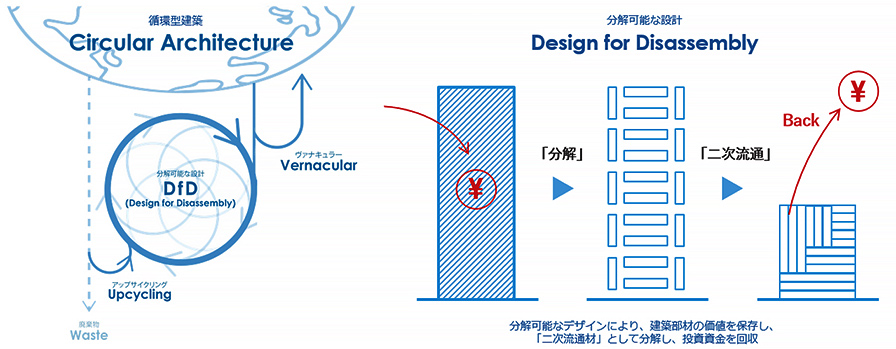 Figure: Classification of “Circular Architecture” and the Concept of “Design for Disassembly”
Launch of the “Circular Idea Catalog” Project: A Catalog Providing an Overview of “Circular Design” Concepts
While information on initiatives, technologies, and materials that contribute to the circular economy does exist, it is scattered across various media, making it difficult to identify information suitable for individual projects.Therefore, as the first initiative of the “Circular Design Collective,” Nikken Sekkei has cataloged examples of “circular architecture,” along with the “Circular Design” concepts that underpin it and information on external experts who can serve as partners in implementing “Circular Design,” and has begun utilizing this catalog internally.We aim to create an environment where anyone involved in architecture and civil engineering can engage in “Circular Design,” thereby widely disseminating and embedding the value of “Circular Architecture” throughout society.
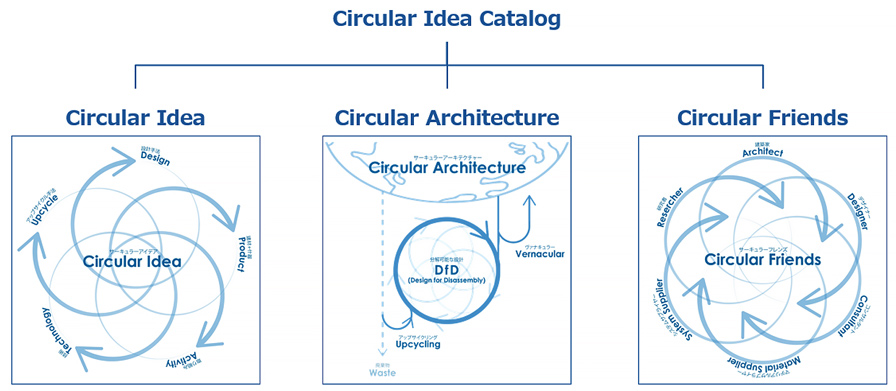 Figure: Image of the “Circular Idea Catalog”
Future prospects
Examples from Europe have shown that initiatives toward “circular architecture”—including the upcycling of construction waste—are expected to yield positive environmental and economic benefits.NIKKEN SEKKEI believes it is crucial to promote and implement “Circular Design”—the foundation of these initiatives—in society. To this end, we will practice “Circular Design” ourselves to accumulate ideas and know-how, while also recruiting external partners to implement these practices. We will then consolidate and co-create highly replicable information in the “Circular Idea Catalog.”As part of our long-term vision, we plan to open-source the catalog as a database accessible to everyone, with the goal of making “Circular Design” knowledge—not only in the field of architectural design but across the entire construction industry—the new standard in the architecture and civil engineering sectors. Nikken Sekkei, which champions “Social and Environmental Design,” will continue to promote initiatives aimed at solving environmental and social challenges.
※1:The Circularity Gap Report 2024
※2:Global Footprint Network Nowcasting the World's Footprint & Biocapacity for 2024
※3:国土交通省 建設リサイクル推進計画2020(案)~「質」を重視するリサイクルへ~
※4:Lendager, A., & Pedersen, E. (2021). SOLUTION. Danish Architectural Press. ISBN: 9788774074731.
※1:The Circularity Gap Report 2024
※2:Global Footprint Network Nowcasting the World's Footprint & Biocapacity for 2024
※3:国土交通省 建設リサイクル推進計画2020(案)~「質」を重視するリサイクルへ~
※4:Lendager, A., & Pedersen, E. (2021). SOLUTION. Danish Architectural Press. ISBN: 9788774074731.
SHARE