

“Xenobe” Project: Environmental Renovation Completed on 57-Year-Old Nikken Building No. 1 — Verifying a “Renovation Model That Balances Environmental Performance and Investment Efficiency” to Achieve ZEB Ready —
PRESS RELEASE
2025.04.08
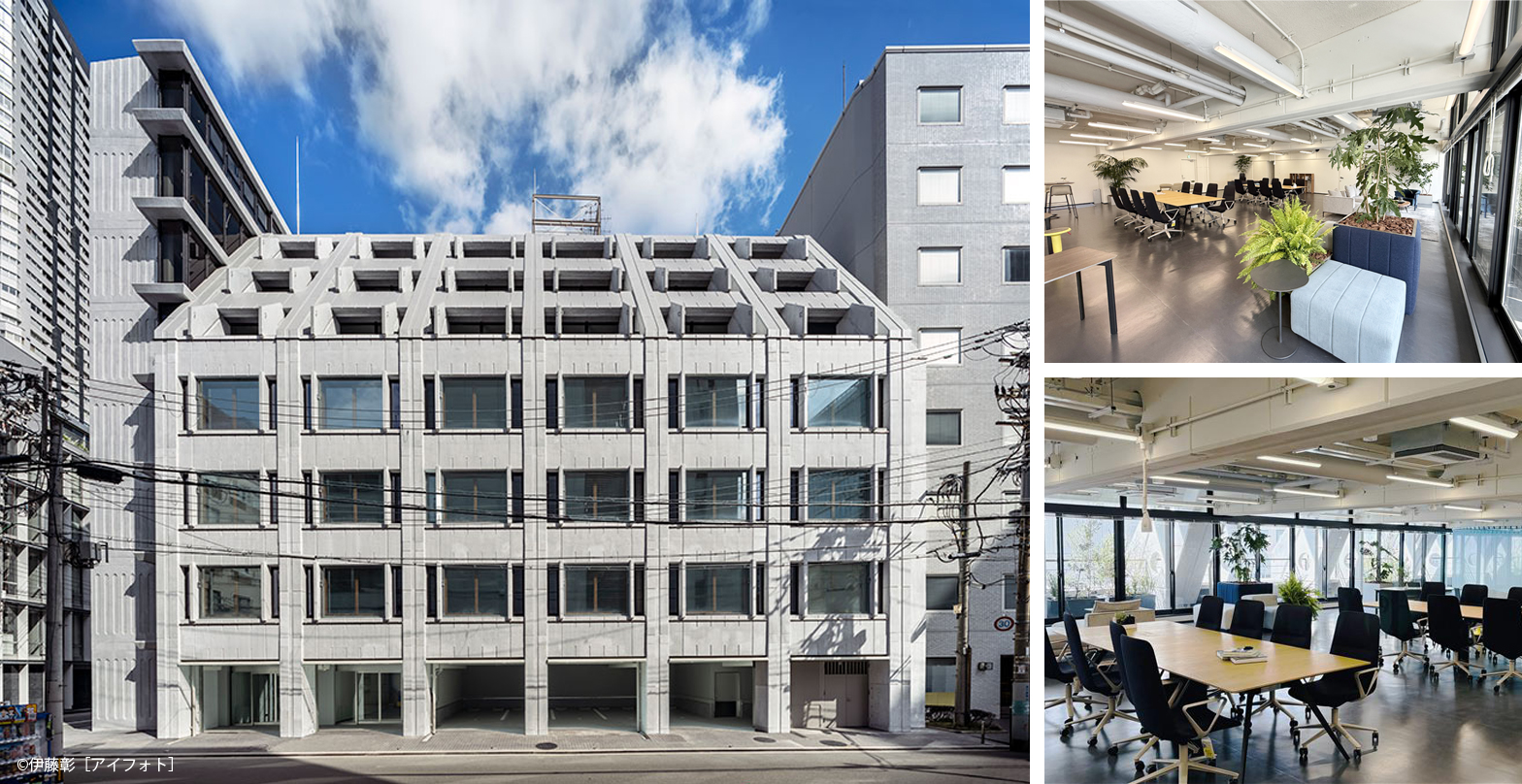
Development Bank of Japan Inc. (Headquarters: Chiyoda-ku, Tokyo; Representative Director President and CEO: Seiji Chika; hereinafter “DBJ”), DBJ Asset Management Co., Ltd. (Headquarters: Chiyoda-ku, Tokyo; Representative Director President and CEO: Shoichiro Kubota; hereinafter “DBJAM”), and Nikken Sekkei Ltd. (Headquarters: Chiyoda-ku, Tokyo; Representative Director President and CEO: Atsushi Omatsu, hereinafter “Nikken Sekkei”) are promoting the “Zenobe (Zero-Energy Renovation)” project, which aims to achieve net-zero in the real estate industry by balancing CO₂ reduction with real estate value through the renovation of existing buildings to improve their environmental performance.As the first phase of the “Zenobe” project, the 57-year-old “Nikken Sekkei Building No. 1” (Chuo Ward, Osaka City) has now been completed.
- Against the backdrop of calls to curb the construction of new buildings and reduce GHG (greenhouse gas) emissions, the DBJ Group and Nikken Sekkei have launched the “Zenobe” project. The project aims to reduce CO2 emissions and enhance property values through environmental retrofits (*1).
- Through the “Zenobe” project, the goal is to visualize the economic value of environmental retrofits and use this information to inform investment decisions, thereby aiming to expand the market for environmental retrofits of existing buildings, which account for the majority of the nation’s office building stock.
- In March 2025, as the first phase of the project, environmental retrofitting of “Nikkken Building No. 1”—utilizing a real estate securitization scheme—was completed, and the building obtained ZEB Ready certification.By combining versatile technologies that are easy to implement in the environmental retrofitting of existing buildings, energy savings were maximized. Annual CO2 emissions are projected to be reduced by approximately 58% (137 metric tons of CO2).
- As a method for evaluating real estate value, we quantify CO₂ reduction amounts and multiply them by the carbon price to estimate the economic viability of investments in environmental retrofits. By visualizing how improvements in environmental performance affect real estate value, we aim to create a new market that positions environmental retrofits as investment opportunities.
- Going forward, we will expand the “Zenobe” network and contribute to the growth of the environmental renovation market and the promotion of net-zero goals in the real estate industry.
Reasons for and Challenges in Environmental Retrofits of Existing Buildings
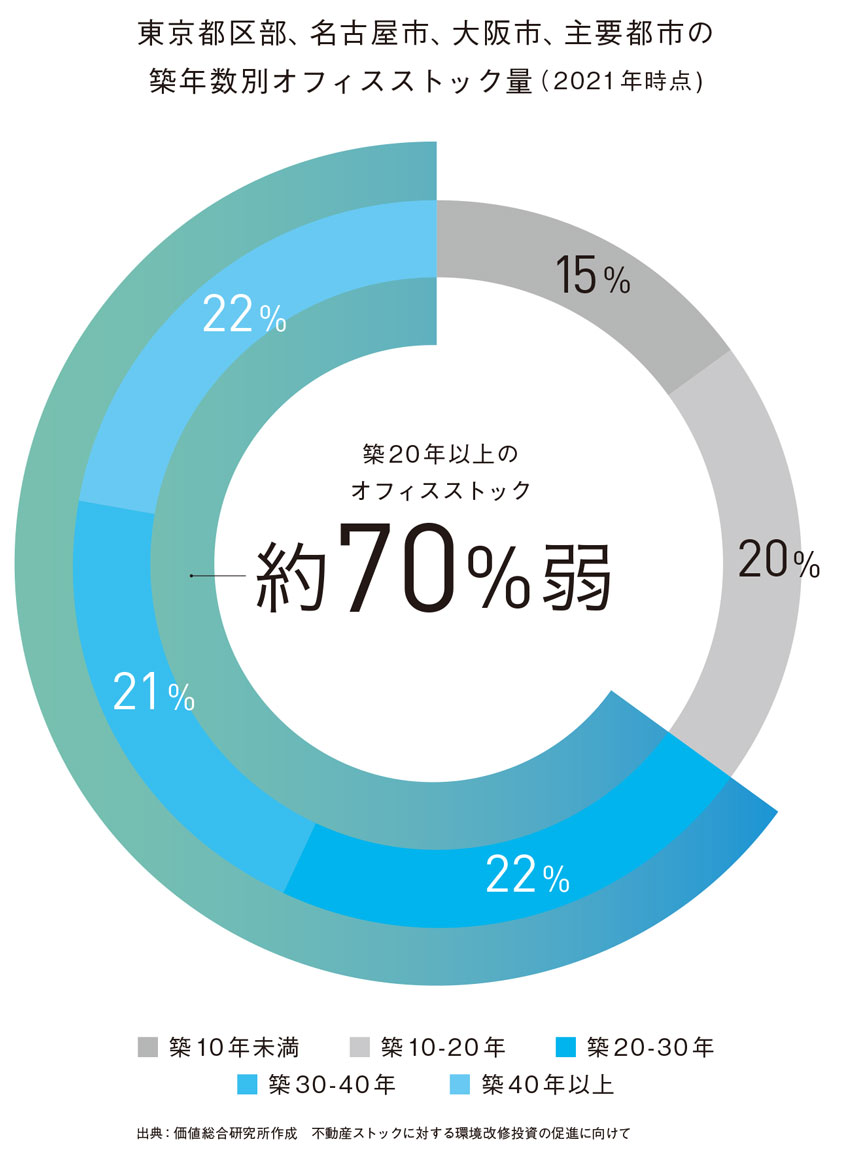
The real estate industry is required to reduce CO2 emissions by 51% by 2030 compared to fiscal year 2013 levels; however,nearly 70% of the office building stock is over 20 years old (*2). Since replacing these buildings with new construction would result in even higher CO2 emissions—and given the impact of soaring construction costs due to recent inflation—environmental retrofits of existing buildings are considered a realistic option for achieving this target.However, there is a challenge in that the environmental benefits of such retrofits—such as CO2 reductions—are not sufficiently reflected in property values, causing many building owners to hesitate to invest.
“Zenobe” Pioneers the Environmental Renovation Market: A New Form of Decarbonization Investment
—Establishing an Environmental Renovation Model That Aims to Balance Environmental Performance and Real Estate Value Enhancement

Against this backdrop, DBJ, DBJAM, and Nikken Sekkei began collaborating in 2022 with the aim of developing and promoting an environmental retrofit model, and in 2024, they launched the “Zenobe” project to promote environmental retrofits of existing buildings.Through this project, the partners aim to create an environmental retrofit model that balances environmental performance with economic value, provide practical case studies, and reflect and visualize the benefits of these retrofits in property values. By doing so, they seek to create a new market that links the real estate sector with the reduction of GHG emissions. This initiative will help promote investment in environmental retrofits and support the development of a sustainable real estate market.
57-Year-Old Building Achieves 58% Reduction in CO2 Emissions Through Environmental Renovations
—The first phase of the “Zenobe” project, “Nikkken Building No. 1,” has been completed in Osaka
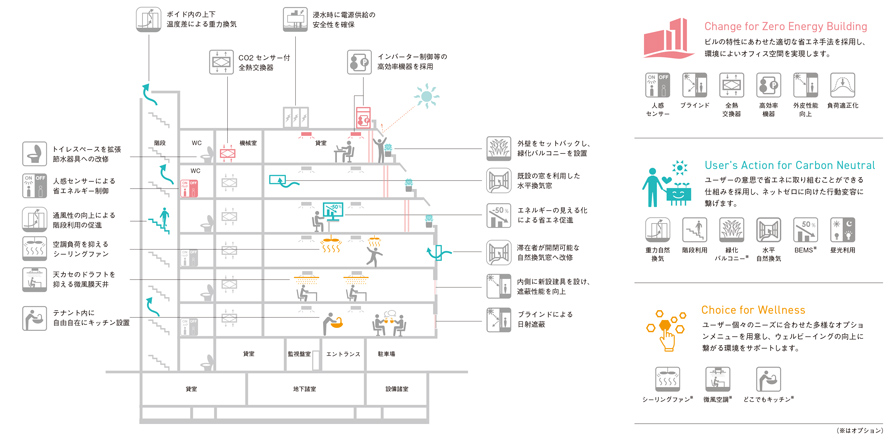
Of the 1,802 office buildings in Osaka City, 1,603—or 89 percent—are small- and medium-sized buildings (*3) that are more than 20 years old.Ahead of the Osaka-Kansai World Expo, the Osaka area is attracting attention as an investment destination. In this context, we carried out environmental retrofitting on the 57-year-old “Nikkken Building No. 1.” This retrofit combined versatile technologies—such as LED lighting, improved HVAC efficiency, and enhanced thermal insulation—prioritizing the adoption of environmentally friendly technologies with high return on investment.The building obtained ZEB Ready certification in 2024, and is expected to reduce CO₂ emissions by approximately 58%—or 137 metric tons of CO₂ annually—compared to a standard building (BEI = 1.0).Furthermore, renovations to improve livability and wellness—such as the installation of natural ventilation windows and the maintenance of ceiling height—were carried out simultaneously. Through these measures, we aimed to encourage behavioral changes toward environmental sustainability while enhancing comfort and well-being.
Achieving Both CO2 Reduction and Increased Property Value Through Environmental Renovations
—Verifying the economic viability of investments by factoring in CO2 reduction effects to visualize the increase in property value resulting from environmental retrofits
To visualize the return on investment from environmental retrofits, we estimated property value and investment profitability by multiplying CO₂ reduction amounts by the carbon price. By making the economic benefits of these investments—which are generally viewed as additional costs—visible, this approach enables building owners and investors to use this information as one factor in their investment decisions.
At Nikken Building No. 1, we confirmed that implementing environmental retrofits equivalent to the ZEB Ready standard resulted in a measurable increase in property value due to CO2 reduction effects.
At Nikken Building No. 1, we confirmed that implementing environmental retrofits equivalent to the ZEB Ready standard resulted in a measurable increase in property value due to CO2 reduction effects.
Team “Zenobe” Collaborates with Stakeholders to Decarbonize the Real Estate Industry
Going forward, we plan to expand the number of companies participating in the “Zenobe” project and strengthen our efforts to promote environmental retrofits. Achieving net-zero in the real estate industry requires the cooperation of a wide range of stakeholders, including those in the real estate and construction sectors, government agencies, and financial institutions.Moving forward, DBJ, DBJAM, and Nikken Sekkei will leverage their respective roles, engage in dialogue with various stakeholders, and pool expertise from diverse sectors and industries. By expanding the “Zenobe” network to promote environmental retrofits of existing buildings, we will contribute to achieving the real estate industry’s 2030 CO₂ reduction targets.
To achieve the 2050 net-zero target, we aim to further accelerate the decarbonization of the real estate industry by working to expand the number of companies that endorse and cooperate with “Zenobe.”
To achieve the 2050 net-zero target, we aim to further accelerate the decarbonization of the real estate industry by working to expand the number of companies that endorse and cooperate with “Zenobe.”
Received the “Selection Committee Chair’s Award” in the “FY2024 Best Practices” category of the 21st Century Financial Conduct Principles
—Recognized for promoting environmental improvements and driving market transformation
The “Zenobe” project received the “Selection Committee Chair’s Award” in the “FY2024 Best Practice Awards.” This award recognizes outstanding initiatives addressing environmental and social challenges, and the project was highly commended for its efforts to develop and promote a model for environmental retrofits aimed at achieving net-zero in the real estate industry. In particular, the project was commended for its approach to collaborating with various stakeholders to demonstrate the cost-effectiveness of environmental retrofits, as well as for prioritizing dialogue with building owners and tenants and adopting designs that encourage behavioral changes among tenants themselves.Additionally, the selection committee cited the project’s potential to transform societal perceptions of existing buildings by promoting the visualization of environmental value in the real estate market. Building on this award, the “Zenobe” project aims to further expand the market for environmental retrofits and contribute to the real estate industry’s achievement of net-zero.
*1: In a joint survey released in June 2023, the “Zenobe” project team defined “environmental retrofitting” as follows:“It refers to the entirety of renovation work aimed at enhancing a building’s environmental performance (i.e., performance related to environmental considerations such as energy efficiency) and transforming it into an office building that is more environmentally friendly than its current state, while taking into account the building’s unique characteristics.”
*2: From the 46th Energy Conservation Subcommittee meeting, “Policies, Challenges, and Requests Regarding Energy Conservation and Renewable Energy Initiatives for Achieving Carbon Neutrality in the Real Estate Industry” (September 3, 2024)
*3: From Xymax Real Estate Research Institute, “Office Pyramid 2025: Tokyo’s 23 Wards and Osaka City” (January 15, 2025)
*1: In a joint survey released in June 2023, the “Zenobe” project team defined “environmental retrofitting” as follows:“It refers to the entirety of renovation work aimed at enhancing a building’s environmental performance (i.e., performance related to environmental considerations such as energy efficiency) and transforming it into an office building that is more environmentally friendly than its current state, while taking into account the building’s unique characteristics.”
*2: From the 46th Energy Conservation Subcommittee meeting, “Policies, Challenges, and Requests Regarding Energy Conservation and Renewable Energy Initiatives for Achieving Carbon Neutrality in the Real Estate Industry” (September 3, 2024)
*3: From Xymax Real Estate Research Institute, “Office Pyramid 2025: Tokyo’s 23 Wards and Osaka City” (January 15, 2025)
Contact information for inquiries regarding this press release
株式会社日本政策投資銀行 アセットファイナンス部 電話番号 03-3244-1714
DBJアセットマネジメント株式会社 不動産運用部 電話番号 03-3241-5387
株式会社日建設計 広報室 電話番号 03-5226-3030
DBJアセットマネジメント株式会社 不動産運用部 電話番号 03-3241-5387
株式会社日建設計 広報室 電話番号 03-5226-3030
Reference Materials
<Benefits of Environmental Improvements>
ZEB Ready Certification Obtained
—Achieved approximately a 58% reduction in CO2 emissions through the use of general-purpose technologies
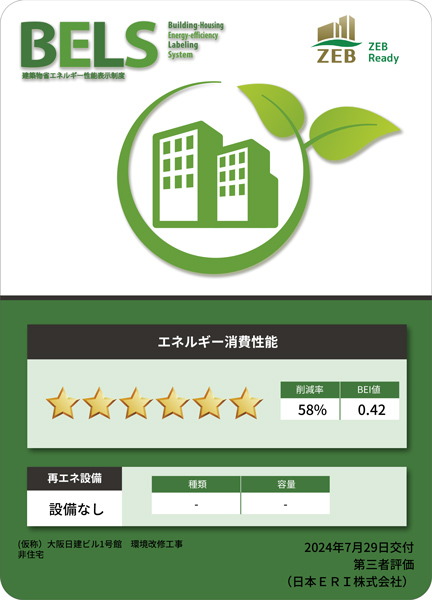
Through environmental improvements that combined versatile technologies, this project obtained “ZEB Ready” certification under the Building-Housing Energy-efficiency Labeling System (BELS) in July 2024.These environmental retrofits demonstrate the potential to achieve CO₂ reduction effects above a certain threshold in future retrofits as well, without relying on any specific technology.Furthermore, as a result of these renovations, Nikken Building No. 1 is expected to achieve an annual CO₂ reduction of 137 metric tons—a reduction of approximately 58% compared to a standard building (BEI = 1.0) (*Estimated by Nikken Sekkei).
Air Conditioning Downsizing…High-Efficiency Air Conditioning and Ventilation Systems
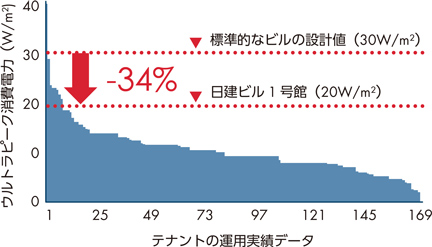
- We analyzed tenant energy consumption in other cases and noted that more than 95% of tenants operate at 20 W/m² or less.
- We have adopted a high-efficiency multi-package air conditioning system for buildings that supports both cooling and heating, thereby optimizing the supply of necessary energy.
- We enhanced the thermal insulation of the building envelope and reassessed the heat generated by indoor equipment and lighting.
- As a result, excessive air-conditioning loads are reduced, allowing for a reduction in total capacity of approximately 40% compared to existing air-conditioning systems. This helps optimize energy consumption and contributes to reducing CO2 emissions.
Improving Lighting Efficiency…Optimal Placement of LED Lighting
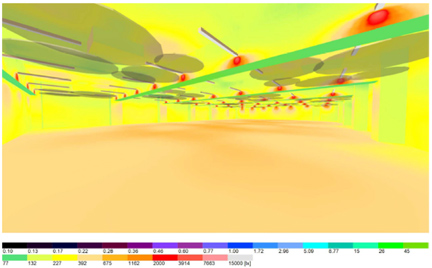
- Optimal placement of LED lighting achieves 500 lux at approximately 5 W/m². Additionally, further energy savings are achieved through brightness-sensing control and initial illuminance correction control.
- The lighting system features a mechanism that allows the light source to rotate up and down, enabling a lighting design that optimally controls the perceived brightness of the room. This maximizes energy efficiency without compromising comfort.
- As a result, electricity consumption per square meter is reduced by approximately 27% compared to a standard building (*Estimated by Nikken Sekkei). This contributes not only to reducing the lighting load but also to cutting CO2 emissions.
Improved Thermal Insulation…Double-Skin Construction Using Wooden Joinery
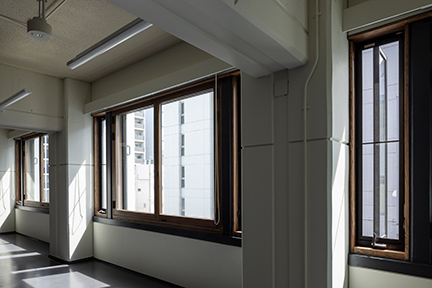
- The combination of interior insulation and inner sashes creates a double-skin structure, improving the thermal performance of the building envelope.
- For interior insulation, sprayed polyurethane foam insulation is used on the roof and exterior walls.
- The inner sashes feature Low-E double-pane glass and wooden frames. This not only enhances solar shading but also adds to the comfort of the space thanks to the wood.
- As a result, the BPI (Building Palstar Index *3) value, which was 1.41 prior to the renovation, was improved to 0.72. Improved insulation has reduced the air conditioning load and enhanced energy efficiency.
Natural Ventilation System
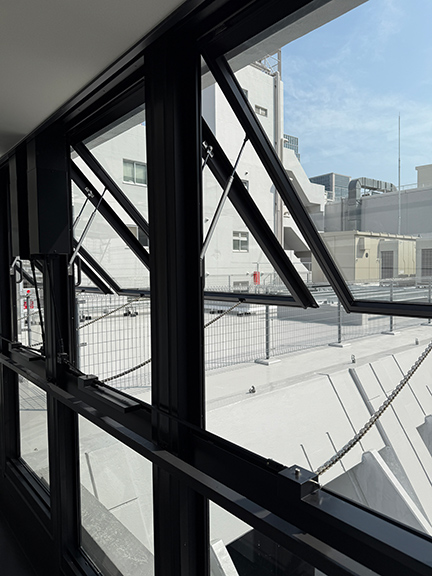
- Gravity-based natural ventilation using a stairwell shaft is employed.
- Replaced existing fixed windows with openable windows. Additionally, a system was introduced to encourage behavioral change, prompting residents to open the windows when the indoor lights are turned on.
- As a result, the workspace maintains a comfortable temperature range during the interim period without the need for air conditioning. This helps reduce energy consumption for heating and cooling and contributes to lowering CO2 emissions.
<Visualizing the Economic Value of Environmental Improvements>
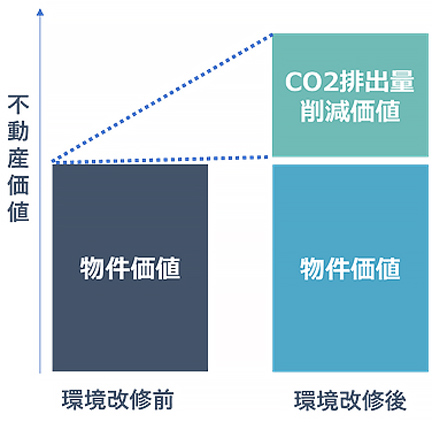
To evaluate the economic viability of environmentally conscious investments, we calculate and verify the results using a method that converts the energy savings—calculated as the difference between the target property’s energy consumption and the baseline BEI (Building Energy Index)—into CO₂ reductions and multiplies that figure by the carbon price. This approach converts environmental indicators into economic indicators and quantitatively visualizes the investment returns from environmental retrofits, enabling these metrics to serve as a reference for investment decisions.
Furthermore, starting in fiscal year 2024, DBJ will begin a pilot program to introduce a new methodology for evaluating the environmental performance and economic viability of green retrofits, which combines CO₂ reduction effects with a carbon price. We plan to continue strengthening our engagement with stakeholders, including investors.
By establishing a system that allows for the quantitative assessment of the economic value of environmental retrofits, we expect this approach to serve as one of the factors building owners consider when making investment decisions. In particular, even for existing buildings where obtaining environmental certification is difficult, we aim to broaden the range of investment options available to building owners by clearly demonstrating the economic benefits of environmental retrofits, thereby promoting investment in such projects.
Furthermore, starting in fiscal year 2024, DBJ will begin a pilot program to introduce a new methodology for evaluating the environmental performance and economic viability of green retrofits, which combines CO₂ reduction effects with a carbon price. We plan to continue strengthening our engagement with stakeholders, including investors.
By establishing a system that allows for the quantitative assessment of the economic value of environmental retrofits, we expect this approach to serve as one of the factors building owners consider when making investment decisions. In particular, even for existing buildings where obtaining environmental certification is difficult, we aim to broaden the range of investment options available to building owners by clearly demonstrating the economic benefits of environmental retrofits, thereby promoting investment in such projects.
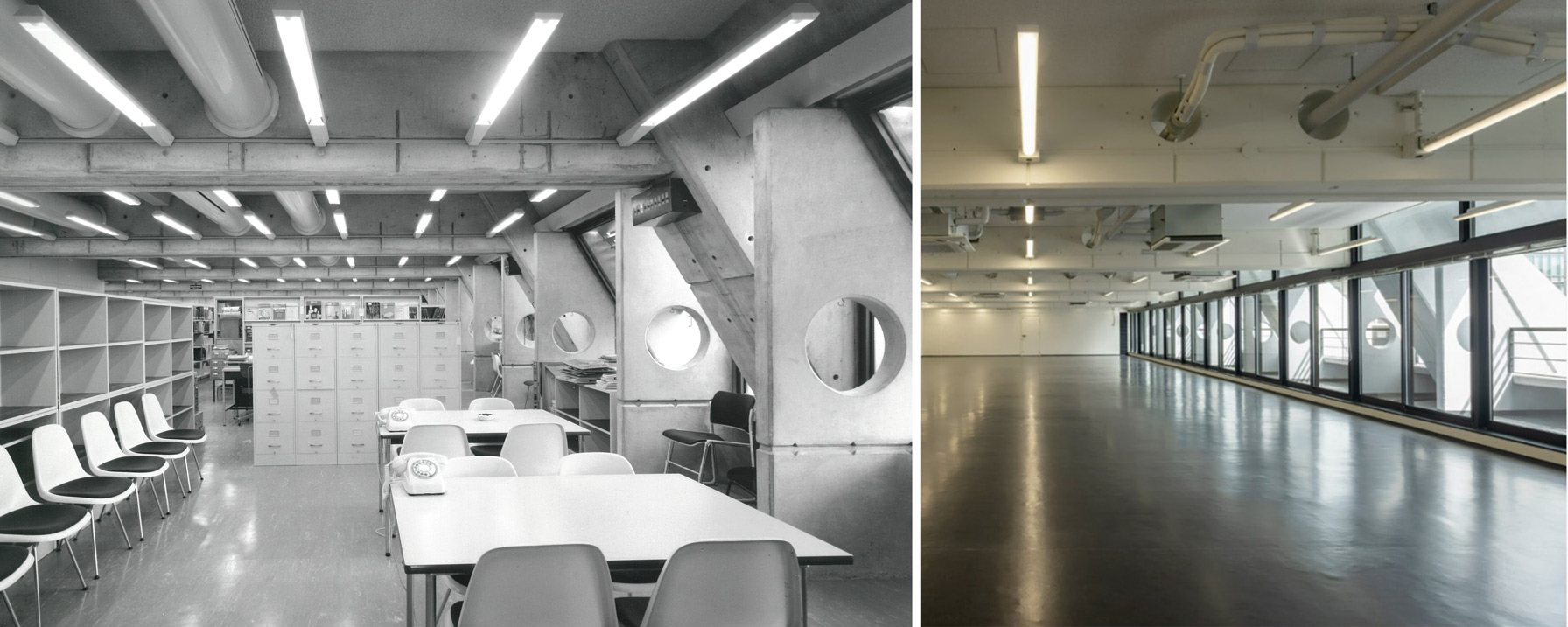 Left: The office at the time of completion
Right: High-insulation windows were installed to ensure a comfortable indoor environment while providing access to the outdoor space. Features such as a garden hose outlet on the balcony demonstrate a commitment to convenience and well-being.
About the Development Bank of Japan, Inc.
DBJ is a government-affiliated financial institution that provides a wide range of services—including advisory, knowledge-sharing, and asset management—to flexibly meet customer needs, starting with its “Integrated Investment and Lending Services,” which combine equity investment and lending.Its predecessors were the Japan Development Bank and the Hokkaido-Tohoku Development Corporation, both established in 1951 to support postwar reconstruction. Since then, DBJ has been committed to its mission of solving the challenges faced by its clients and society, and contributing to the sustainable development of Japan and the world through relentless exploration of new frontiers in finance.
About DBJ Asset Management Co., Ltd.
DBJ Asset Management is an asset management company within the DBJ Group that was established in 2006 with the aim of stimulating domestic capital flows and contributing to the development of financial and capital markets.DBJAM focuses primarily on three sectors—real estate, private equity, and infrastructure—and, drawing on DBJ’s comprehensive financial strength, provides institutional investors with high-quality investment opportunities and asset management services.
About Nikken Sekkei Ltd.
Nikken Sekkei is a professional services firm engaged in architectural and civil engineering design and supervision, urban design, and related survey, planning, and consulting services.For over 120 years since our founding in 1900, we have been committed to creating value through “Social and Environmental Design,” which seeks solutions to both apparent and latent social issues, in order to meet the needs of society and the diverse requests of our clients.We have been involved in a wide range of projects in Japan, China, ASEAN, and the Middle East, and in recent years have expanded our operations to India and Europe.
SHARE