

Transforming the Value of Urban Green Spaces from “Perception” to “Metrics”
Nikken Sekkei Develops “Green Ruler®: Social Value Edition”
Visualizing the Impact of Urban Green Spaces on Human Behavior and Experiences Through Five Indicators
PRESS RELEASE
2026.09.14
Nikken Sekkei Ltd. (Headquarters: Chiyoda-ku, Tokyo; Representative Director President and CEO: Atsushi Omatsu; hereinafter “Nikken Sekkei”) has developed a method called “The Green Ruler” to evaluate and visualize the impact of urban green spaces on human behavior and experiences.®We have developed the “Social Value Edition.” By utilizing pedestrian flow data, green space coverage rates, visitor data, and social media data, we capture the social value of urban green spaces based on five evaluation indicators: “Increased Interaction and Time Spent,” “Improved Well-being,” “Promotion of Urban Mobility,” “Enhanced Regional Appeal,” and “Improved Quality of Life.”
Furthermore, we applied this methodology to “GRAND GREEN OSAKA” to analyze trends observed in people’s time spent in green spaces, their movement through them, the geographic distribution of visitors’ places of residence, and their evaluations of urban spaces. Note that the “Social Value Edition” is part of the “Green Yardstick,” which assesses the value of urban green spaces from three perspectives: environmental, social, and economic.®"This is the second installment, following the 'Environmental Value Edition' published in 2024."
Furthermore, we applied this methodology to “GRAND GREEN OSAKA” to analyze trends observed in people’s time spent in green spaces, their movement through them, the geographic distribution of visitors’ places of residence, and their evaluations of urban spaces. Note that the “Social Value Edition” is part of the “Green Yardstick,” which assesses the value of urban green spaces from three perspectives: environmental, social, and economic.®"This is the second installment, following the 'Environmental Value Edition' published in 2024."
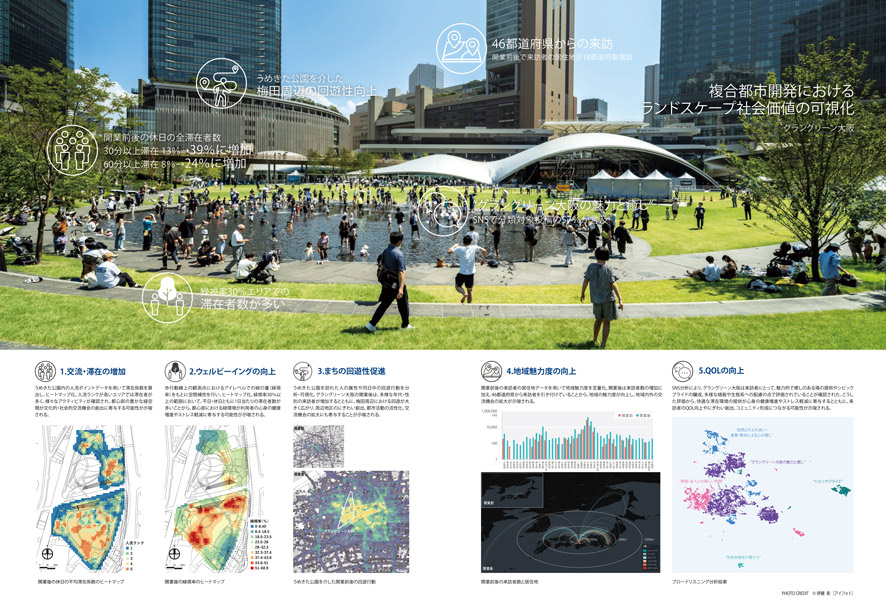
Urban green spaces have long been considered a source of various social values. However, while these values are often discussed in qualitative terms, methods for objectively evaluating and visualizing them by focusing on human behavior and experiences have not yet been fully established. Nikken Sekkei has addressed this issue by developing the “Green Yardstick”®We have developed the “Social Value Edition.” This methodology utilizes observational data—such as pedestrian flow data, green visibility rates, visitor data, and social media data—to objectively and quantitatively evaluate and visualize the social value provided by urban green spaces.
*In this press release, the terms “green,” “greening,” and “greenery” are used to refer not only to physically increasing the number of plants—such as through rooftop and wall greening—but also to the creation of green, open urban spaces that contribute to environmental conservation and the realization of a sustainable society.
*In this press release, the terms “green,” “greening,” and “greenery” are used to refer not only to physically increasing the number of plants—such as through rooftop and wall greening—but also to the creation of green, open urban spaces that contribute to environmental conservation and the realization of a sustainable society.
Background of the Policy’s Development
"The Green Ruler"®Following the first installment, “Environmental Value Edition,” in which Nikken Sekkei evaluated and visualized the environmental value provided by urban green spaces, the firm has now developed a new “Social Value Edition” to capture the value of urban green spaces from a more multifaceted perspective.In addition to environmental value, by quantitatively assessing changes reflected in people’s behaviors and experiences—such as social interaction, time spent in green spaces, physical and mental health, urban accessibility, and attachment to the community—the firm aims to capture the value of green spaces from an even more multifaceted perspective and utilize these insights to inform decision-making in urban planning and community development.
"The Green Ruler"®Features of the “Social Value” Section
A key feature of this study is its use of observational data to examine the impact of urban green spaces on people’s behavior and experiences.
Based on prior research and insights from both Japan and abroad, we have established five evaluation indicators: “increased interaction and time spent in the area,” “improved well-being,” “promotion of urban mobility,” “enhanced regional appeal,” and “improved quality of life (QOL).”By combining observational data suitable for gauging social value—such as pedestrian flow data, green space coverage rates, visitor data, and social media data—we aim to evaluate and visualize the social value generated by urban green spaces from multiple perspectives. We further aim to utilize these results in the planning, development, operation, and management of urban green spaces.
Based on prior research and insights from both Japan and abroad, we have established five evaluation indicators: “increased interaction and time spent in the area,” “improved well-being,” “promotion of urban mobility,” “enhanced regional appeal,” and “improved quality of life (QOL).”By combining observational data suitable for gauging social value—such as pedestrian flow data, green space coverage rates, visitor data, and social media data—we aim to evaluate and visualize the social value generated by urban green spaces from multiple perspectives. We further aim to utilize these results in the planning, development, operation, and management of urban green spaces.
"The Green Ruler"®"Social Value Edition": 5 Evaluation Metrics
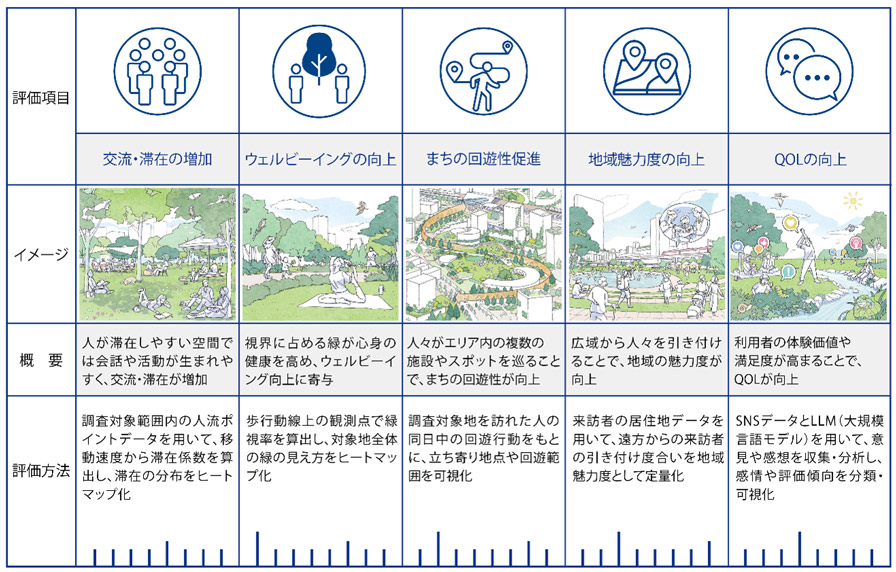 "The Green Ruler"®Five Evaluation Metrics in the “Social Value” Section
"The Green Ruler"®Apply the "Social Value" section to GRAND GREEN OSAKA
At Nikken Sekkei, the "Green Ruler"®Using the “Social Value” section, we evaluated and visualized the social value created by urban green spaces, focusing on “GRAND GREEN OSAKA,” a large-scale mixed-use development centered around an urban park.As a result, we used multiple sets of observational data to identify changes and trends in people’s behaviors and experiences across five evaluation indicators: social interaction and time spent in the park, well-being, accessibility, community appeal, and quality of life (QOL).
1. Increased Exchange and Visits
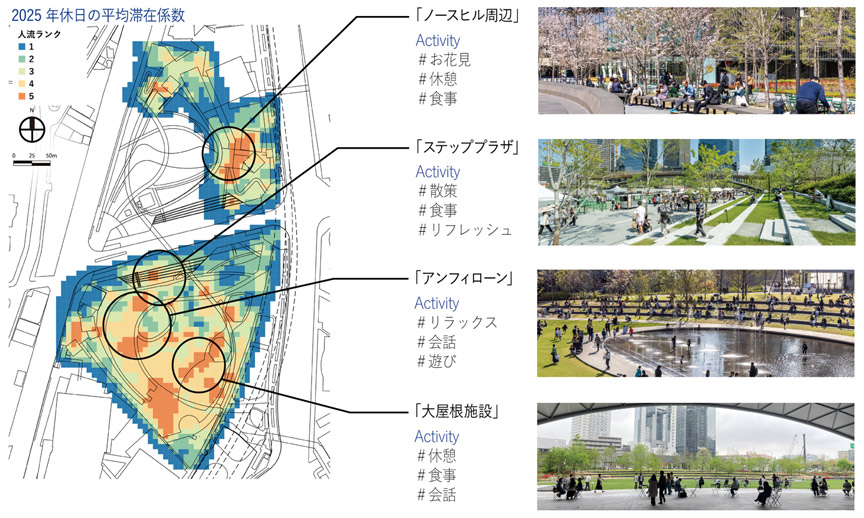
Foot Traffic Data※1We used this data to analyze how people spend time and interact within the park.
The distribution of the “dwell time coefficient”—calculated based on the movement speed in the pedestrian flow data—showed that people tended to linger in areas such as the “North Hill area,” “Step Plaza,” “Lawn Plaza,” and “Grand Roof Facility” within Umekita Park, where a variety of activities—including resting, eating, conversing, playing, and viewing cherry blossoms—were observed.※1.
It was confirmed that urban green spaces function as places that support people’s diverse ways of spending time and interacting with one another.
The distribution of the “dwell time coefficient”—calculated based on the movement speed in the pedestrian flow data—showed that people tended to linger in areas such as the “North Hill area,” “Step Plaza,” “Lawn Plaza,” and “Grand Roof Facility” within Umekita Park, where a variety of activities—including resting, eating, conversing, playing, and viewing cherry blossoms—were observed.※1.
It was confirmed that urban green spaces function as places that support people’s diverse ways of spending time and interacting with one another.
2. Improving Well-Being
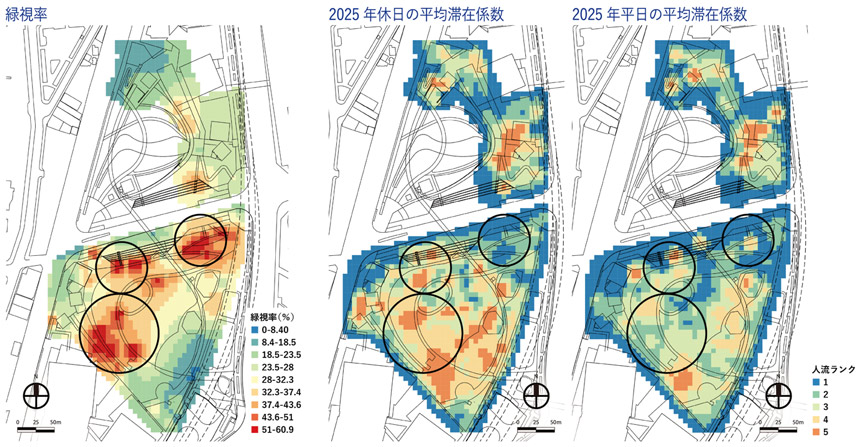
We analyzed the relationship between the “green visibility ratio”—which indicates the proportion of greenery in a person’s field of vision—and the number of people present in an area. We found that areas with a green visibility ratio of 30% or higher tend to have higher numbers of people present on both weekdays and weekends. This suggests that green spaces create a comfortable environment for visitors, contributing to their well-being and improving their physical and mental health.
3. Promoting Walkability in the City
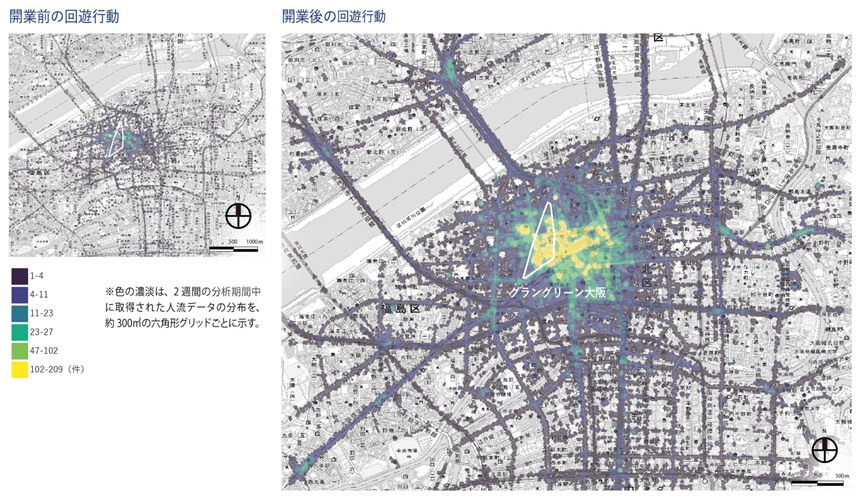
Foot Traffic Data※1We used [method] to analyze visitor movement patterns originating from the park. After the park opened, we confirmed that the range of movement around the Umeda area had expanded, with visitors of diverse ages and genders moving into the surrounding commercial districts. The analysis demonstrated that the green space centered on the park generates a flow of people to the surrounding areas, contributing to the vibrancy of the entire city and the revitalization of urban activity.
4. Enhancing the Region's Appeal
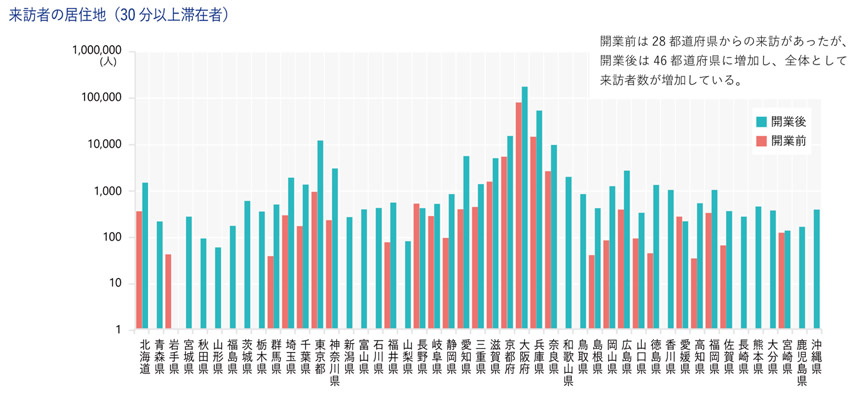
Data on Visitors' Places of Residence※2An analysis revealed that, while visitors were confirmed to have come from 28 prefectures prior to opening, this number expanded to 46 prefectures after opening. In addition, the Regional Attractiveness Index※3It was confirmed that visitor numbers have also increased, and there is a growing trend toward attracting visitors from a wider area. This suggests that urban green spaces are contributing to enhancing the region’s appeal, attracting visitors from beyond the local area, and creating opportunities for interaction between residents and visitors.
5. Improving Quality of Life
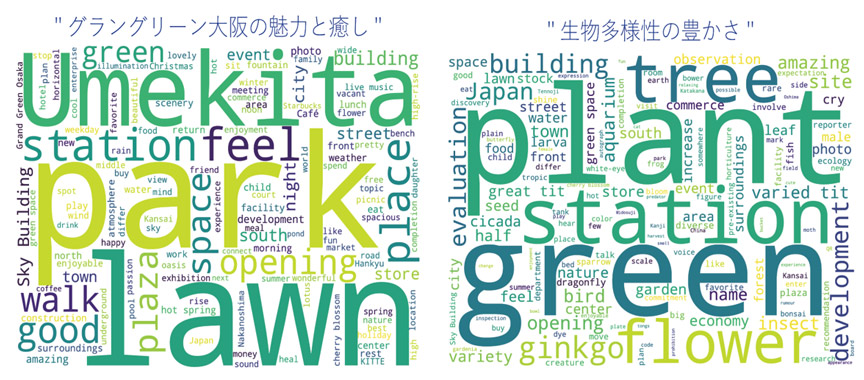
Analysis of 11,965 social media posts※4As a result, five themes were identified: “The Charm and Healing Power of ‘GRAND GREEN OSAKA’,” “Enjoyable Time with Family and Friends,” “Emotional Healing Through Interaction with Nature, Meals, and Walks,” “Civic Pride,” and “Rich Biodiversity.”Through exploring urban green spaces, we identified positive experiences and perceptions—such as a sense of comfort and healing, time spent with family and friends, interaction with nature, and a sense of attachment to the community—that have the potential to improve quality of life (QOL).
Future developments
 "The Green Ruler"®"Valuation of Urban Green Space"
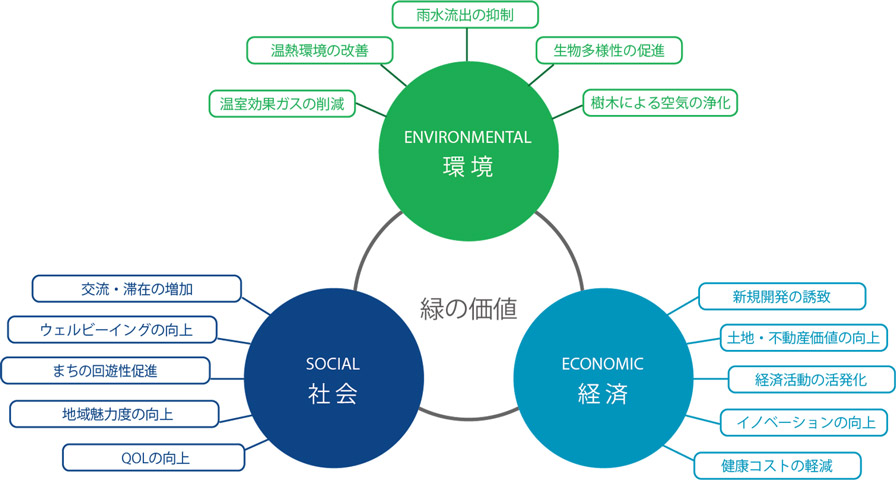
The “Environmental Value” section examines the effects on nature and the environment; the “Social Value” section captures the impact on human behavior and experiences; and the “Economic Value” section, which will be developed in the future, will assess the value contributed to the economy, including economic activity, real estate value, productivity, and innovation.Based on these three aspects—environmental, social, and economic—the “Green Yardstick” enables a comprehensive evaluation of the value of urban green spaces.®" We aim to build [...].
Nikken Sekkei, which champions “Social Environment Design,” will promote initiatives aimed at creating high-quality green spaces and realizing sustainable cities and societies by evaluating and visualizing the value of urban greenery from multiple perspectives and clearly communicating that value to society.
Nikken Sekkei, which champions “Social Environment Design,” will promote initiatives aimed at creating high-quality green spaces and realizing sustainable cities and societies by evaluating and visualizing the value of urban greenery from multiple perspectives and clearly communicating that value to society.
About Nikken Sekkei
Nikken Sekkei is a professional services firm specializing in architectural and civil engineering design and supervision, urban design, and related research, planning, and consulting services. For 120 years since its founding in 1900, Nikken Sekkei has been committed to creating value through "social environment design," which aims to solve both explicit and implicit social issues, in order to meet the demands of society and the diverse needs of its clients. To date, it has been involved in various projects in Japan, China, ASEAN, and the Middle East, and in recent years has expanded into India and Europe.
Contact information regarding this matter
株式会社日建設計 広報室 Tel. 03-5226-3030 e-mail:webmaster@nikken.jp
*1: Agoop Point-Based Population Flow Data
*2: KDDI and Giken Shoji International “KDDI Location Analyzer”
*3: Keisuke Kondo (2024), “Proposal for a Regional Attractiveness Index Based on People Flow Data,” RIETI Policy Discussion Paper Series, 24-P-005, Research Institute of Economy, Trade and Industry (RIETI)
*4: This is based on publicly posted data on social media; Nikken Sekkei Research Institute, Inc. compiled and categorized multiple posts and organized the results as an analysis. It does not constitute a direct quotation from any individual post.
SHARE