

Announcement of the 41st NSRI Forum
SEMINAR/EVENT
2016.11.22
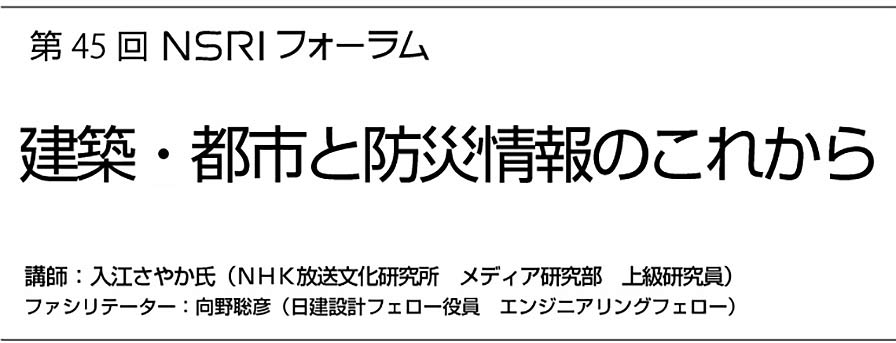
In recent years, Japan has been struck by severe natural disasters, such as the Great East Japan Earthquake, the Kumamoto Earthquake, and the torrential rains in the Kanto and Tohoku regions.Preparing for a major earthquake directly beneath the capital, a massive Nankai Trough earthquake, and large-scale flooding in the Tokyo metropolitan area are also urgent priorities. Accurate and rapid collection, transmission, and sharing of information are essential for encouraging residents to take appropriate evacuation measures and ensuring the prompt restoration of infrastructure.Japan’s disaster prevention information systems have been improved and advanced in response to major disasters such as the 1923 Great Kanto Earthquake, the 1959 Ise Bay Typhoon, the 1995 Great Hanshin-Awaji Earthquake, and the 2011 Great East Japan Earthquake.
In the field of earthquake engineering, monitoring systems that quantify seismic shaking and building damage during earthquakes are becoming increasingly widespread. We will explore how to utilize and integrate disaster prevention information within the contexts of architecture and urban planning. (Facilitator: Toshihiko Mukai)
Date and Time: Thursday, December 15, 2016, 3:00 PM – 5:00 PM
Venue: NSRI Hall
(2nd Floor, Meiji Yasuda Life Iidabashi Building, 2-7-5 Iidabashi, Chiyoda-ku, Tokyo)
Admission: Free
Please include “NSRI Forum” in the subject line and send your name, affiliation, and contact phone number
to the email address or fax number below.
toshikei@nikken.jp
03-5259-0180
*Registration will close once the first 100 registrants have been reached.
Speaker Profile
Sayaka Irie
Senior Researcher, Media Research Division, NHK Broadcasting Culture Research Institute
Graduated from Hitotsubashi University’s Faculty of Social Sciences in 1987.After working in the Science Department at the Yomiuri Shimbun, at the John A. Blume Earthquake Engineering Center at Stanford University in the U.S., and at Japan Research Institute, Ltd., she joined NHK in 2000. She has worked at the Fukuoka and Nagoya Broadcasting Stations, the Social Affairs Department of the News Division, and the Disaster and Weather Center, and has held her current position since 2014.
She has been involved in disaster and disaster prevention reporting since 1992. In addition to covering disaster-stricken areas such as the Southwestern Hokkaido Earthquake (1993), the Great Hanshin-Awaji Earthquake (1995), the Sichuan Earthquake in China (2008), and the Great East Japan Earthquake (2011), she has also worked on NHK Specials“A Megathrust Earthquake Strikes Japan: The Interlinked Tokai, Tonankai, and Nankai Zones” (2005), “Unexpected Shaking Strikes a Nuclear Power Plant: A Report from Kashiwazaki-Kariwa” (2007), and “The Threat of a ‘Major Earthquake on an Active Fault’: How Should Information Disclosure Proceed?” (2008), among others. He is currently conducting research at the Institute for Broadcasting Culture on disaster reporting and the role of disaster prevention information in the multimedia era.
He serves as a director of the Japan Society of Earthquake Engineering and is a certified disaster prevention specialist.
Facilitator
Toshihiko Kono
(Nikken Sekkei Executive Officer, Head of the Urban Development Group, Project Development Division)
Born in Fukuoka Prefecture in 1957; raised in Hokkaido, Ehime, and Kagoshima
After completing his master’s degree at the University of Tokyo in 1982 and working for the Japanese National Railways, he joined Nikken Sekkei in 1987.
As a structural engineer, he has been responsible for the structural design of a wide variety of buildings and has received awards such as the 2000 JSCA Award for the renovation of the Shizuoka Prefectural Government East Building, the 2007 Japan Steel Structure Association Achievement Award for Midland Square, the HOKI Museum (2012 Japan Structural Design Award), and NBF Osaki (2012 Japan Seismic Isolation Association Award). Guided by the mottos “Learning from the past to understand the present” and “The timeless and the trendy,” he approaches structural design by valuing craftsmanship and human connections.
He is a member of the Architectural Institute of Japan, the Japan Association of Structural Engineers, the Japan Structural Engineers Club, and the Japan Institute of Architects.
In the field of earthquake engineering, monitoring systems that quantify seismic shaking and building damage during earthquakes are becoming increasingly widespread. We will explore how to utilize and integrate disaster prevention information within the contexts of architecture and urban planning. (Facilitator: Toshihiko Mukai)
Date and Time: Thursday, December 15, 2016, 3:00 PM – 5:00 PM
Venue: NSRI Hall
(2nd Floor, Meiji Yasuda Life Iidabashi Building, 2-7-5 Iidabashi, Chiyoda-ku, Tokyo)
Admission: Free
Please include “NSRI Forum” in the subject line and send your name, affiliation, and contact phone number
to the email address or fax number below.
toshikei@nikken.jp
03-5259-0180
*Registration will close once the first 100 registrants have been reached.
Speaker Profile
Sayaka Irie
Senior Researcher, Media Research Division, NHK Broadcasting Culture Research Institute
Graduated from Hitotsubashi University’s Faculty of Social Sciences in 1987.After working in the Science Department at the Yomiuri Shimbun, at the John A. Blume Earthquake Engineering Center at Stanford University in the U.S., and at Japan Research Institute, Ltd., she joined NHK in 2000. She has worked at the Fukuoka and Nagoya Broadcasting Stations, the Social Affairs Department of the News Division, and the Disaster and Weather Center, and has held her current position since 2014.
She has been involved in disaster and disaster prevention reporting since 1992. In addition to covering disaster-stricken areas such as the Southwestern Hokkaido Earthquake (1993), the Great Hanshin-Awaji Earthquake (1995), the Sichuan Earthquake in China (2008), and the Great East Japan Earthquake (2011), she has also worked on NHK Specials“A Megathrust Earthquake Strikes Japan: The Interlinked Tokai, Tonankai, and Nankai Zones” (2005), “Unexpected Shaking Strikes a Nuclear Power Plant: A Report from Kashiwazaki-Kariwa” (2007), and “The Threat of a ‘Major Earthquake on an Active Fault’: How Should Information Disclosure Proceed?” (2008), among others. He is currently conducting research at the Institute for Broadcasting Culture on disaster reporting and the role of disaster prevention information in the multimedia era.
He serves as a director of the Japan Society of Earthquake Engineering and is a certified disaster prevention specialist.
Facilitator
Toshihiko Kono
(Nikken Sekkei Executive Officer, Head of the Urban Development Group, Project Development Division)
Born in Fukuoka Prefecture in 1957; raised in Hokkaido, Ehime, and Kagoshima
After completing his master’s degree at the University of Tokyo in 1982 and working for the Japanese National Railways, he joined Nikken Sekkei in 1987.
As a structural engineer, he has been responsible for the structural design of a wide variety of buildings and has received awards such as the 2000 JSCA Award for the renovation of the Shizuoka Prefectural Government East Building, the 2007 Japan Steel Structure Association Achievement Award for Midland Square, the HOKI Museum (2012 Japan Structural Design Award), and NBF Osaki (2012 Japan Seismic Isolation Association Award). Guided by the mottos “Learning from the past to understand the present” and “The timeless and the trendy,” he approaches structural design by valuing craftsmanship and human connections.
He is a member of the Architectural Institute of Japan, the Japan Association of Structural Engineers, the Japan Structural Engineers Club, and the Japan Institute of Architects.
SHARE