

NIKKEN FORUM Webinar to Be Held on October 7
SEMINAR/EVENT
2020.09.08
Instructor: Takaaki Kato(Professor, Institute of Industrial Science, The University of Tokyo; Specially Appointed Professor, Institute of Social Science, The University of Tokyo; Ph.D. in Engineering)
Mr. Kazuo Konagai(Academic Director, International Institute for Landslide Research; Professor Emeritus, University of Tokyo; Doctor of Engineering)
Facilitator: Seiji Nishiyama(Director of Facilities at Nikken Sekkei Civil Architectural Design Department; General Manager; Ph.D. in Engineering)
In recent years, so-called “unforeseen” disasters—such as typhoons, torrential rains, earthquakes, and the spread of infectious diseases—have been occurring with increasing frequency. Historically, we have experienced many catastrophic disasters, and based on that experience, we should have been able to anticipate a certain level of damage and implement countermeasures. So why do these “unforeseen” events occur so frequently?
While global environmental changes are certainly a factor, it is believed that a significant part of the reason lies in the gap in perception between experts and the general public regarding trust in and expectations for disaster prevention technology, as well as limitations related to the timeframe and budget for disaster countermeasures.
In this forum, we will explore strategies to strengthen the resilience of society as a whole, based on the premise that “unforeseen” events will occur. We will also propose a shift from a “zero-risk” mindset to a society that accepts risk, and discuss the feasibility of this shift and the challenges involved in achieving it.
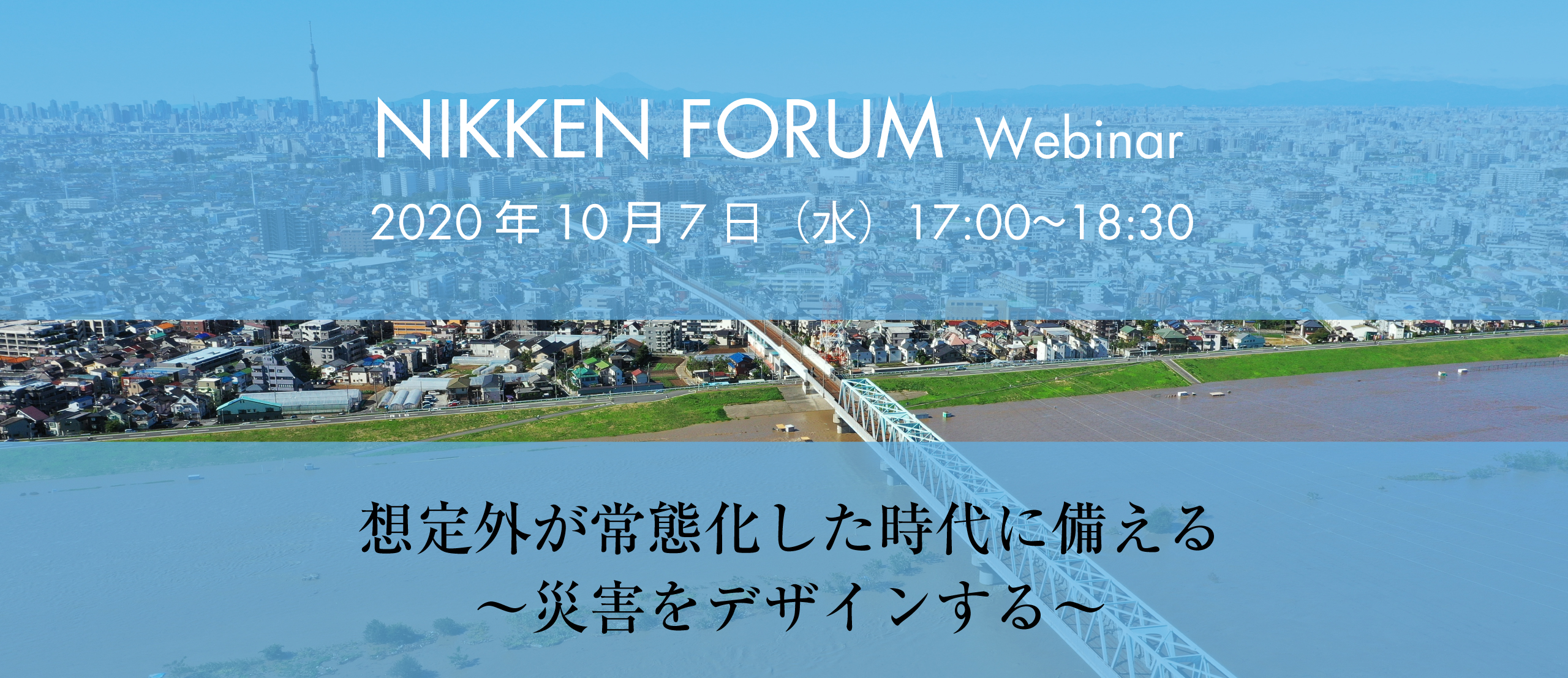
Date and Time: Wednesday, October 7, 2020, 5:00 PM – 6:30 PM
5:00 PM – Introduction: Seiji Nishiyama
5:05 PM – Lecture by Takaaki Kato: “Designing Community Development for a New Era
—Learning from the Past to Innovate: Disaster Prevention and Community Development”
5:35 PM – Lecture by Kazuo Konagai: “How Do We Determine Scenarios?
~‘Man forgets.’ (from Rio Bravo, 1959)~”
6:05 PM– Discussion and Q&A
6:30 PM – End
Admission: Free
Mr. Kazuo Konagai(Academic Director, International Institute for Landslide Research; Professor Emeritus, University of Tokyo; Doctor of Engineering)
Facilitator: Seiji Nishiyama(Director of Facilities at Nikken Sekkei Civil Architectural Design Department; General Manager; Ph.D. in Engineering)
In recent years, so-called “unforeseen” disasters—such as typhoons, torrential rains, earthquakes, and the spread of infectious diseases—have been occurring with increasing frequency. Historically, we have experienced many catastrophic disasters, and based on that experience, we should have been able to anticipate a certain level of damage and implement countermeasures. So why do these “unforeseen” events occur so frequently?
While global environmental changes are certainly a factor, it is believed that a significant part of the reason lies in the gap in perception between experts and the general public regarding trust in and expectations for disaster prevention technology, as well as limitations related to the timeframe and budget for disaster countermeasures.
In this forum, we will explore strategies to strengthen the resilience of society as a whole, based on the premise that “unforeseen” events will occur. We will also propose a shift from a “zero-risk” mindset to a society that accepts risk, and discuss the feasibility of this shift and the challenges involved in achieving it.
Date and Time: Wednesday, October 7, 2020, 5:00 PM – 6:30 PM
5:00 PM – Introduction: Seiji Nishiyama
5:05 PM – Lecture by Takaaki Kato: “Designing Community Development for a New Era
—Learning from the Past to Innovate: Disaster Prevention and Community Development”
5:35 PM – Lecture by Kazuo Konagai: “How Do We Determine Scenarios?
~‘Man forgets.’ (from Rio Bravo, 1959)~”
6:05 PM– Discussion and Q&A
6:30 PM – End
Admission: Free
↓↓Please register via the website below.↓↓

Speaker Profile:
Takaaki Kato (Professor, Institute of Industrial Science, The University of Tokyo; Specially Appointed Professor, Institute of Social Science, The University of Tokyo; Ph.D. in Engineering)
Graduated from the Department of Urban Engineering, University of Tokyo, in 1990.His specialty is regional safety systems. He has been actively involved in community-based disaster-resilient urban development across various regions, primarily from a disaster prevention perspective. He advocates for “disaster-resilient [as well as] community development”—an approach that not only focuses on disaster prevention but also comprehensively plans and implements community development while ensuring disaster prevention is thoroughly addressed. He is exploring new models for community development aimed at achieving a sustainable society.Regarding disaster prevention, he conducts practical research in collaboration with local governments and communities, focusing not only on earthquake disaster prevention but also on developing methods for reducing flood risks in light of climate change, as well as approaches to pre-disaster recovery and recovery preparedness. In addition, he conducts disaster resilience assessments—including urban disaster simulations—and develops and applies “community development support technologies” that integrate these findings into society.The regions involved have received awards such as the Minister of Internal Affairs and Communications Award at the Disaster Prevention Community Development Grand Prix (2013, 2016), the Grand Prix at the Resilience Award 2018 (FY 2018), and the Special Jury Award at the Ministry of Land, Infrastructure, Transport and Tourism’s Advanced Community Development City Competition (FY 2018).
Kazuo Konagai (Academic Representative, International Institute for Slope Disaster Research; Professor Emeritus, The University of Tokyo; Doctor of Engineering)
Specialties: Earthquake Engineering, Geotechnical Disaster Prevention
1975: Graduated from the Department of Civil Engineering, Faculty of Engineering, University of Tokyo; 1977: Completed the Master’s program at the same university
After serving as an Assistant Professor in the Department of Civil Engineering at Nagaoka University of Science and Technology and as an Assistant Professor at the Institute of Industrial Science, The University of Tokyo, he became a Professor at the Institute of Industrial Science, The University of Tokyo in 1997; a Professor at the Institute of Urban Innovation, Yokohama National University in 2013; and assumed his current position in 2017.
His research focuses on topics such as “seismic traces remaining in the ground,” “slope disasters,” “liquefaction assessment,” “damage surveys using drone aerial photography and aerial surveying,” and “interaction between the ground and structures.”
He has received numerous awards, including the Japan Society of Civil Engineers Achievement Award, the Japan Society of Civil Engineers Earthquake Engineering Committee Paper Award, the Japan Geotechnical Society Paper Award, and the Japan Society of Civil Engineers Paper Award.
Takaaki Kato (Professor, Institute of Industrial Science, The University of Tokyo; Specially Appointed Professor, Institute of Social Science, The University of Tokyo; Ph.D. in Engineering)
Graduated from the Department of Urban Engineering, University of Tokyo, in 1990.His specialty is regional safety systems. He has been actively involved in community-based disaster-resilient urban development across various regions, primarily from a disaster prevention perspective. He advocates for “disaster-resilient [as well as] community development”—an approach that not only focuses on disaster prevention but also comprehensively plans and implements community development while ensuring disaster prevention is thoroughly addressed. He is exploring new models for community development aimed at achieving a sustainable society.Regarding disaster prevention, he conducts practical research in collaboration with local governments and communities, focusing not only on earthquake disaster prevention but also on developing methods for reducing flood risks in light of climate change, as well as approaches to pre-disaster recovery and recovery preparedness. In addition, he conducts disaster resilience assessments—including urban disaster simulations—and develops and applies “community development support technologies” that integrate these findings into society.The regions involved have received awards such as the Minister of Internal Affairs and Communications Award at the Disaster Prevention Community Development Grand Prix (2013, 2016), the Grand Prix at the Resilience Award 2018 (FY 2018), and the Special Jury Award at the Ministry of Land, Infrastructure, Transport and Tourism’s Advanced Community Development City Competition (FY 2018).
Kazuo Konagai (Academic Representative, International Institute for Slope Disaster Research; Professor Emeritus, The University of Tokyo; Doctor of Engineering)
Specialties: Earthquake Engineering, Geotechnical Disaster Prevention
1975: Graduated from the Department of Civil Engineering, Faculty of Engineering, University of Tokyo; 1977: Completed the Master’s program at the same university
After serving as an Assistant Professor in the Department of Civil Engineering at Nagaoka University of Science and Technology and as an Assistant Professor at the Institute of Industrial Science, The University of Tokyo, he became a Professor at the Institute of Industrial Science, The University of Tokyo in 1997; a Professor at the Institute of Urban Innovation, Yokohama National University in 2013; and assumed his current position in 2017.
His research focuses on topics such as “seismic traces remaining in the ground,” “slope disasters,” “liquefaction assessment,” “damage surveys using drone aerial photography and aerial surveying,” and “interaction between the ground and structures.”
He has received numerous awards, including the Japan Society of Civil Engineers Achievement Award, the Japan Society of Civil Engineers Earthquake Engineering Committee Paper Award, the Japan Geotechnical Society Paper Award, and the Japan Society of Civil Engineers Paper Award.
SHARE