

Event Co-hosted by Nikken Sekkei and Pacific Consultants
"Prospects for Cities and Regions in the Post-COVID Era" was held.
SEMINAR/EVENT
2021.03.22
On February 18, 2021, Nikken Sekkei and Pacific Consultants co-hosted an event titled “Prospects for Cities and Regions in the Post-COVID Era,”The two companies, which have collaborated to address urban challenges through Transit-Oriented Development (TOD) projects in central Tokyo—such as around Shibuya Station—shared their vision for the direction of transformation required for cities and regions in the post-COVID era.
In Part 1, based on joint research by young and mid-career working members from both companies, the firms presented proposals on “Transformation Required for Cities and Regions: Social Design for the Future.” Transcending specialized fields such as architecture, urban planning, and social infrastructure, and incorporating multifaceted perspectives including energy and smart city initiatives, they presented their vision for future autonomous, decentralized cities across eight themes.
Part 2 featured a panel discussion among three participants: Atsushi Omatsu (Representative Director, Nikken Sekkei; President and CEO President and CEO Executive Officer), Tomoyuki Shigenaga (President and CEO Executive Officer) of Pacific Consultants, and Chiaki Hayashi (Representative Director, Loftwork) as moderator. The discussion began with the two companies—which have collaborated on the Shibuya Station Area Development project—sharing their perspectives on urban development.
In Part 1, based on joint research by young and mid-career working members from both companies, the firms presented proposals on “Transformation Required for Cities and Regions: Social Design for the Future.” Transcending specialized fields such as architecture, urban planning, and social infrastructure, and incorporating multifaceted perspectives including energy and smart city initiatives, they presented their vision for future autonomous, decentralized cities across eight themes.
Part 2 featured a panel discussion among three participants: Atsushi Omatsu (Representative Director, Nikken Sekkei; President and CEO President and CEO Executive Officer), Tomoyuki Shigenaga (President and CEO Executive Officer) of Pacific Consultants, and Chiaki Hayashi (Representative Director, Loftwork) as moderator. The discussion began with the two companies—which have collaborated on the Shibuya Station Area Development project—sharing their perspectives on urban development.
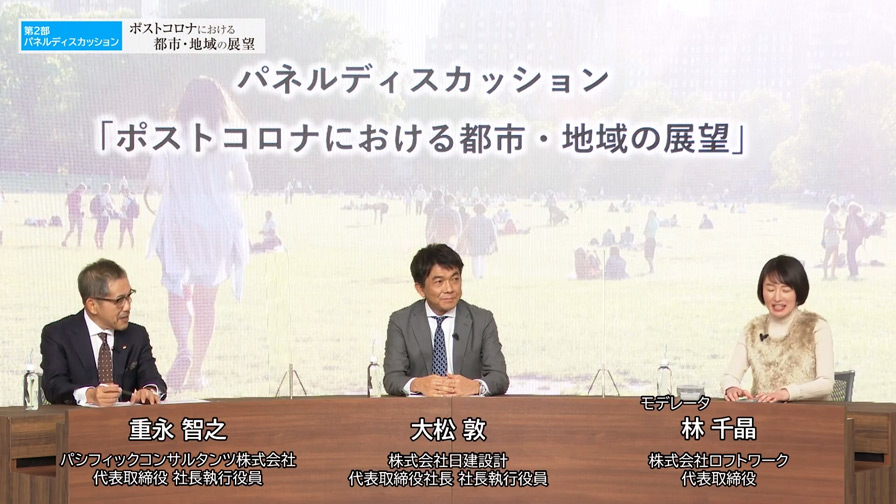 Panel discussion featuring both President and CEO, moderated by Mr. Hayashi, CEO of Loftwork
Work styles are becoming more diverse, and the workplace is evolving into a space for communication.
HayashiWhy did Nikken Sekkei and Pacific Consultants decide to launch a joint research project focused on the post-COVID era?
ShigenagaWe have been collaborating with Nikken Sekkei on the Shibuya Station Area Development project for nearly 20 years. This complex project began with the underground relocation of the Tokyu Toyoko Line and has since involved rerouting the railway and redeveloping the surrounding area. With the shared theme of “How should we shape the city?” we have worked together across the boundaries of architecture and civil engineering.We began research to explore the post-COVID era together, which has now led to this presentation.
OhmatsuIn Shibuya, we have shared the challenge of how to create an attractive town that everyone loves from the very beginning. Now that society is undergoing major changes due to the pandemic, I felt that by working together, we could broaden our perspective and explore the direction in which cities and communities will evolve in the future.
HayashiWhat do you think has changed in cities and communities as a result of the pandemic?
OhmatsuAs noted in the recommendations of Part 1, the first major change has been in where people work. People’s travel patterns have shifted; rather than simply commuting back and forth between the city center and home, they are spending more time in their local neighborhoods.
HayashiIs it a good thing for people to start working from home? Also, what will happen once the COVID-19 pandemic subsides?
OhmatsuThere are some things—such as brainstorming sessions and training junior employees—that are better done in person at the office, while other tasks can be done remotely. The COVID-19 pandemic has made this clear. Since the possibilities for where we work are constantly expanding—beyond just our homes and offices to include shared offices near our local train stations, for example—I don’t think the workplace will ever go back to being limited to the office alone.
ShigenagaThe diversification of work styles has accelerated amid the COVID-19 pandemic. Although our company had a telework policy in place, it had hardly been used until now. However, for people who are raising children or caring for family members, working from home or nearby is more efficient than commuting to the office. Looking ahead to the future of society, I believe it is important to provide tools such as telework and online platforms.
HayashiWhat kind of place will the workplace become for employees in the future?
OhmatsuI don’t think the headquarters will ever disappear. I believe it’s necessary as a place that preserves our employees’ sense of identity and a sense of belonging, as well as the organization’s DNA—for example, by providing a lounge where everyone can enjoy lively discussions together.
ShigenagaHumans are social creatures who need to communicate, so that’s something we must prioritize. Also, since our company handles a lot of public works projects, we have a somewhat formal corporate culture. There are also practical constraints, such as the need to print blueprints, so not everything can be done remotely. However, I don’t think we’ll have to provide a desk and chair for every employee anymore.
OhmatsuI agree that direct communication is important in the workplace. In the Shibuya Station area development project as well, I believe we were able to successfully determine the division of roles and responsibilities by holding face-to-face meetings with stakeholders several times a week.
ShigenagaWe have been collaborating with Nikken Sekkei on the Shibuya Station Area Development project for nearly 20 years. This complex project began with the underground relocation of the Tokyu Toyoko Line and has since involved rerouting the railway and redeveloping the surrounding area. With the shared theme of “How should we shape the city?” we have worked together across the boundaries of architecture and civil engineering.We began research to explore the post-COVID era together, which has now led to this presentation.
OhmatsuIn Shibuya, we have shared the challenge of how to create an attractive town that everyone loves from the very beginning. Now that society is undergoing major changes due to the pandemic, I felt that by working together, we could broaden our perspective and explore the direction in which cities and communities will evolve in the future.
HayashiWhat do you think has changed in cities and communities as a result of the pandemic?
OhmatsuAs noted in the recommendations of Part 1, the first major change has been in where people work. People’s travel patterns have shifted; rather than simply commuting back and forth between the city center and home, they are spending more time in their local neighborhoods.
HayashiIs it a good thing for people to start working from home? Also, what will happen once the COVID-19 pandemic subsides?
OhmatsuThere are some things—such as brainstorming sessions and training junior employees—that are better done in person at the office, while other tasks can be done remotely. The COVID-19 pandemic has made this clear. Since the possibilities for where we work are constantly expanding—beyond just our homes and offices to include shared offices near our local train stations, for example—I don’t think the workplace will ever go back to being limited to the office alone.
ShigenagaThe diversification of work styles has accelerated amid the COVID-19 pandemic. Although our company had a telework policy in place, it had hardly been used until now. However, for people who are raising children or caring for family members, working from home or nearby is more efficient than commuting to the office. Looking ahead to the future of society, I believe it is important to provide tools such as telework and online platforms.
HayashiWhat kind of place will the workplace become for employees in the future?
OhmatsuI don’t think the headquarters will ever disappear. I believe it’s necessary as a place that preserves our employees’ sense of identity and a sense of belonging, as well as the organization’s DNA—for example, by providing a lounge where everyone can enjoy lively discussions together.
ShigenagaHumans are social creatures who need to communicate, so that’s something we must prioritize. Also, since our company handles a lot of public works projects, we have a somewhat formal corporate culture. There are also practical constraints, such as the need to print blueprints, so not everything can be done remotely. However, I don’t think we’ll have to provide a desk and chair for every employee anymore.
OhmatsuI agree that direct communication is important in the workplace. In the Shibuya Station area development project as well, I believe we were able to successfully determine the division of roles and responsibilities by holding face-to-face meetings with stakeholders several times a week.
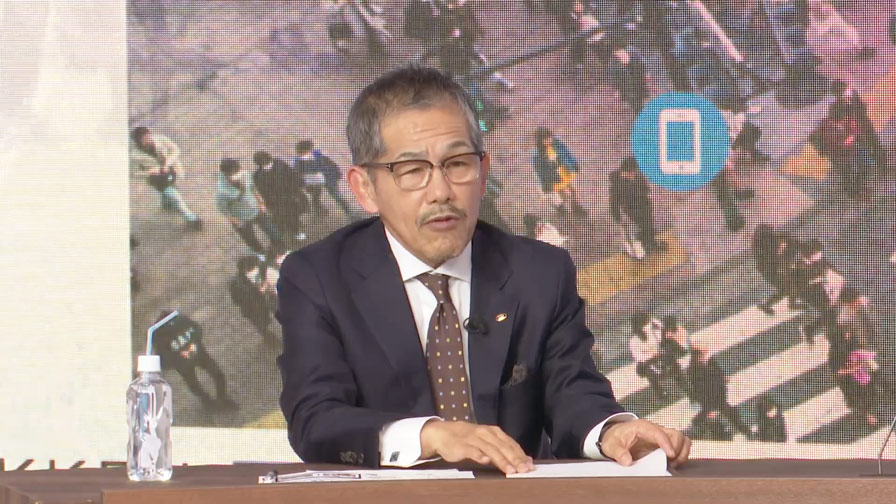 Pacific Consultants, Shigenaga President and CEO Executive Officer
Toward a self-governing, decentralized city tailored to users' needs
HayashiThe recommendations in Part 1 included a concept for public spaces that utilize streets as multipurpose public areas. What will the future hold for proposals regarding the use of public spaces and the entities responsible for implementing them?
OhmatsuUntil now, these spaces have been created and managed by the government, but I think it would be good to establish a user-oriented system that can better understand people’s needs. At SHIBUYA KITAYA PARK, several private companies, including Nikken Sekkei, have established a system for redevelopment and management. I believe we’ll see more examples in the future of the private sector operating public spaces that are better suited to their needs.
HayashiI think it will become possible in the future to make suggestions using smartphone apps and the like. It’s also possible that urban spaces and apps will become even more closely integrated in the future, isn’t it?
OhmatsuThat’s right. With crowdfunding on the rise, I think the day when we can apply that kind of system to parks isn’t too far off. As for apps, we’ll likely be able to monitor in real time where people are, how many there are, and what activities are taking place, and make use of that information.
ShigenagaI believe that if we can dynamically track people’s movements, it will lead to the creation of better spaces. Since last December, in collaboration with SoftBank Corp., we have been compiling statistical data on human mobility called the “National Mobility Statistics.”This data allows us to estimate which modes of transportation and routes people are using, and we provide it for a fee. By utilizing this data, we can identify the purposes of people’s movements and the facilities they need, and I believe we can use this information—along with infrastructure data—to inform the design of urban spaces.
HayashiWhat will the future hold for public spaces in rural areas?
ShigenagaWhile this isn’t limited to rural areas, I believe it’s necessary to build public facilities with disaster prevention in mind.For example, “Mutsuzawa Smart Wellness Town”—which consists of “Roadside Station Mutsuzawa: Tsudoi no Sato,” operated by our company in Mutsuzawa Town, Chiba Prefecture, as well as town-owned housing—has introduced a natural gas-powered cogeneration system that supplies electricity via a microgrid to the hot spring facilities and residential units.Even when the surrounding area lost power during Typhoon No. 15 two years ago, this facility was able to maintain its power supply, drawing significant attention.
OhmatsuThat's local production and consumption of energy, isn't it?
ShigenagaUntil now, we’ve been laying power lines from distant power plants, but given the transmission losses involved—and the fact that small-scale wind power generation and other options are now feasible—I believe energy systems will become more self-sufficient and decentralized.
OhmatsuIn other words, rather than an urban structure where production facilities are located in rural areas to support centralization, what’s needed is autonomous decentralization. As for logistics, if decisions are based solely on economic rationality—such as the idea that it’s cheaper to manufacture in a certain area—it leads to inconvenience when transportation networks fail and logistics come to a standstill. The COVID-19 pandemic made that clear.
HayashiUntil now, GDP has been the primary indicator, but will there be a shift toward placing greater emphasis on measures such as Gross National Happiness (GNH)?
OhmatsuSince we are striving to improve society through architecture and urban planning, I think it would be good to have metrics that are directly linked to the results of our efforts.
ShigenagaIn modern terms, this might be called “prosperity,” but the measures of it are becoming more diverse. Amid this trend, we aim to make Japan a country where people want to live. To that end, “communities” are extremely important, and we need to give serious thought to how we should build them.
OhmatsuUntil now, these spaces have been created and managed by the government, but I think it would be good to establish a user-oriented system that can better understand people’s needs. At SHIBUYA KITAYA PARK, several private companies, including Nikken Sekkei, have established a system for redevelopment and management. I believe we’ll see more examples in the future of the private sector operating public spaces that are better suited to their needs.
HayashiI think it will become possible in the future to make suggestions using smartphone apps and the like. It’s also possible that urban spaces and apps will become even more closely integrated in the future, isn’t it?
OhmatsuThat’s right. With crowdfunding on the rise, I think the day when we can apply that kind of system to parks isn’t too far off. As for apps, we’ll likely be able to monitor in real time where people are, how many there are, and what activities are taking place, and make use of that information.
ShigenagaI believe that if we can dynamically track people’s movements, it will lead to the creation of better spaces. Since last December, in collaboration with SoftBank Corp., we have been compiling statistical data on human mobility called the “National Mobility Statistics.”This data allows us to estimate which modes of transportation and routes people are using, and we provide it for a fee. By utilizing this data, we can identify the purposes of people’s movements and the facilities they need, and I believe we can use this information—along with infrastructure data—to inform the design of urban spaces.
HayashiWhat will the future hold for public spaces in rural areas?
ShigenagaWhile this isn’t limited to rural areas, I believe it’s necessary to build public facilities with disaster prevention in mind.For example, “Mutsuzawa Smart Wellness Town”—which consists of “Roadside Station Mutsuzawa: Tsudoi no Sato,” operated by our company in Mutsuzawa Town, Chiba Prefecture, as well as town-owned housing—has introduced a natural gas-powered cogeneration system that supplies electricity via a microgrid to the hot spring facilities and residential units.Even when the surrounding area lost power during Typhoon No. 15 two years ago, this facility was able to maintain its power supply, drawing significant attention.
OhmatsuThat's local production and consumption of energy, isn't it?
ShigenagaUntil now, we’ve been laying power lines from distant power plants, but given the transmission losses involved—and the fact that small-scale wind power generation and other options are now feasible—I believe energy systems will become more self-sufficient and decentralized.
OhmatsuIn other words, rather than an urban structure where production facilities are located in rural areas to support centralization, what’s needed is autonomous decentralization. As for logistics, if decisions are based solely on economic rationality—such as the idea that it’s cheaper to manufacture in a certain area—it leads to inconvenience when transportation networks fail and logistics come to a standstill. The COVID-19 pandemic made that clear.
HayashiUntil now, GDP has been the primary indicator, but will there be a shift toward placing greater emphasis on measures such as Gross National Happiness (GNH)?
OhmatsuSince we are striving to improve society through architecture and urban planning, I think it would be good to have metrics that are directly linked to the results of our efforts.
ShigenagaIn modern terms, this might be called “prosperity,” but the measures of it are becoming more diverse. Amid this trend, we aim to make Japan a country where people want to live. To that end, “communities” are extremely important, and we need to give serious thought to how we should build them.
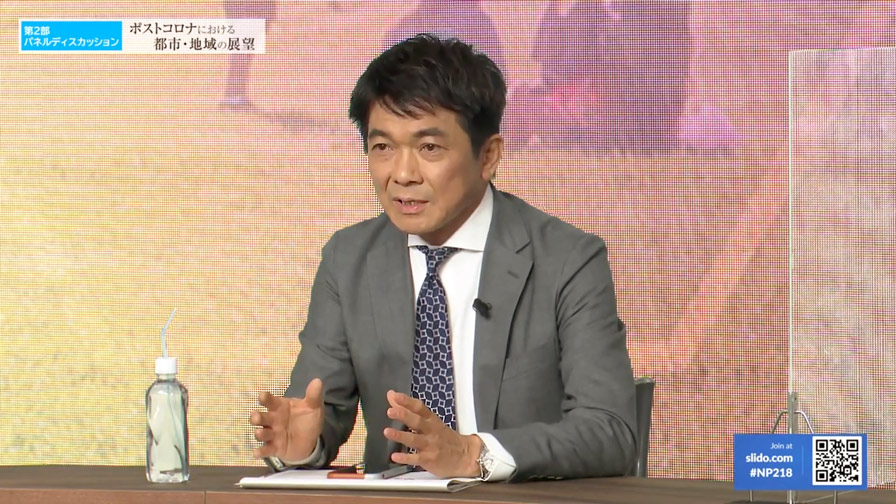 Nikken Sekkei, Ohmatsu President and CEO Executive Officer
Toward a Sustainable, Diverse, and Resilient City
HayashiIt is often said that Japan is a leader in disaster prevention. Could you please share the knowledge and expertise Japan has accumulated to date in the areas of disaster prevention and recovery?
ShigenagaJapan experiences a great many disasters, but if we tried to absorb them all and reduce the risk to zero, it would require an enormous effort. Therefore, rather than facing them head-on, we have no choice but to coexist with them—to let them slip past us smoothly.Even in the reconstruction efforts following the Great East Japan Earthquake, we aimed to create towns that avoided excessive preparedness as much as possible. In that context, collaboration that transcends traditional bureaucratic silos becomes the key. For example, while river embankments are built by river administration agencies, since towns lie beyond them, river administration and urban planning must be considered as a single, integrated whole. I believe such initiatives have finally begun.
Furthermore, in a way that also relates to the use of public spaces, a new direction is emerging: developing these spaces so that the private sector can make effective use of them during normal times, while they function as disaster response hubs during emergencies.
OhmatsuSince it is difficult to fully protect everything from unforeseen disasters, it is essential to reach a solid consensus on what to protect in order to mitigate and prevent disasters.
HayashiHow do you distinguish between what needs to be protected and what doesn't?
OhmatsuOf course, we must protect human lives. Beyond that, in the case of Tokyo, for example, we need to safeguard the functions that the capital serves. To that end, if we distribute those functions across several locations, even if the city center is hit by a disaster, functions such as communicating the situation to the world and serving as a point of contact for receiving aid will continue to operate.
ShigenagaTokyo is home to various critical functions—such as government and finance—that must be protected. If these functions were to be lost due to a disaster, it would lead to major chaos, so it is essential to develop a business continuity plan (BCP) for the city.
Even outside the capital, it is essential to build resilience against disasters. It is crucial for each community to engage in concrete, localized discussions to determine what must be protected at a minimum.
HayashiUntil now, it was generally believed that centralization was efficient and that work productivity increased when employees gathered in an office. Is it new technology that has made decentralization possible?
OhmatsuWhile technology certainly plays a role, I believe the vision of the society we aspire to has changed.
We experienced the collapse of the bubble economy, and the direction society was heading clearly shifted around that time. I believe a similar shift will occur in the future in the wake of the COVID-19 pandemic.
HayashiE-commerce has been growing since the pandemic. As various aspects of life become digitized and move to the cloud, will people increasingly prioritize and choose places that are comfortable and that they enjoy?
ShigenagaI believe that as people’s movements change due to COVID-19, cities will need to become more adaptable. To achieve that, as you mentioned, IT technology is also necessary.Another key factor, I believe, is the ability to develop a unique identity. Right now, no matter where you go in Japan, cities have similar layouts and feature the same kinds of stores. We need to consider urban planning that takes into account each city’s unique characteristics. Through competition among cities, I believe we’ll see the emergence of cities where people can experience each one’s distinct character.
OhmatsuI think it’s like imagining a city that used to be monochrome becoming colorful.
HayashiOne last thing—please share a closing remark for today.
ShigenagaI think it really all comes down to the importance of communication between people. I would like to continue working on community development with that in mind.
OhmatsuToday, I sensed even more possibilities than I had imagined. Through co-creation—including everyone who participated—I felt inspired to help build a vibrant new society.
ShigenagaJapan experiences a great many disasters, but if we tried to absorb them all and reduce the risk to zero, it would require an enormous effort. Therefore, rather than facing them head-on, we have no choice but to coexist with them—to let them slip past us smoothly.Even in the reconstruction efforts following the Great East Japan Earthquake, we aimed to create towns that avoided excessive preparedness as much as possible. In that context, collaboration that transcends traditional bureaucratic silos becomes the key. For example, while river embankments are built by river administration agencies, since towns lie beyond them, river administration and urban planning must be considered as a single, integrated whole. I believe such initiatives have finally begun.
Furthermore, in a way that also relates to the use of public spaces, a new direction is emerging: developing these spaces so that the private sector can make effective use of them during normal times, while they function as disaster response hubs during emergencies.
OhmatsuSince it is difficult to fully protect everything from unforeseen disasters, it is essential to reach a solid consensus on what to protect in order to mitigate and prevent disasters.
HayashiHow do you distinguish between what needs to be protected and what doesn't?
OhmatsuOf course, we must protect human lives. Beyond that, in the case of Tokyo, for example, we need to safeguard the functions that the capital serves. To that end, if we distribute those functions across several locations, even if the city center is hit by a disaster, functions such as communicating the situation to the world and serving as a point of contact for receiving aid will continue to operate.
ShigenagaTokyo is home to various critical functions—such as government and finance—that must be protected. If these functions were to be lost due to a disaster, it would lead to major chaos, so it is essential to develop a business continuity plan (BCP) for the city.
Even outside the capital, it is essential to build resilience against disasters. It is crucial for each community to engage in concrete, localized discussions to determine what must be protected at a minimum.
HayashiUntil now, it was generally believed that centralization was efficient and that work productivity increased when employees gathered in an office. Is it new technology that has made decentralization possible?
OhmatsuWhile technology certainly plays a role, I believe the vision of the society we aspire to has changed.
We experienced the collapse of the bubble economy, and the direction society was heading clearly shifted around that time. I believe a similar shift will occur in the future in the wake of the COVID-19 pandemic.
HayashiE-commerce has been growing since the pandemic. As various aspects of life become digitized and move to the cloud, will people increasingly prioritize and choose places that are comfortable and that they enjoy?
ShigenagaI believe that as people’s movements change due to COVID-19, cities will need to become more adaptable. To achieve that, as you mentioned, IT technology is also necessary.Another key factor, I believe, is the ability to develop a unique identity. Right now, no matter where you go in Japan, cities have similar layouts and feature the same kinds of stores. We need to consider urban planning that takes into account each city’s unique characteristics. Through competition among cities, I believe we’ll see the emergence of cities where people can experience each one’s distinct character.
OhmatsuI think it’s like imagining a city that used to be monochrome becoming colorful.
HayashiOne last thing—please share a closing remark for today.
ShigenagaI think it really all comes down to the importance of communication between people. I would like to continue working on community development with that in mind.
OhmatsuToday, I sensed even more possibilities than I had imagined. Through co-creation—including everyone who participated—I felt inspired to help build a vibrant new society.
SHARE