
Series: What is Supervision? Part 4
Fulfilling accountability to clients,
Responding to social needs
*Titles are as of the time of the interview.
SCROLL DOWN
There is a growing demand for accountability—that is, verifying the construction process from multiple perspectives, such as whether construction is proceeding as requested and whether construction costs associated with design changes are reasonable—and maintaining a record of these verifications.
To meet these societal needs, Nikken Sekkei’s Construction Supervision Group established the Construction Supervision Business Development Office in 2019.We are working to improve building performance and quality by promoting “third-party supervision”—which involves overseeing construction from a fair and neutral standpoint—and “technical consulting for construction” (hereinafter referred to as “construction technical consulting”), which is commissioned by clients.
In this article, we feature Keiji Fukumoto, Senior Manager and Head of the office. Director(At the time of the interview)We spoke with him.



"Third-Party Supervision," which neutrally ensures building quality, and
"Construction Engineering Consulting" that meets a wide range of needs
So, what exactly do third-party supervision and construction engineering consulting entail? And what are the benefits for clients of outsourcing these services?
Construction supervision, as defined by the Building Standards Act and the Architect Act, is generally carried out by the architectural firm that performed the design.In 2001, so-called “third-party supervision”—in which an architectural firm not involved in the design performs construction supervision—was introduced for projects directly managed by the national government. The rationale behind this introduction was to ensure the proper execution of duties by having an architect other than the designer perform supervision tasks and devote full attention to them.Since its founding, Nikken Sekkei has maintained an organizational structure in which architects distinct from the designers are dedicated exclusively to supervision duties, and has carried out supervision equivalent to third-party supervision from a fair and neutral standpoint.
Nikken Sekkei has carried out numerous third-party supervision projects not only for projects it designed itself but also, at the request of clients, for buildings designed by other firms.As part of our core services, we have contributed to quality improvement by ensuring that evidence is reliably documented to verify that construction is carried out in accordance with the design documents and that quality is maintained, as well as by providing advice on improvements for building details where defects are likely to occur.As part of our specialized services, we also provide cost management and project management, including ensuring transparency in construction costs, verifying construction schedules, and offering appropriate advice to facilitate smooth project progress and help bring projects back on schedule.
On the other hand, construction technical consulting involves acting as an owner’s consultant to verify that the design supervisor and contractor are performing their duties appropriately. We support clients by providing effective advice to ensure reliable quality and smooth construction progress.Unlike legally mandated construction supervision, our core function is to monitor construction progress. At times, we may also provide advice to facilitate smooth operations or recommend course corrections. As part of our special-contract services, we can provide consulting across the entire project, including reviewing design specifications, examining construction documents and offering advice, and evaluating construction costs associated with design changes made during construction.
Whether providing third-party supervision or construction technical consulting, we leverage Nikken Sekkei’s strengths in construction supervision to meticulously verify the construction process from a fair, neutral, and objective standpoint. By ensuring accountability, we strongly support the assurance of a building’s performance and quality. This is the greatest benefit for our clients.
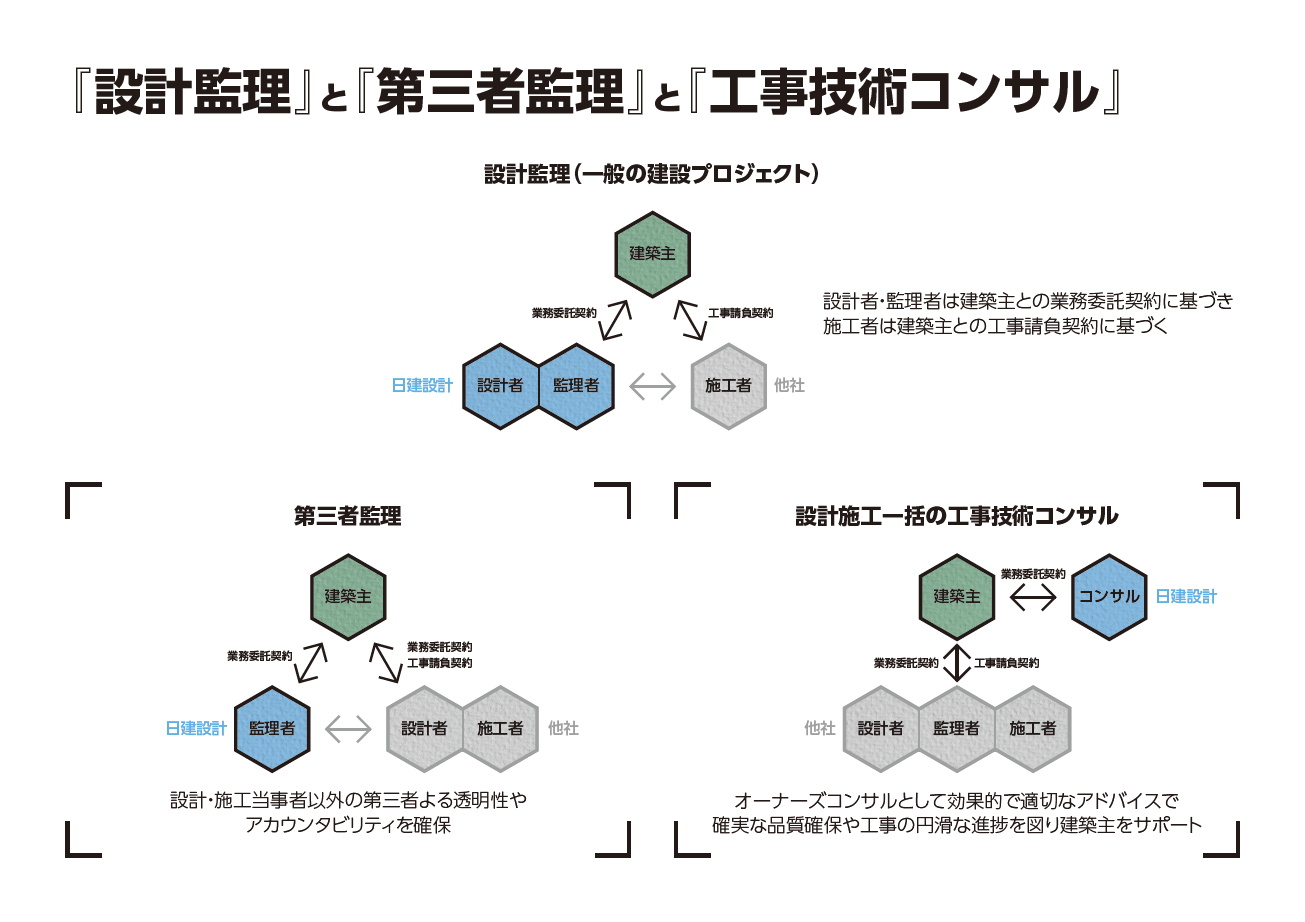 Diagrams Illustrating the Relationships Among “Design Supervision,” “Third-Party Supervision,” and “Construction Technical Consulting”
Preventing Problems Before They Arise and Handling Recovery
Construction Technical Consulting
Here are some examples of our recent projects.
For example, for buildings designed, constructed, and supervised by other companies, we review construction plans and drawings to verify their content and provide advice as needed if we identify areas requiring improvement. We document these findings in a comment log, share them with the designers, supervisors, contractors, and clients, and track how the contractors addressed the issues.
In addition, we conduct site inspections approximately twice a month, identifying areas or issues that could lead to defects along with site photographs, and similarly record advice for improvement in the comment log. By having the contractor document whether and how they have corrected or improved these issues, we can reliably maintain a record of the construction process.At the same time, by submitting these records to the client as a monthly report, they serve as the required reporting documentation under the service contract. This not only builds a relationship of trust with the client but also provides a valuable, third-party verification record—verified by Nikken Sekkei—that demonstrates the building’s quality meets appropriate standards to not only the building owner but also tenants and users.
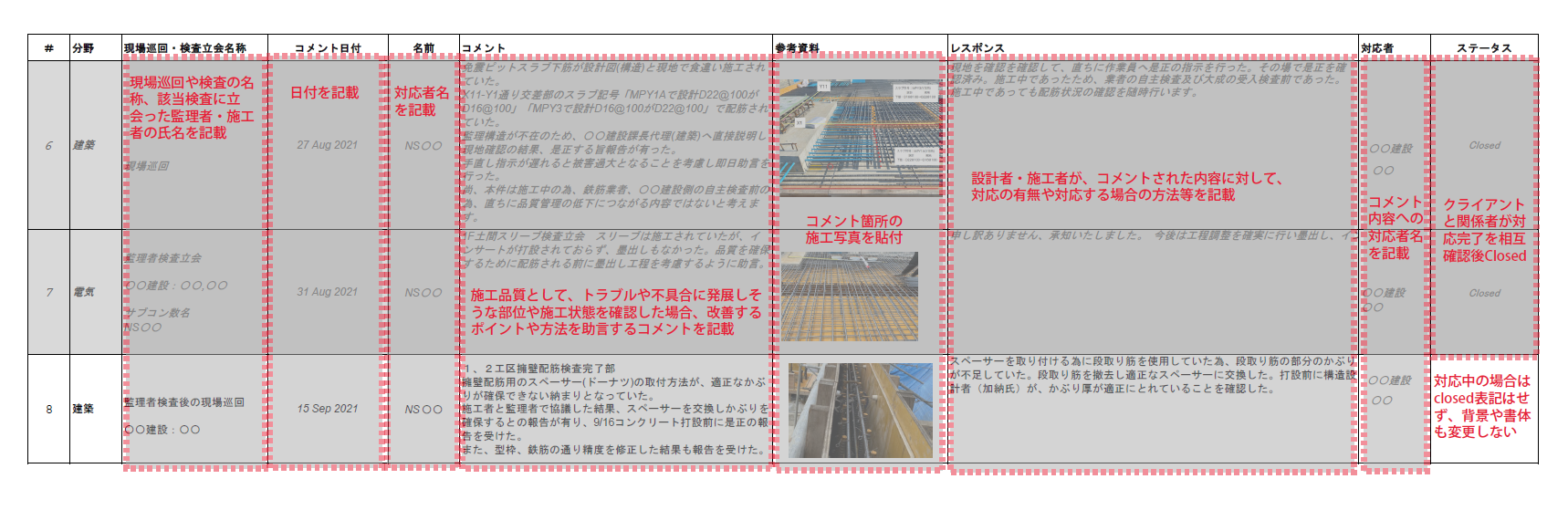 工事技術コンサルの一つ「現場巡回レポート」の一例。上記赤字の要領で記載し、運用されている。
<画像を拡大する>
For example, we may be commissioned to investigate and resolve the root causes of issues such as water leakage from exterior window frames or leaks in hot-water piping for air conditioning units after a project is completed. This involves reviewing construction plans, drawings, and inspection records from the construction phase; verifying the on-site construction conditions; and assessing the validity of corrective measures proposed by the contractor.In addition, we sometimes conduct retrospective verification of the construction work—such as cross-referencing with Nikken Sekkei’s accumulated database of trouble reports—to determine whether any serious defects exist beyond the specific issues that have arisen.
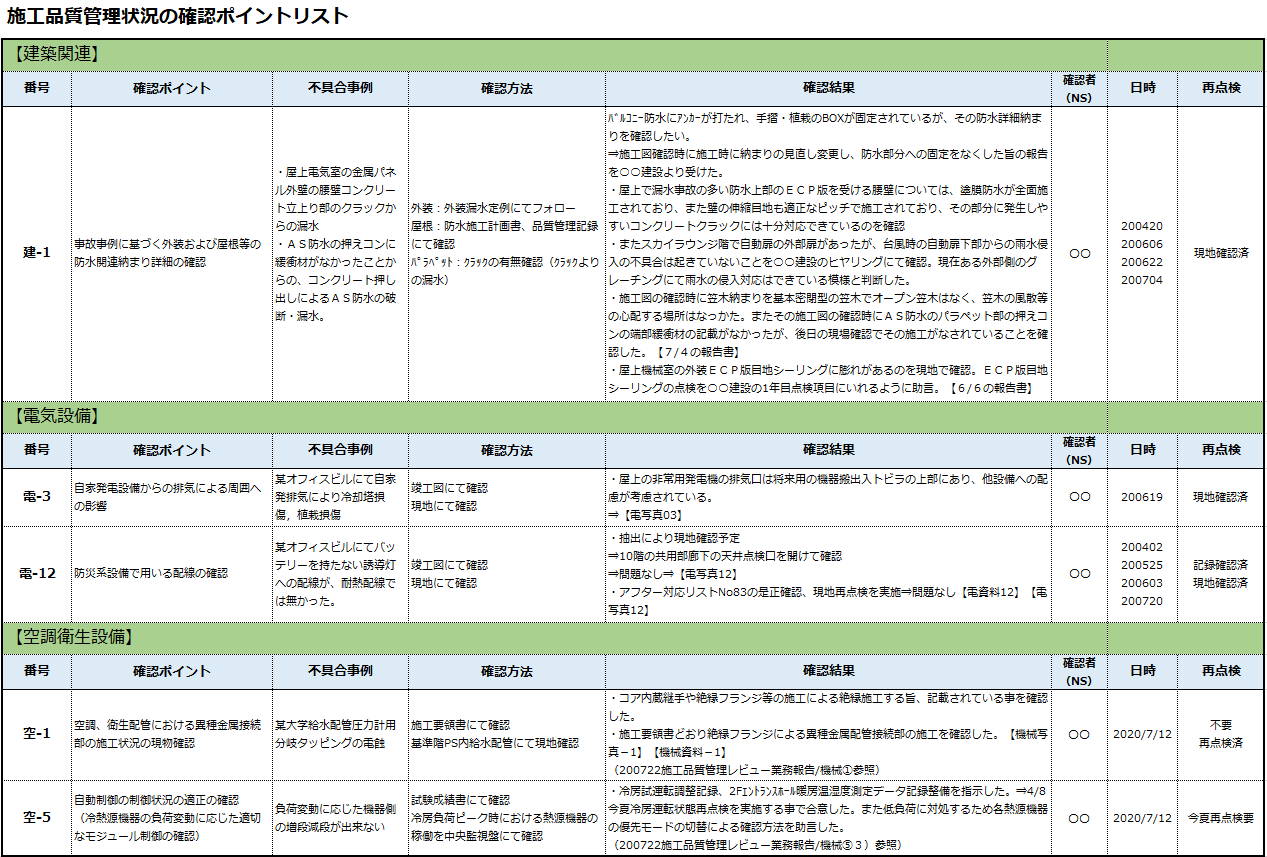 Verification is conducted using the “Checklist for Construction Quality Control.”
Seeking New Opportunities for Social Contribution Through the Expansion of “Supervision”
We are living in an era where, alongside technological innovations such as digital transformation and green transformation, values and lifestyles are undergoing significant changes. The demands placed on construction supervision and technical consulting services will also change significantly and become increasingly diverse in response to these social and environmental shifts.At the Nikken Sekkei Supervision Group, we will continue to hone our technical expertise while adapting to these societal changes and the transformation of the construction industry, thereby contributing to ensuring and improving building quality and realizing sustainable buildings.