

Developed "Direct Monitoring" with the University of Tokyo to Accurately Assess Cumulative Damage to Buildings After an Earthquake
PRESS RELEASE
2024.02.22
Nikken Sekkei Ltd. (Headquarters: Chiyoda Ward, Tokyo; Representative Director President and CEO:Atsushi Omatsu) has jointly developed “Direct Monitoring”—a system that uses strain sensors to directly verify the structural integrity of columns and beams supporting steel-framed buildings—in collaboration with Associate Professor Jun Iyama of the University of Tokyo (Graduate School of Engineering, Department of Architecture, Steel Structures Laboratory; located in Bunkyo Ward, Tokyo).The newly developed system directly measures the strain in columns and beams of steel-framed buildings—which are covered by finishes and difficult to inspect visually—that were previously excluded from the scope of the “NSmos® (Nikken Sekkei Earthquake Building Damage Assessment System),” which was developed in 2014 to measure a building’s sway during an earthquake and immediately assess the extent of damage. It directly measures the strain in columns and beams—which are typically covered by finishes and difficult to inspect visually—allowing for accurate and rapid assessment of damage status. Furthermore, it measures the accumulation of damage, helping prepare for future earthquakes.Nikken Sekkei aims to put this system into practical and commercial use as part of its Resilience Support Service, which is designed to enable the early restoration of buildings following a major earthquake.
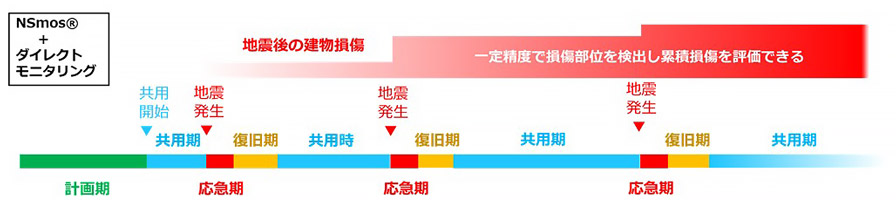 Monitoring to Track Accumulated Damage
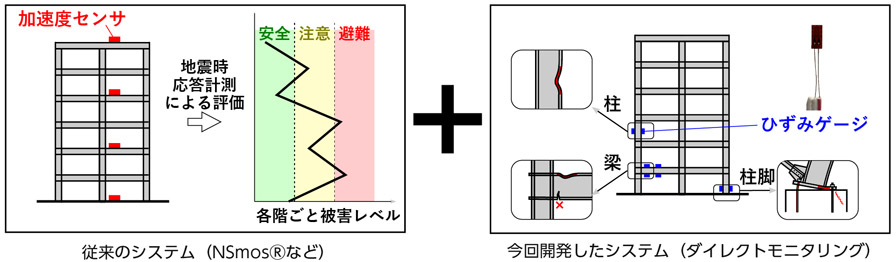 High-precision monitoring that provides an accurate assessment of damage
Background of the Development
Given the increasing risk of major earthquakes, such as the Nankai Trough earthquake and an earthquake directly beneath the Tokyo metropolitan area, as well as the damage caused by recent major earthquakes, there is growing interest in assessing the safety of buildings following an earthquake.An increasing number of buildings—particularly disaster response centers and large-scale facilities used by the general public—are adopting structural health monitoring systems to immediately determine whether evacuation is necessary after an earthquake.
On the other hand, it has become clear that damage to buildings accumulates when multiple major earthquakes—of a magnitude assumed by the Building Standards Act to occur only about once during a building’s service life—occur repeatedly, as seen in cases such as the Reiwa 6 Noto Peninsula Earthquake, or when there are foreshocks and aftershocks, as observed in the Kumamoto Earthquake.
Against this backdrop, we concluded that, in addition to general health monitoring systems that merely assess the overall damage to a building after an earthquake, it is necessary to monitor the damage accumulating in the building’s structural members over the long term in order to facilitate early restoration.
On the other hand, it has become clear that damage to buildings accumulates when multiple major earthquakes—of a magnitude assumed by the Building Standards Act to occur only about once during a building’s service life—occur repeatedly, as seen in cases such as the Reiwa 6 Noto Peninsula Earthquake, or when there are foreshocks and aftershocks, as observed in the Kumamoto Earthquake.
Against this backdrop, we concluded that, in addition to general health monitoring systems that merely assess the overall damage to a building after an earthquake, it is necessary to monitor the damage accumulating in the building’s structural members over the long term in order to facilitate early restoration.
Features of “Direct Monitoring”
The “Direct Monitoring” system developed for this project utilizes the measurement system and detection technology developed by Associate Professor Jun Iyama of the University of Tokyo. By conducting detailed analyses based on accumulated damage data from the columns and beams of steel-frame buildings, it supports rapid recovery in the event of damage caused by a major earthquake.
Furthermore, by tracking accumulated damage, the system supports building maintenance even for small-to-medium-sized earthquakes—which occur more frequently—ensuring that buildings can continue to be used with confidence.
Furthermore, by tracking accumulated damage, the system supports building maintenance even for small-to-medium-sized earthquakes—which occur more frequently—ensuring that buildings can continue to be used with confidence.
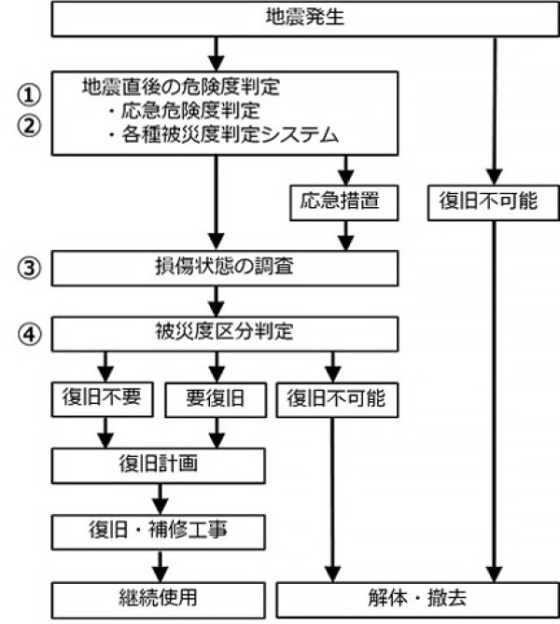 See the 2015 edition of “Criteria for Classifying the Damage Severity of Buildings Affected by Earthquakes and Technical Guidelines for Restoration.”
[Conventional Method]
① Assess the extent of damage to the building through visual inspections of its exterior and interior
* It is difficult to verify the detailed condition of areas covered by finishes
② Survey technicians assess safety based on the results of preliminary visual inspections
③ Conduct extensive, long-term detailed surveys for restoration
④ Safety cannot be assessed in the event of repeated earthquakes
▼
[Development Method (NSmosⓇ + Direct Monitoring)]
① Detects the extent of damage to the building and structural members as digital data
* Estimates the location and condition of damage even in areas covered by finishes
② Based on the detected data, promptly notify the building owner of whether repairs are necessary
③ Conduct efficient, detailed surveys limited to specific areas to facilitate restoration
④ Safety assessments can be made that account for cumulative damage even in the event of repeated earthquakes
① Assess the extent of damage to the building through visual inspections of its exterior and interior
* It is difficult to verify the detailed condition of areas covered by finishes
② Survey technicians assess safety based on the results of preliminary visual inspections
③ Conduct extensive, long-term detailed surveys for restoration
④ Safety cannot be assessed in the event of repeated earthquakes
▼
[Development Method (NSmosⓇ + Direct Monitoring)]
① Detects the extent of damage to the building and structural members as digital data
* Estimates the location and condition of damage even in areas covered by finishes
② Based on the detected data, promptly notify the building owner of whether repairs are necessary
③ Conduct efficient, detailed surveys limited to specific areas to facilitate restoration
④ Safety assessments can be made that account for cumulative damage even in the event of repeated earthquakes
Currently being tested on a 10-story steel-frame office test structure and our own building
In February 2023, we conducted a verification of direct monitoring with Associate Professor Jun Iyama of the University of Tokyo, utilizing the surplus space rental program for the “Experiment on the Dynamic Characteristics of Buildings Using a 10-Story Steel-Frame Office Test Model” conducted by the National Research Institute for Earth Science and Disaster Prevention.Furthermore, in April 2023, we implemented this system at “PYNT,” a co-creation space established at Nikken Sekkei’s Tokyo office, and have been conducting verification tests there since its opening.
-
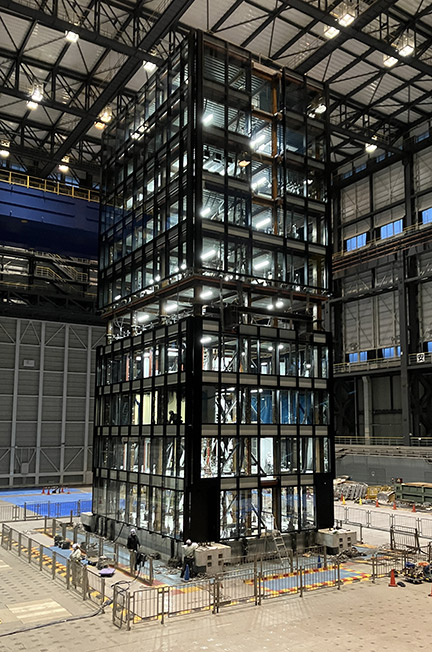 Demonstration Using a 10-Story Steel-Frame Office Test Structure
-
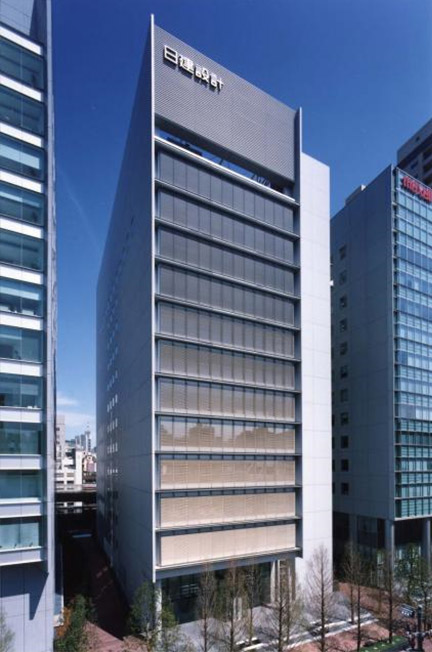 Demonstration at Nikken Sekkei's Tokyo Office
*Exterior photos courtesy of: Shin Shasin Kobo (Koji Horiuchi) -
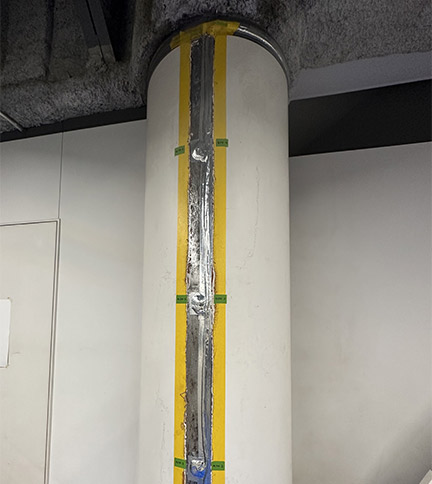 Strain Sensor
Installation (Column) -
 With different sensitivities
strain sensors
Future developments
The Structural Design Group at Nikken Sekkei is developing and establishing comprehensive resilience support services—covering everything from design to post-earthquake building functionality and restoration—with the goal of putting them into practical use and commercializing them.
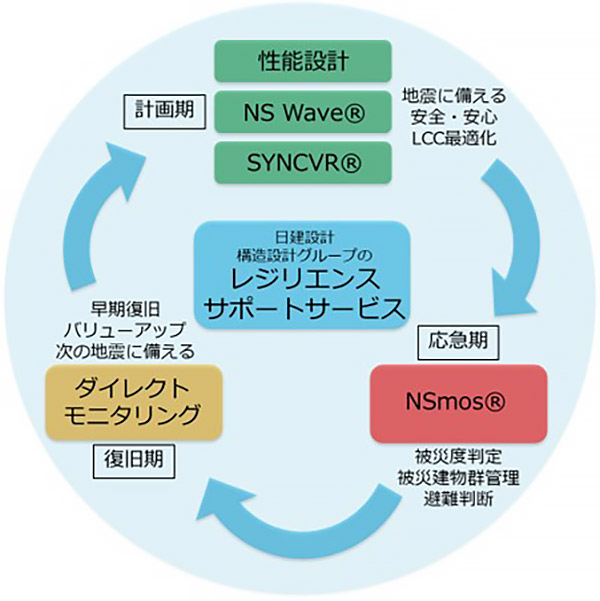
[Planning Phase]
"Performance-Based Design": An Interactive Design Process Based on Repair Costs and Recovery Times Derived from Damage Simulations
“NS Wave®,” a Customized Simulated Earthquake Motion for Design Purposes
“SYNCVR®,” which allows users to simulate the sensation of shaking during an earthquake
[Emergency Response Phase]
“NSmos®”: Rapid Assessment of Building Damage Severity During Earthquakes
[Recovery Phase]
“Direct Monitoring” to Support the Early Restoration of Buildings After an Earthquake
Through this suite of resilience support services, we aim to maintain building functionality and optimize lifecycle costs.
Furthermore, we will continue to strive to enrich our content and improve service quality, contributing to the resolution of diverse social challenges.
"Performance-Based Design": An Interactive Design Process Based on Repair Costs and Recovery Times Derived from Damage Simulations
“NS Wave®,” a Customized Simulated Earthquake Motion for Design Purposes
“SYNCVR®,” which allows users to simulate the sensation of shaking during an earthquake
[Emergency Response Phase]
“NSmos®”: Rapid Assessment of Building Damage Severity During Earthquakes
[Recovery Phase]
“Direct Monitoring” to Support the Early Restoration of Buildings After an Earthquake
Through this suite of resilience support services, we aim to maintain building functionality and optimize lifecycle costs.
Furthermore, we will continue to strive to enrich our content and improve service quality, contributing to the resolution of diverse social challenges.
Comment by Associate Professor Jun Iyama of the University of Tokyo
Amid concerns about the occurrence of earthquakes—such as the Nankai Trough earthquake—that exceed previous projections, as well as the resulting prolonged disruption of urban functions and economic activity, we believe it is the responsibility of those involved in building construction to continuously monitor the actual performance of building structures and to verify and maintain their safety.
To date, I have been conducting research on technologies to rapidly assess the performance of individual building components and the actual extent of damage by measuring acceleration and strain in actual buildings at a simple and practical level. I am delighted that, through this collaboration with Nikken Sekkei, we are now able to move into the implementation and widespread adoption phase.I intend to continue advancing the sophistication and simplicity of our measurement and analysis technologies through ongoing structural and vibration testing, as well as field verification, and strive to improve safety assessment technologies so that they can be adopted in an increasing number of buildings.
To date, I have been conducting research on technologies to rapidly assess the performance of individual building components and the actual extent of damage by measuring acceleration and strain in actual buildings at a simple and practical level. I am delighted that, through this collaboration with Nikken Sekkei, we are now able to move into the implementation and widespread adoption phase.I intend to continue advancing the sophistication and simplicity of our measurement and analysis technologies through ongoing structural and vibration testing, as well as field verification, and strive to improve safety assessment technologies so that they can be adopted in an increasing number of buildings.
About Nikken Sekkei
Nikken Sekkei is a professional services firm engaged in architectural design and supervision, urban design, and related research, planning, and consulting services.For 120 years since our founding in 1900, we have been committed to creating value through “social and environmental design,” which seeks solutions to both apparent and latent social challenges in order to meet the needs of society and the diverse requests of our clients.To date, we have been involved in a wide range of projects in Japan, China, ASEAN, and the Middle East, and in recent years, we have expanded our operations to India and Europe. In March 2021, we issued a “Climate Emergency Declaration” as part of our efforts toward a decarbonized society.
Contact information regarding this matter
株式会社日建設計 広報室 Tel. 03-5226-3030(代表) e-mail:webmaster@nikken.jp
SHARE