

Proposal of a Draft Methodology for Calculating Greenhouse Gas Emission Reductions in the Construction and Real Estate Sectors; Aiming to Develop the World’s First Industry-Standard Guidelines—which will serve as a benchmark for future investment decisions—by Incorporating Input from a Broad Range of Stakeholders, Including the Financial Sector
PRESS RELEASE
2025.06.18
Nikken Sekkei Ltd. (Headquarters: Chiyoda-ku, Tokyo; Representative Director: President and CEO:Atsushi Omatsu; hereinafter “Nikken Sekkei”) proposed the establishment of the “Study Group on Guidelines for Calculating Emissions Reduction Contributions in the Construction and Real Estate Sectors”—composed of external experts and stakeholders—in June 2024, and has now submitted the group’s findings as a draft methodology for calculating greenhouse gas emissions reduction contributions.This draft represents the world’s first set of guidelines for emission reduction contributions targeting the construction and real estate sectors, and is an initiative expected to help accelerate the creation of a GX market in these fields.
"Emissions Reduction Contributions" Draw Attention from an Investment Perspective; Meanwhile, Development of Guidelines Lags in the Construction and Real Estate Sectors
As corporate efforts to reduce GHG (greenhouse gas) emissions are becoming an important criterion for investment decisions, companies are working to reduce their Scope 1 through 3 emissions.Meanwhile, in recent years, “emission reduction contribution”—a new evaluation metric that assesses a company’s ability to solve problems based on its contribution to reducing GHG emissions—has been gaining attention. Emission reduction contribution refers to the difference in GHG emissions between existing products and services (the baseline) and new products and services (the solution).
At COP29, held in November 2024, the World Business Council for Sustainable Development (WBCSD) announced that it would begin considering the adoption of this metric under the GHG Protocol, and various industries are also making progress in developing guidelines for calculating reduction contribution.
At COP29, held in November 2024, the World Business Council for Sustainable Development (WBCSD) announced that it would begin considering the adoption of this metric under the GHG Protocol, and various industries are also making progress in developing guidelines for calculating reduction contribution.
-
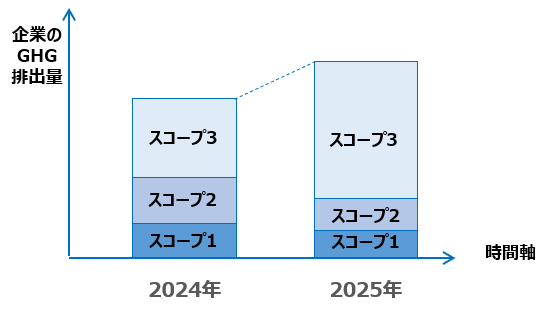 Traditional Approach to Scope 1, 2, and 3 GHG Emissions
-
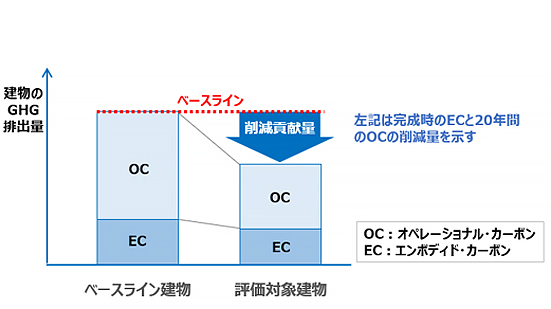 Concept of GHG Reduction Contributions
On the other hand, in the construction and real estate sectors, the process of calculating life cycles has been extremely complex—and the development of guidelines has been delayed—due to factors such as the large number of stakeholders involved in the construction and operation of buildings; the longer service life compared to electrical appliances and other products; the need for renovations; the prevalence of leasing properties while retaining ownership rather than selling them; and the fact that real estate is not only a product but also has the characteristics of a one-of-a-kind project.
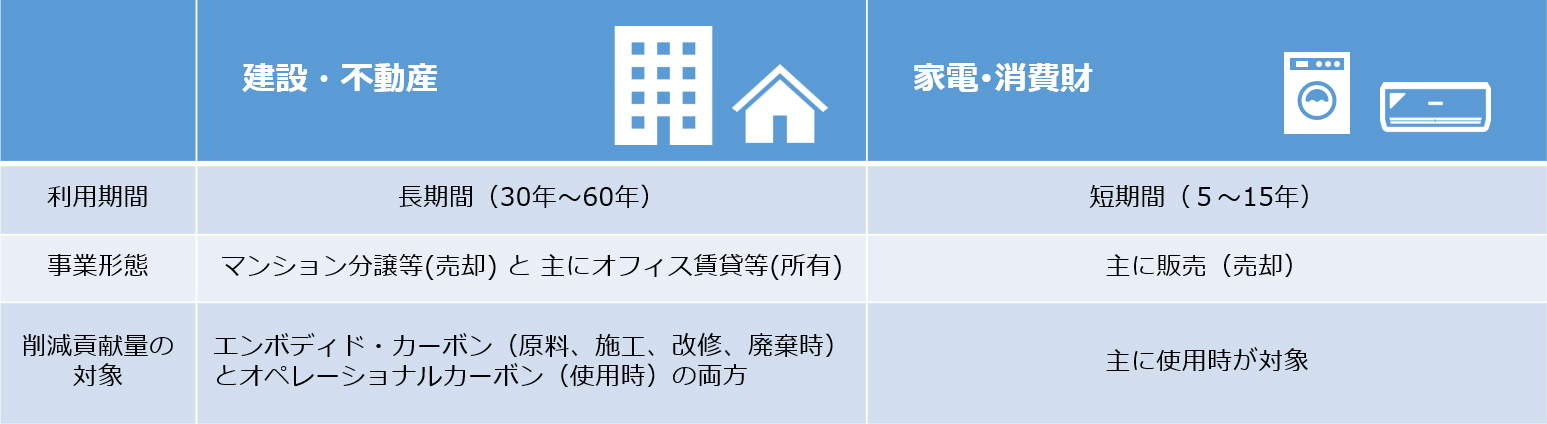 Differences Between Construction and Real Estate vs. Home Appliances and Consumer Goods
*Embedded Carbon: Carbon emissions generated during the manufacturing of building materials, new construction, renovation, and demolition
Operational Carbon: Carbon emissions resulting from energy and water consumption during a building’s operation
To promote decarbonization, proposed the establishment of a guidelines review committee and submitted a draft calculation method
Nikken Sekkei has leveraged its neutrality as an architectural firm to contribute to the development of tools for calculating the whole-life carbon footprint of buildings.In this context, recognizing that establishing a unified industry standard for evaluating emission reduction contributions is essential to attracting investment in companies that contribute to emissions reductions and further advancing decarbonization in the construction and real estate sectors, the firm proposed and established the “Study Group on Guidelines for Emission Reduction Contributions in the Construction and Real Estate Sectors” in June 2024.The study group—which included not only representatives from the construction and real estate sectors but also financial professionals who use such data for investment decisions—held extensive discussions and, in June 2025, drafted the “Methodology for Calculating Greenhouse Gas Emission Reduction Contributions in the Construction and Real Estate Sectors (Draft)” and submitted it to the industry and relevant government ministries. This marks the world’s first draft methodology of its kind in this sector.
This draft outlines the conceptual framework and calculation methods for emission reduction contributions in this sector. It is expected to facilitate CO₂ reductions across the entire industry by enabling appropriate evaluation and promoting investment decisions by financial institutions.
In fiscal year 2025, we will continue the study group’s work and update this draft—the result of this voluntary initiative—into guidelines that meet the standards required to function as an industry standard, while incorporating feedback from a diverse range of stakeholders.Discussions regarding emission reduction contributions are expected to progress further in the future, and debates are anticipated to intensify in forums such as the “Zero-Carbon Buildings (LCCO₂ Net Zero) Promotion Council” (Housing and Construction SDGs Promotion Center (IBECs), a general incorporated foundation). We will continue to monitor these developments closely.
Regarding Emissions Reduction Contributions
・Differences from Conventional GHG Emissions Metrics (Scope 1, 2, and 3)
Scopes 1–3 are calculated based on a company’s actual emissions. In contrast, the reduction contribution is calculated by comparing the actual emissions to a modeled baseline. In the construction and real estate sectors, buildings are the primary focus.The calculation focuses on the positive contribution represented by the emissions that were socially avoided as a result of constructing the building under evaluation, rather than those from a baseline building. This allows for an assessment of the contribution made by the company that built the building toward reducing society’s overall emissions.
For example, if a company constructs a building that reduces GHG emissions during construction or operation, its Scope 1–3 emissions will increase compared to what they would have been if the building had not been built. However, by expressing the GHG emissions that were reduced in this process as a reduction contribution, the company’s meaningful contribution to GHG emission reduction can be evaluated.
・Existing Guidelines on Reduction Contribution
Internationally, the WBCSD, and domestically, the Ministry of Economy, Trade and Industry (METI), the Japan Society for Life Cycle Assessment (JSLCA), and the GX Management Promotion Working Group of the GX League have issued guidelines and basic policies regarding reduction contributions.Sector-specific calculation guidelines already exist in industries such as chemicals, electronics, and gas. This draft has been formulated by referencing existing guidelines while taking into account the characteristics of the construction and real estate sectors.
Overview of the Methodology for Calculating Greenhouse Gas Emission Reductions in the Construction and Real Estate Sectors (Draft)
| 1. | Eligibility Criteria: We defined the requirements for “corporate eligibility” and “solution eligibility.” | |
|---|---|---|
| 1) | It explicitly states that the energy efficiency, resilience, and wellness performance of real estate must not be compromised. | |
| 2. | Method for Calculating Emissions Reduction Contributions: We defined the “Scope of Quantification,” “Establishment of the Baseline,” “Scope of Evaluation,” and “Calculation Approach.” | |
| 1) | Scope of Quantification: This covers the contribution to reducing greenhouse gas emissions (both operational carbon and embodied carbon) throughout the life cycle of real estate projects involving new construction or renovation. Baseline and solution calculations are performed using tools such as J-CATⓇ. (J-CAT is a registered trademark of the Housing and Construction SDGs Promotion Center, a general incorporated foundation.) | |
| 2) | Establishment of the Baseline: For new construction, conventional properties were used as the baseline; for renovations, the baseline was set based on the scenario in which the property would have continued to be used without undergoing renovation. However, further consideration of the details is needed. | |
| 3) | Evaluation Scope: For new construction, the period covers the construction phase and the usage phase of the property; for renovations, it covers the renovation phase through the usage phase immediately preceding the next renovation. In both cases, the demolition phase of the property is excluded. Furthermore, the valuation period is assumed to be the time span from new construction or renovation to the next renovation, and is set at 20 years as a general rule. | |
| 4) | Valuation Approach: As a general rule, it was deemed desirable to apply the forward-looking approach—which recognizes the full value of real estate held for sale, including future value, at the time of completion—to such properties, and the year-on-year approach—which reflects actual performance on an annual basis—to real estate held for rental.Furthermore, since there is currently no internationally agreed-upon approach regarding contribution rates, this draft does not address the issue and has deferred further consideration. | |
| 3. | Reduction Contribution per Company: When calculating the reduction contribution per company, the evaluation was based on the total of all solutions implemented by the company during that year, including those that resulted in a negative reduction contribution. | |
| 4. | Verification and Reporting: It was recommended that the calculation results undergo third-party verification (including internal verification). It was also recommended that the report clearly state whether verification was conducted and, if so, identify the verifier and describe the details of the verification. | |
Examples of Calculating Emissions Reduction Contributions
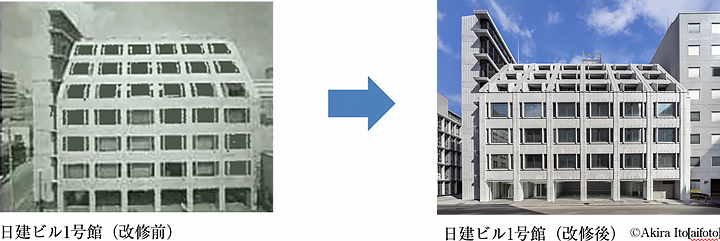
Renovation of Nikken Building No. 1 (2025):
This project involved a 57-year-old building that achieved ZEB Ready certification through “Zenobe,” an environmental retrofit program that combines versatile technologies such as LED lighting, improved HVAC efficiency, and enhanced thermal insulation. According to estimates, the use of low-carbon concrete, electric arc furnace steel, andlow-GWP refrigerants during the renovation work will limit embodied carbon to 760 metric tons of CO2e, while energy savings will reduce operational carbon by 1,270 metric tons of CO2e, resulting in a total reduction contribution of 510 metric tons of CO2e over a 20-year period.Furthermore, if demolition and new construction—rather than renovation—were used as the baseline, the reduction contribution would be even greater.
This project involved a 57-year-old building that achieved ZEB Ready certification through “Zenobe,” an environmental retrofit program that combines versatile technologies such as LED lighting, improved HVAC efficiency, and enhanced thermal insulation. According to estimates, the use of low-carbon concrete, electric arc furnace steel, andlow-GWP refrigerants during the renovation work will limit embodied carbon to 760 metric tons of CO2e, while energy savings will reduce operational carbon by 1,270 metric tons of CO2e, resulting in a total reduction contribution of 510 metric tons of CO2e over a 20-year period.Furthermore, if demolition and new construction—rather than renovation—were used as the baseline, the reduction contribution would be even greater.
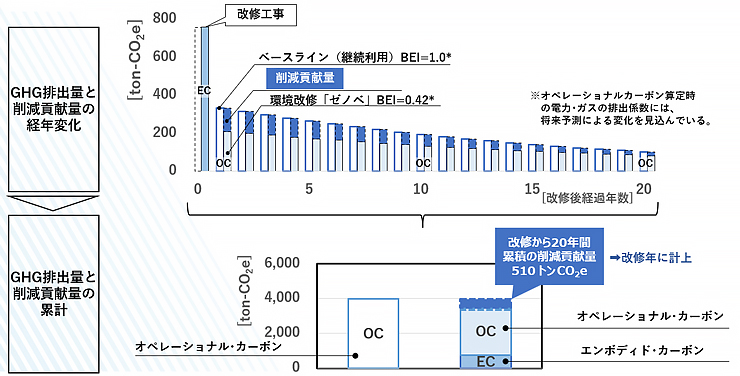
Impact on Investment Decisions
With Mizuho Financial Group, Inc. publishing a report on emission reduction contributions in October 2024, followed by Nomura Holdings, Inc. in March 2025, expectations are rising within the financial sector for the use of emission reduction contributions in corporate evaluations and investment decisions.
By incorporating feedback on this draft from a wide range of stakeholders—including those in the construction and real estate sectors as well as the financial sector—and updating it into guidelines that serve as an industry standard, we aim to promote appropriate asset valuation and investment decisions for construction and real estate-related companies, which is expected to lead to CO₂ reductions across the entire sector.
By incorporating feedback on this draft from a wide range of stakeholders—including those in the construction and real estate sectors as well as the financial sector—and updating it into guidelines that serve as an industry standard, we aim to promote appropriate asset valuation and investment decisions for construction and real estate-related companies, which is expected to lead to CO₂ reductions across the entire sector.
<Comment by Hayato Tsuji (Member of the Guidelines Review Committee), Asset Finance Division, Development Bank of Japan, Inc. (Director)>
As the scope of GHG emissions calculation and disclosure expands to include the supply chain (Scope 3), we view “emissions reduction contribution” as a critical concept that enables companies to advance efforts toward societal decarbonization while simultaneously strengthening sound business operations and industrial competitiveness, and ensuring the maintenance and renewal of necessary social infrastructure.
From a financial perspective, “emission reduction contributions” are also attracting attention from financial institutions and investors as indicators for assessing climate-related opportunities and risks in companies receiving investment or financing, as well as for impact investing and sustainable finance.Furthermore, in the “Zero Energy Renovation Project” (“Zenobe”), in which our bank participates, we are measuring “emission reduction contributions” in actual real estate fund investments, aiming to achieve both improved environmental performance in existing buildings and investment returns.We believe that the publication of this “draft” will serve as a catalyst for clarifying the calculation methods and conceptual framework for “emission reduction contributions” in the construction and real estate sectors, thereby contributing significantly to the decarbonization of society.
Composition of the “Study Group on Guidelines for Emissions Reduction Contributions in the Construction and Real Estate Sectors”
| List of Committee Members (in alphabetical order) | ||
|---|---|---|
| Academics | Shunji Ikaga | Professor Emeritus, Keio University |
| Shinichi Tanabe | Waseda University Professor, School of Creative Science and Engineering, Faculty of Science and Engineering | |
| Mari Yoshitaka | Visiting Professor, Faculty of Liberal Arts, The University of Tokyo; Specially Appointed Professor, School of Policy Studies, Keio University; Representative Director, Virtue Design, a General Incorporated Association | |
| Committee Member | Ryota Ii | Pacific Consultants, Inc., Social Innovation Business Division, GX Promotion Director |
| Toshiyuki Inoue | Mitsubishi Estate Co., Ltd. Managing Executive Officer, in charge of the Urban Development Promotion Department, Smart Energy Design Department, Marunouchi Development Department, and TOKYO TORCH Business Division | |
| Kunihiko Kitayama | Mizuho Bank, Ltd. Senior Executive Officer Head of the Social and Industrial Infrastructure Industry Group | |
| Shima Koyama | Daikin Industrieds,Ltd Tokyo Branch, Public Relations Office (also serving as the CSR and Global Environment Center) — Person in Charge Director | |
| Masafumi Sekine | Nikken Sekkei Ltd. Executive Officer Head of the DX·GX Center | |
| Hayato Tsuji | Development Bank of Japan, Inc. Asset Finance Director | |
| Ryuichi Horie | CSR Design Environmental Investment Consulting Co., Ltd., Representative Director President and CEO | |
| Yu Yamamoto | Mitsui Fudosan Co., Ltd. Promoting Sustainability Director | |
| Yoshimura Yoshiki | Deputy Director, Environment Division, and Head of the Global Environment Office, Kajima Corporation | |
| Observer | Masashi Kono | Nikken Sekkei Research Institute, Inc. Executive Officer |
| Susumu Horikawa | Nikken Sekkei, Ltd. Senior Director | |
| Secretariat | Keiko Ogami | Nikken Sekkei Ltd. Engineering Department MEP Design Group Associate |
| Katsumi Niwa | Nikken Sekkei Ltd., DX & GX Center, Sustainability Promotion Office Director | |
| Megumi Horii | Nikken Sekkei Ltd., DX & GX Center, Sustainability Promotion Office Associate | |
| Hiroyuki Uchida | Mizuho Research & Technologies, Inc. Principal, Sustainability Consulting Division 1 |
|
| Riku Kawamoto | Mizuho Research & Technologies Co., Ltd. Senior Consultant, Sustainability Consulting Division 1 |
|
| Maiko Sugimura | Mizuho Research & Technologies Co., Ltd. Senior Consultant, Sustainability Consulting Division 1 |
|
| Kentaro Noguchi | Mizuho Research & Technologies Co., Ltd. Senior Consultant, Sustainability Consulting Division 1 |
|
| Miki Yamane | Mizuho Research & Technologies Co., Ltd. Senior Consultant, Sustainability Consulting Division 1 |
|
About Nikken Sekkei
Nikken Sekkei is a professional services firm engaged in architectural and civil engineering design and supervision, urban design, and related survey, planning, and consulting services.For over 120 years since our founding in 1900, we have been committed to creating value through “Social and Environmental Design,” which seeks solutions to both apparent and latent social issues, in order to meet the needs of society and the diverse requests of our clients.We have been involved in a wide range of projects in Japan, China, ASEAN, and the Middle East, and in recent years have expanded our operations to India and Europe.
Inquiries Regarding This Matter
株式会社⽇建設計 広報室 TEL:03-5226-3030(代表) E-mail:webmaster@nikken.jp
SHARE