

Natural light simulation lighting that recreates "above-ground" light in an underground space, and brainwave measurements demonstrate its relaxing and concentration-enhancing effects.
Future plans include expanding into educational facilities, hospitals, offices, and hotels where natural light is scarce.
PRESS RELEASE
2026.04.01
Nikken Sekkei Ltd. (Headquarters: Chiyoda-ku, Tokyo; Representative Director President and CEO: Atsushi Omatsu; hereinafter “Nikken Sekkei”) has been developing and implementing “natural light simulation lighting”—a lighting technique that reproduces “light just like that on the ground” in environments where natural light does not reach, such as underground spaces—and has now verified its effectiveness through brainwave measurements*.Through this verification, the company has quantitatively demonstrated that biophilic environments incorporating this lighting method contribute to users’ relaxation and improved concentration.
*This verification was conducted as a joint research project with Chuo University.
*This verification was conducted as a joint research project with Chuo University.
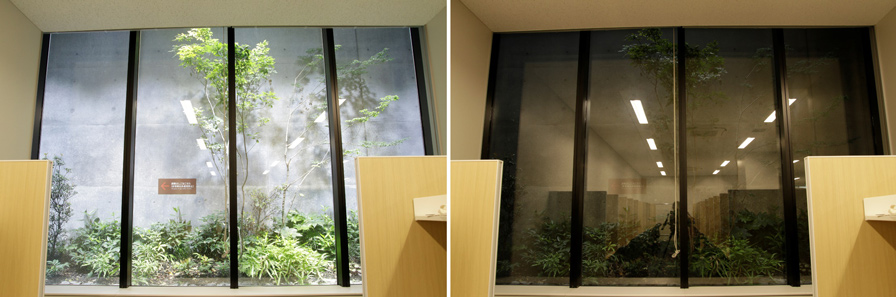 Natural light simulation lighting installed in an underground space (Left: When lit; Right: When off)
Background of Development: In today’s world, where the use of underground spaces in architecture is essential, it is difficult for natural light—which has a positive effect on people—to reach these areas.
It is well known that natural light not only provides people with a sense of psychological comfort but also has positive effects in many areas, including physical and mental health. However, in recent years—particularly in urban areas where land is limited—many buildings require highly efficient use of site space and the utilization of underground areas. As a result, there are spaces in educational and research facilities, hospitals, nursing care facilities, offices, and hotels where natural light does not reach sufficiently.
Overview: “Natural Light Simulation”—a lighting technique that brings light to underground spaces that feels “just like being above ground”
Recognizing these challenges, Nikken Sekkei developed a lighting method called “Natural Light Simulation,” which artificially creates a lighting environment that mimics the characteristics of natural light by combining lights with different color temperatures.
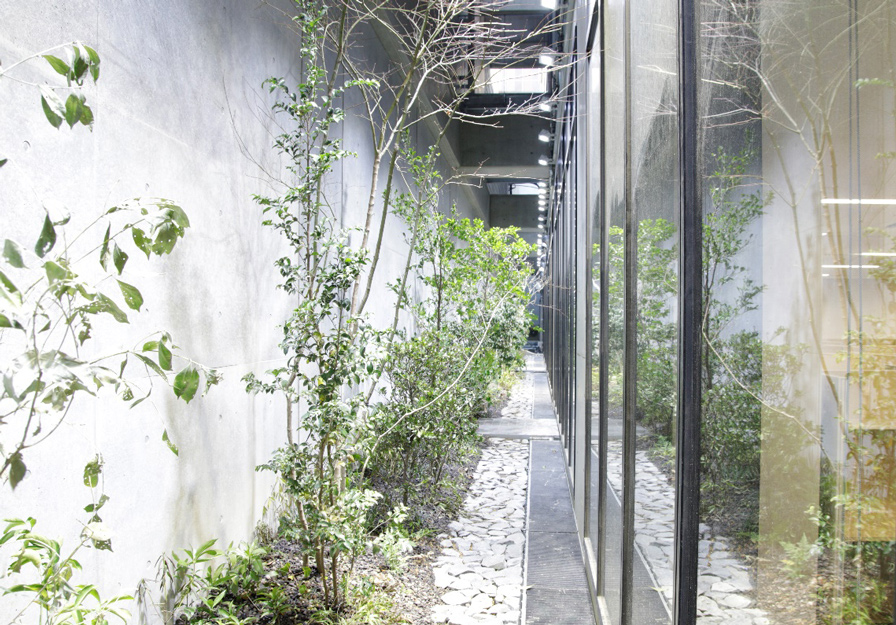
By combining two types of lighting—skylight-simulated lighting with a color temperature of 10,000 K (Kelvin) and direct light-simulated lighting with a color temperature of 5,000 K—and directing them toward plants and other elements in underground spaces, the system reproduces natural light distribution and shadows just as they would be experienced above ground.This creates spaces that evoke the sensation of sunlight even on underground levels, aiming to alleviate the feeling of confinement and enhance comfort.
By combining two types of lighting—skylight-simulated lighting with a color temperature of 10,000 K (Kelvin) and direct light-simulated lighting with a color temperature of 5,000 K—and directing them toward plants and other elements in underground spaces, the system reproduces natural light distribution and shadows just as they would be experienced above ground.This creates spaces that evoke the sensation of sunlight even on underground levels, aiming to alleviate the feeling of confinement and enhance comfort.
Results of the Pilot Study: Relaxation and Improved Concentration Quantitatively Confirmed Through EEG Measurements
This pilot study was conducted in collaboration with Chuo University. As the university was relocating its Faculty of Law and Graduate School of Law to the Myogadani Campus in Bunkyo Ward, Tokyo, space constraints necessitated placing the study rooms in the basement.Concerned about the learning environment for students preparing for challenging exams in a confined underground space, the university installed simulated natural light lighting in April 2023 with the goal of enhancing the quality of relaxation and, through that high-quality relaxation, promoting greater concentration after breaks.
To verify the intended effects from an objective and quantitative perspective, this pilot study used brainwave monitors on students using the university’s underground self-study rooms, revealing the following results:
1. Brain waves associated with relaxation increased during breaks
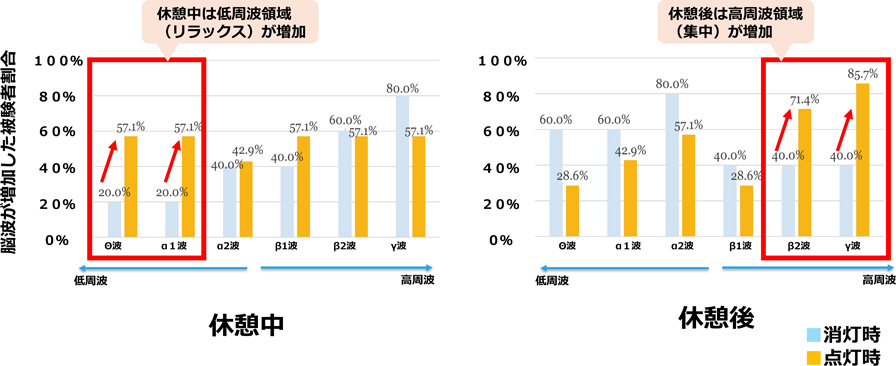
Under the simulated natural light, a higher proportion of participants exhibited an increase in low-frequency bands (theta waves and alpha-1 waves)—which indicate a relaxed state—compared to when the lights were off.When brainwaves during breaks were measured and compared, both θ waves and α1 waves were observed in 57.1% of participants under the simulated natural light, compared to 20.0% when the lights were off.
2. Improved alertness (concentration) after breaks
During work following a relaxing break, the percentage of participants showing an increase in high-frequency bands (β2 waves, γ waves)—which contribute to alertness and concentration—also rose significantly compared to when the lights were off.For β2 waves, the percentage rose from 40.0% with the lights off to 71.4% with the lights on, and for γ waves, it rose from 40.0% with the lights off to 85.7% with the lights on.
These results confirm that simulated natural light is an effective method for providing high-quality rest, which in turn facilitates a smooth transition to a state of high concentration afterward.
To verify the intended effects from an objective and quantitative perspective, this pilot study used brainwave monitors on students using the university’s underground self-study rooms, revealing the following results:
1. Brain waves associated with relaxation increased during breaks
Under the simulated natural light, a higher proportion of participants exhibited an increase in low-frequency bands (theta waves and alpha-1 waves)—which indicate a relaxed state—compared to when the lights were off.When brainwaves during breaks were measured and compared, both θ waves and α1 waves were observed in 57.1% of participants under the simulated natural light, compared to 20.0% when the lights were off.
2. Improved alertness (concentration) after breaks
During work following a relaxing break, the percentage of participants showing an increase in high-frequency bands (β2 waves, γ waves)—which contribute to alertness and concentration—also rose significantly compared to when the lights were off.For β2 waves, the percentage rose from 40.0% with the lights off to 71.4% with the lights on, and for γ waves, it rose from 40.0% with the lights off to 85.7% with the lights on.
These results confirm that simulated natural light is an effective method for providing high-quality rest, which in turn facilitates a smooth transition to a state of high concentration afterward.
Overview of the Demonstration
・Period: June 20–28, 2025
・Participants: 34 students who actually use the study rooms in the basement of Chuo University
(Of these, brain waves were compared between 5 students who took a break when the lights were off and 7 students who took a break when the lights were on)
・Method: Participants wore EEG monitors to record brain waves while studying for certification exams, as they normally do in the study room
・Analysis Timing: Brainwave data was analyzed during breaks (10 minutes before the break through the duration of the break) and after breaks (10 minutes before the break through 10 minutes after the break)
Nikken Sekkei, which champions “Social Environmental Design” and works to solve the diverse challenges facing architecture and urban environments, plans to propose and implement this lighting approach in a wide range of building types—including offices with limited natural light, educational facilities, medical and welfare facilities, hotels, and factories—based on the insights gained from this demonstration.Even in environments with limited land or architectural constraints, we aim to maximize the value of architecture by promoting the creation of spaces where people can fully relax and easily concentrate when necessary.
・Participants: 34 students who actually use the study rooms in the basement of Chuo University
(Of these, brain waves were compared between 5 students who took a break when the lights were off and 7 students who took a break when the lights were on)
・Method: Participants wore EEG monitors to record brain waves while studying for certification exams, as they normally do in the study room
・Analysis Timing: Brainwave data was analyzed during breaks (10 minutes before the break through the duration of the break) and after breaks (10 minutes before the break through 10 minutes after the break)
Nikken Sekkei, which champions “Social Environmental Design” and works to solve the diverse challenges facing architecture and urban environments, plans to propose and implement this lighting approach in a wide range of building types—including offices with limited natural light, educational facilities, medical and welfare facilities, hotels, and factories—based on the insights gained from this demonstration.Even in environments with limited land or architectural constraints, we aim to maximize the value of architecture by promoting the creation of spaces where people can fully relax and easily concentrate when necessary.
About Nikken Sekkei
Nikken Sekkei is a professional services firm specializing in architectural and civil engineering design and supervision, urban design, and related research, planning, and consulting services. For 125 years since its founding in 1900, Nikken Sekkei has been committed to creating value through "social environment design," which aims to solve both explicit and implicit social issues, in order to meet the demands of society and the diverse needs of its clients. To date, it has been involved in various projects in Japan, China, ASEAN, and the Middle East, and in recent years has expanded into India and Europe.
Contact information regarding this matter
株式会社日建設計 広報室 Tel. 03-5226-3030 e-mail:webmaster@nikken.jp
SHARE