

Nikken Sekkei Launches Full-Scale Efforts to Implement Circular Design in the Construction Industry
~Launches the “CDC Co-creation Council” as a new driving force for the “Circular Design Collective.” With Loftwork serving as the secretariat, the initiative aims to accelerate co-creation focused on putting insights into practice and solving challenges~
Project Overview and Initiatives from the Previous Fiscal Year
To address these challenges, Nikken Sekkei launched the “Circular Design Collective (CDC)” in 2024 to promote the circular economy and carbon neutrality in the construction industry by researching and pooling collective knowledge on “people, things, and processes.”Guided by a mission to eliminate the concept of “waste” from the architecture and civil engineering industries, the CDC has been developing concrete methodologies and accumulating knowledge focused on the reuse of building materials after demolition and the revaluation of materials.
*Circular Economy: A cyclical system in which raw materials and products are reused as much as possible without being discarded during economic activities, thereby reducing environmental impact and achieving sustainable resource use.
[Key Initiatives]
As part of our first-year initiatives, we launched the “Circular Idea Catalog” (hereinafter “CIC”), a knowledge base that systematizes design ideas and best practices for circular architecture, as well as insights from external experts, and began implementing it internally. We have built a foundation that enables everyone to put circular design into practice.
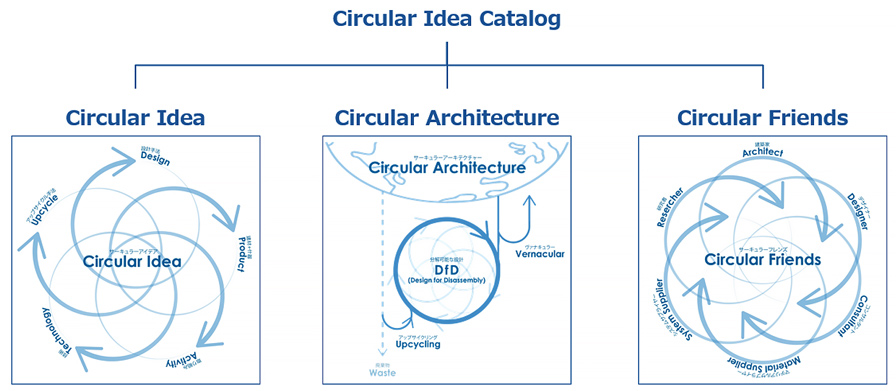
Led by Nikken Sekkei, a co-creation council was established under the banner of “CIC Co-creation” to verify the practical utility of the concept. This council brought together volunteers from seven companies—including general contractors and firms specializing in spatial design and interiors—as well as Loftwork, Inc. Together, we have repeatedly formulated evaluation criteria applicable to actual design sites and conducted prototype testing.In addition, together with volunteers from this collaborative council, we participated in editing and writing for the “Circular Design” special feature in Issue 246 of Shokokusha’s architecture magazine *Detail*.
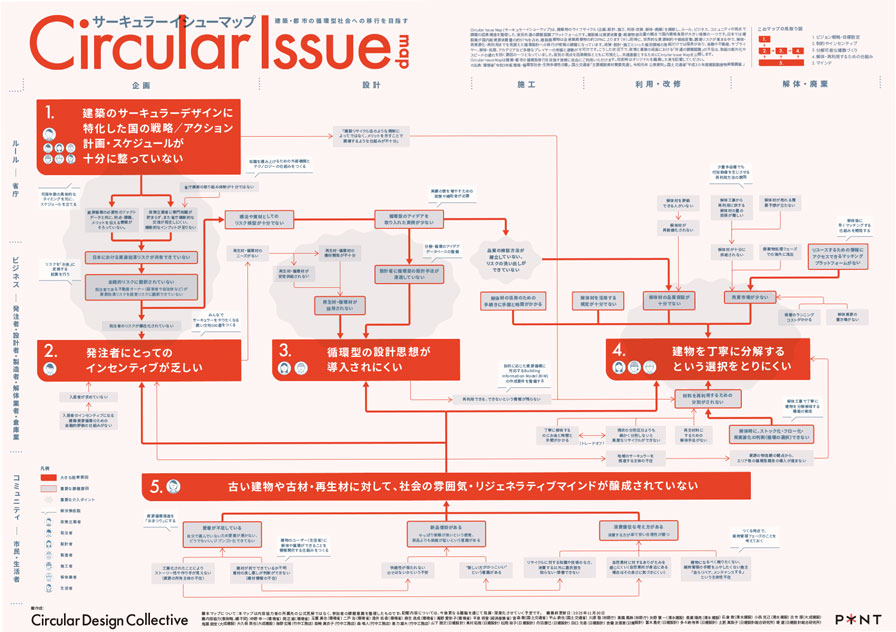
Furthermore, in collaboration with volunteers from central government ministries and agencies, we created the “Circular Issue Map” (hereinafter “CIM”), which visualizes the barriers to resource circulation in architecture and urban planning along with their causal relationships.We have worked to build a cross-industry foundation for advancing this initiative by organizing the challenges faced by diverse stakeholders—including policymakers, designers, contractors, and demolition companies—and identifying points of intervention for their resolution.
Plans for This Fiscal Year
At the CDC Co-creation Council, based on the overarching philosophy and vision formulated by Nikken Sekkei as the founding member, Loftwork, serving as the secretariat, will handle overall planning, the curation and dissemination of discussions, and operational management.
Specific Activities
- We hold monthly meetings based in Tokyo, Osaka, Kyoto, and other locations.In addition to presenting case studies of circular design initiatives, we will deepen discussions from a multifaceted perspective—including that of business operators, architects, designers, and contractors—with a focus on collaboration with stakeholders to bring these initiatives to fruition. The case studies and insights discussed will be compiled into the “Circular Idea Catalog (CIC).”
- We will map the case studies and topics discussed at the CDC Co-creation Conference onto the “Circular Issue Map (CIM)” and consolidate and systematize them as concrete examples that link challenges and solutions related to resource circulation.
- We hold an annual on-site study retreat. During this retreat, we share a firsthand experience of circular design initiatives on-site and engage in in-depth discussions.
Comment by Kousuke Kaneko, Nikken Sekkei Ltd.
The circular architecture we strive for goes beyond simply reusing resources; it is architecture that will be cherished by local communities for generations and passed down to future generations. To date, we have shared our insights with like-minded companies and the members of Private to lay the groundwork for putting these ideas into practice.Now, with Loftwork serving as the administrative secretariat, we will further expand this circle of “co-creation.” Together, we will raise the bar for what is considered “standard” in the industry and move beyond that toward “competitive creation,” where each company can leverage its unique strengths. We aim to realize a prosperous society where resources and a sense of attachment circulate, starting from the fields of architecture and civil engineering.
Comment by Kosuke Kinoshita, Loftwork Inc.
To establish circular architecture firmly in society, it is essential to have not only expertise in technology and materials but also a perspective that connects natural capital, local culture, and community practices with economic rationality.As the operating secretariat, guided by our shared vision of building the collective knowledge and relationships that enable everyone to practice circular design—a goal pursued by the CDC—we will work alongside all those who have supported our co-creation efforts to date. By transcending industry sectors and areas of expertise, transforming diverse questions into concrete experiments, and making both the process and the results transparent, we will foster a space where practical action can flourish.
*1 Source:
Ministry of the Environment, “Reiwa 3 Edition: White Paper on the Environment, a Circular Economy, and Biodiversity”
Ministry of Land, Infrastructure, Transport and Tourism, “Forecast of Demand for Major Construction Materials, Reiwa 1 (Published Materials),” “Survey on the Status of Construction By-products, Fiscal Year Heisei 30”