
Starting with "EXPERIENCE, INTEGRATED"
"TCFD"
TCFD : Task Force on Climate-related Financial Disclosures
SCROLL DOWN
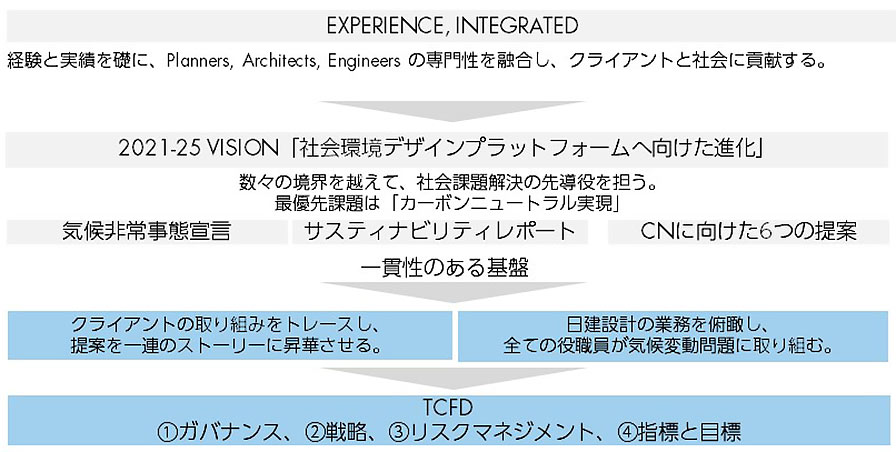
“EXPERIENCE, INTEGRATED” The Nikken Group’s tagline conveys the message: “Combining diverse experiences to deliver enriching experiences.”By integrating the expertise of planners, architects, and engineers, and by focusing our passion, wisdom, and technology, we take on the challenge of creating spaces with new value and building social systems, thereby contributing to our clients and society. This reflects our commitment.
Furthermore, our “Management Plan 2021–25” sets forth “Evolution Toward a Social and Environmental Design Platform” as our VISION. It states that we will take the lead in solving social issues by transcending numerous boundaries, and that our top priority is “achieving carbon neutrality.”
Greenhouse gas emissions from buildings designed by Nikken Sekkei account for approximately one-hundredth of Japan’s total emissions. Taking this fact very seriously, we issued a “Climate Emergency Declaration” in March 2021. As a firm that has been given the opportunity to co-create with numerous clients, Nikken Sekkei’s role and responsibility are boundless.
Many of our clients are already disclosing information in accordance with the TCFD. By disclosing TCFD information ourselves, we believe we can align with our clients’ initiatives and weave our proposals into a cohesive narrative. Furthermore, this will provide an opportunity for all executives and employees to take a holistic view of Nikken Sekkei’s operations and engage with the issue of climate change.
In this way, climate change is a challenge that we must address by fully realizing the spirit embodied in “EXPERIENCE, INTEGRATED.” We expect that TCFD disclosures will significantly advance the sharing of awareness with our clients and other stakeholders.



 October 2022: Endorsed the TCFD recommendations and joined the TCFD Consortium
Governance
DXGX Promotion Council
The DXGX Promotion Council consists of President and CEO, division heads, and relevant Executive Officer. It will continuously monitor the risks and opportunities that climate change poses to Nikken Sekkei’s business, make decisions on corresponding strategies and measures, establish a PDCA cycle, and report to the Senior Executive Officer Committee (*1) and the Board of Directors.
*1 “Senior Executive Officer” Meeting: The Company’s Board of Directors
Sustainability Promotion Office
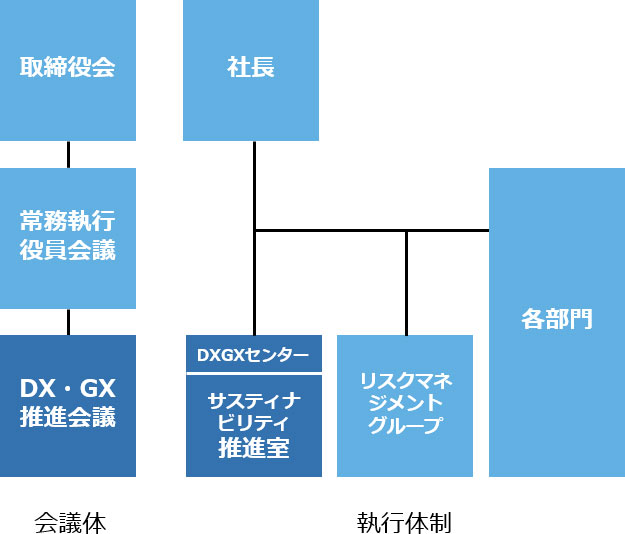
The Sustainability Promotion Office will connect various company-wide activities through strong collaboration with departments and groups, including the Corporate Planning Group, Risk Management Group, Design Construction Administration Department, Engineering Department, and Urban and Civil Project Department.
The Sustainability Promotion Office also works closely with relevant external organizations to serve as a driving force for accelerating sustainability initiatives across society at large.
Strategy
(1) Key Risks and Opportunities
We recognize the primary business opportunities as increased demand for architectural design and supervision services and consulting services driven by emerging market needs, as well as growth in upstream and downstream businesses resulting from the growing need for new frameworks to address climate change.
The main risks include a decline in demand within the construction industry due to rising energy and material costs; increased costs resulting from changes in market needs, policy shifts, and compliance with laws and regulations; ensuring appropriate quality amid uncertain social conditions; and damage to assets caused by natural disasters.
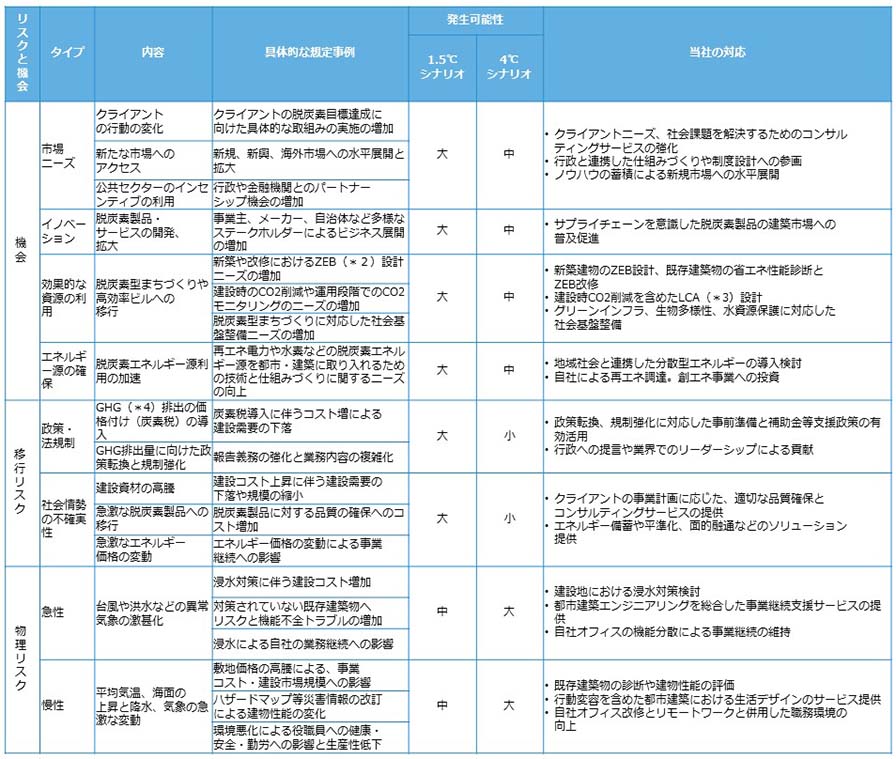 *2 ZEB: Net Zero Energy Building
*3 LCA: Life Cycle Assessment
*4 GHG: Greenhouse Gas
(2) The extent of the financial impact on the business
If an identified risk has a financial impact, the Sustainability Promotion Office conducts a detailed analysis and classifies the risk into SCOPE 1, 2, and SCOPE 3.
For risks related to SCOPE 1 and 2, the company will implement its own measures for each scenario (such as carbon-neutral renovations of company-owned real estate and the purchase of carbon credits).
Furthermore, for SCOPE 3 risks, we will calculate the investment amounts required for mitigation activities (such as internal investments in new technology development and investments in collaboration with external organizations), incorporate these investments into our annual, medium-term, and long-term plans, and introduce a system to enable continuous efforts.
Furthermore, the Sustainability Promotion Office will work in unison with the Risk Management Group to manage the climate-related risks identified above, thereby integrating climate-related risks into the company-wide risk management framework.
③ Response Policy
we plan to strengthen the following three areas: ⅰ) providing new value, ⅱ) providing new frameworks, and ⅲ) communicating our own activities.
i) Providing New Value
We are considering the following items as ways to provide new value:
・Design services that incorporate a management perspective (reducing CO2 emissions from construction and operations, securing renewable energy, etc.).
・ Upstream consulting services (creating flexible systems that envision the future direction of the region; providing support based on an understanding of the supply chain, etc.).
・ Downstream performance verification services and real estate value enhancement initiatives.
In our medium-term management plan, we aim to expand our business scope from upstream to downstream and further to social systems that include the national government and local municipalities; we will strengthen these efforts from an environmental perspective.Nikken Sekkei has a long history of initiatives from an environmental perspective; however, as opportunities increase in the future, we believe it is necessary for the entire company to unite to raise our clients’ awareness of sustainability and actively provide value from a sustainability perspective.
(ii) Providing a New Framework
We plan to introduce new initiatives, such as a framework for developing and providing tools to calculate CO2 emissions associated with construction (embodied CO2) and a framework for environmental performance evaluation indicators for buildings. In doing so, we anticipate collaborating with clients, academic and professional associations, and industry groups.
We also plan to engage in joint development and joint ventures aimed at improving environmental performance. To that end, Nikken Sekkei is working to build an open platform that will strengthen our ability to provide solutions to social issues that transcend industry boundaries.
(iii) Publicizing the Company's Activities
With the goal of achieving net-zero greenhouse gas emissions from Nikken Sekkei’s own business activities, we will work to introduce the most efficient systems and renewable energy sources, leverage digital technology, and implement an app for calculating individual CO₂ emissions. Furthermore, we plan to conduct public awareness campaigns.
We view information disclosure through initiatives such as the “Declaration of a Climate Emergency,” the “Sustainability Report,” and the “Six Proposals” as an integral part of these efforts. We believe that by disclosing information to the public, we can foster empathy and collaboration with society, thereby promoting the resolution of environmental issues across society as a whole.
Risk Management
Risk Management Framework
With regard to strategic and management risks, the Corporate Planning Group formulates hypotheses regarding potential future risks and opportunities. If these need to be reflected in the medium-term management plan, a revision proposal is prepared, discussed at the Senior Executive Officer, and approved by the Board of Directors.
Addressing Climate Change Risks
If physical risks are projected to increase further, a report will be made to the BCP Promotion Liaison Committee, and, if necessary, the Risk Management Group and the Corporate Department will take the lead in reviewing the BCP plan.
Metrics and Goals
(1) CO2 Emissions Associated with Nikken Sekkei’s Business Activities
② CO2 emissions from projects designed by Nikken Sekkei
③ Consideration of CO2 emissions for projects currently in the design phase
DO: Design Orientation—conducted for all projects.
DR: A design review to verify that the objectives identified during the DO are reflected in the basic design.
NDG: Nikken Sekkei’s first design strategy, “NIKKEN DESIGN GOALS". Categorized into 15 categories.
List of Target Values (KPIs) by Category and SCOPE
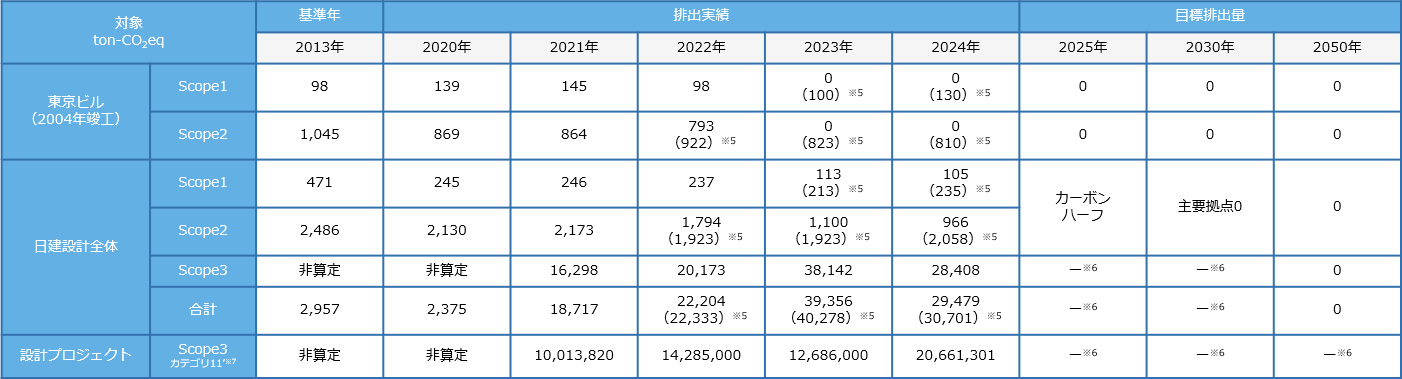 *5 If you are not using the Renewable Energy Plan
※6 –: We will not set a target at this time, but we will monitor actual emissions.
*7 Scope 3 Category 11: Use of buildings designed by Nikken Sekkei (building use by occupants, over a 50-year period)