
Toward Cities That Mature with the Passage of Time
SCROLL DOWN
A city does not become complete the moment its construction is finished. Rather, it gradually matures and evolves as people continue to use it. A walkable city requires more than simply making it easy for people to get around on foot—it means creating environments that encourage people to go out, invite them to linger, support their everyday activities, and enhance their well-being. This discussion explores the possibilities of spaces that embrace change while also continuing to create new value



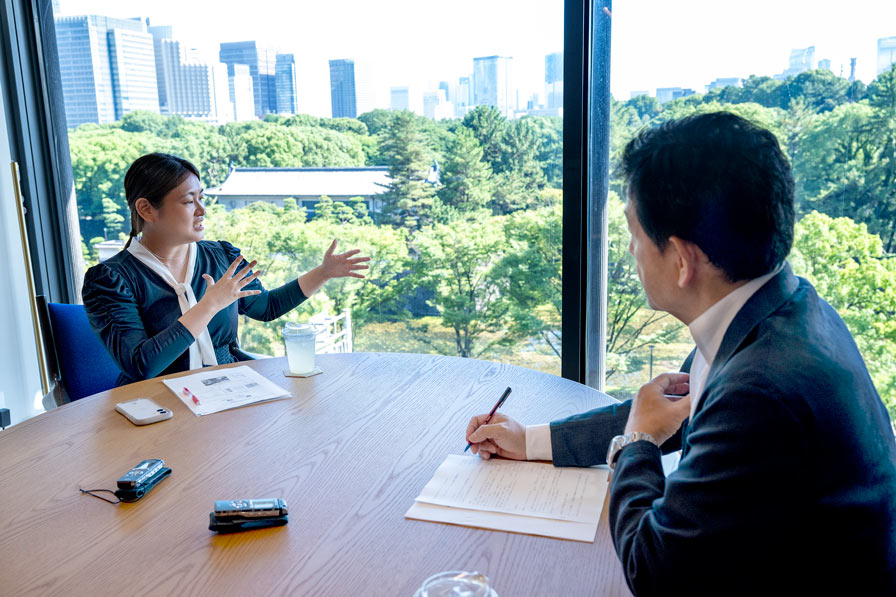
Shino Miura: The concept of walkability has been around for a while. It originally emerged from the idea of reclaiming urban spaces for pedestrians after motorization had reshaped them around the automobile. In the 1960s, figures such as Kevin Lynch and Jane Jacobs helped spark new discussion aimed at critically rethinking modern urban planning, observing cities at eye level, and creating spaces for people
Later, the term found its way into a range of fields, including public health and transportation planning, and walkability came to be considered not only on the scale of districts and neighborhoods but also as a citywide metric. Walking is related both to reducing environmental impact and to people’s physical and psychological health. In this sense, walkability has increasingly come to be seen as a fundamental condition of cities—one that should be enjoyed by all citizens.
Research on walkability grew significantly during the 1990s and 2000s. The ability to work with data at a citywide scale using tools such as GIS (Geographic Information Systems), along with the growing adoption of practical approaches such as placemaking, also had a significant impact. I see the renewed attention to walkability since the 2010s as the result of growing social needs and advances in technology coming together.
Today, walkability is defined as “creating urban environments that accommodate the diverse needs of pedestrians.” When considering how to achieve that, we must think beyond simply a place that is easy to walk through. Pedestrians should be able to get around easily and feel motivated to get out and enjoy the space. They should also be able to linger, relax and feel comfortable, and engage in a variety of activities.
What does it take to create a city that is pedestrian-oriented and also makes the act of walking a joy in itself?
Miura: I would say activity. Over the past decade or so, people have increasingly recognized the importance of not simply creating comfortable spaces but also creating places that actually generate activity for people.
Okumori: I see. In our own practice, we have also felt that simply reclaiming space from cars for pedestrians will not, in itself, lead to new possibilities. For example, in the Chuo-dori Street Reorganization Project in the city of Yokkaichi, we are looking at converting a major street in the city center into a pedestrian-oriented space and also discussing ways to draw universities to the area and create frameworks that give rise to activities in public spaces.
Miura: The next challenge is how to sustain those activities. First, how do we bring together people who are willing to continue contributing to these activities, even on a small scale? And how can we enable them to remain involved not as volunteers, but through paid work? Rather than assessing a project solely in terms of its economic impact, we also need to consider how to support and sustain the diverse activities of local communities from an environmental and social perspective.
A Framework for Sustaining Activity
Miura: Pilot projects are effective in creating the impetus to try something new, but there is little point in holding one large event and leaving it at that. What matters is having people in the community who will continue to be active on a regular basis after the pilot project ends.
In the Hokkaido city of Asahikawa, changing local rules governing the use of public space has encouraged people who had previously wanted to use these spaces but had not taken any action to step up and express their desire to do so. Some use the spaces to sell local products, while some use them for hobby groups and community activities. When there are people who can remain involved on a regular basis, public spaces gradually evolve from event venues into places that accommodate everyday community activities.
Another challenge, however, is how to communicate the value of these activities. In a shopping district, for example, activity tends to be evaluated by economic indicators—sales, for example. But the value of maintaining small, comfortable spaces and bringing more people to them goes beyond such indicators.
So, how do we assess social, environmental, and cultural value? In Asahikawa, for example, we are looking at how much time people spend in the city center and the diversity of the people who participate in activities there. These calculations may not translate directly into sales, but I think greater involvement in the community can itself be seen as a type of value.
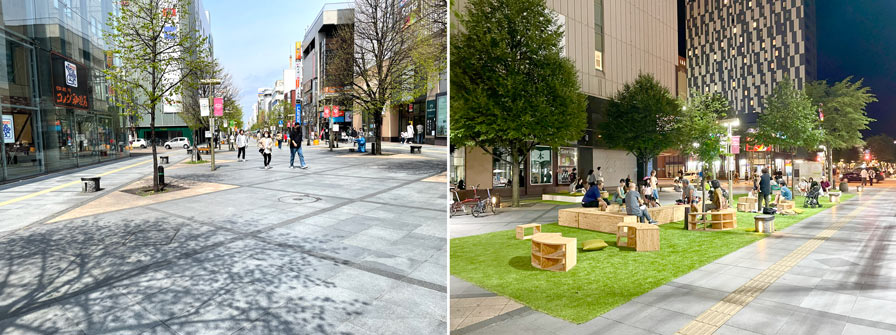 A social experiment in Asahikawa led by Shino Miura. Left: under normal conditions; right: during placemaking activities.
New Measures of Value
Advances in technology, as well as knowledge accumulated over the years, are gradually making it possible to measure and assess forms of value that were previously difficult to quantify. Visualizing these forms of value makes it easier to communicate why such investments are worthwhile.
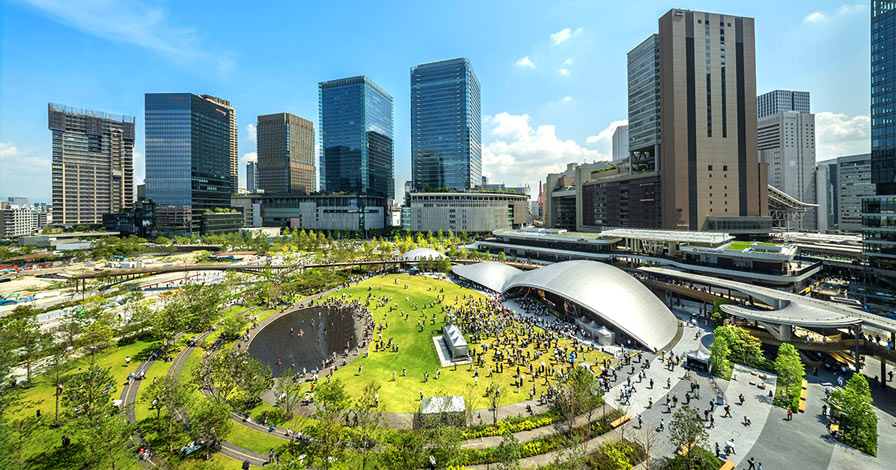 Grand Green Osaka. The “Greenery Gauge” visualizes the value of investing in green spaces.
Photography: Akira Ito [aifoto]
Okumori: So rather than economic, environmental, social, and cultural value existing independently of one another, one form of value leads to the next, creating a virtuous—not a vicious—cycle. It is important to have a grasp of this interconnected structure.
You mentioned that walkability has come to encompass a range of values, including health and the environment. How is walkability related to “Well-being,” which has been receiving a lot of attention lately?
Miura: In London, a policy called “Healthy Streets” is being promoted. Rather than focusing just on streets, it incorporates health considerations into comprehensive urban redevelopment, with the aim of getting people to be more physically active and improving mental well-being across entire areas.
One notable feature is the development of indicators to measure the policy’s impact. For example, increased physical activity through walking or cycling can contribute to better health, while a reduction in the number of days people take off work due to illness can be translated into monetary value as a marker of increased productivity.
Also, people with different roles—including those in the transport and urban development sectors, developers, and local residents—share the common goal of creating a “healthy” city, and they have a set of indicators for measuring progress toward that goal. These indicators enable stakeholders to communicate with each other, which allows each of them to contribute to the transformation of the city from their own perspective.
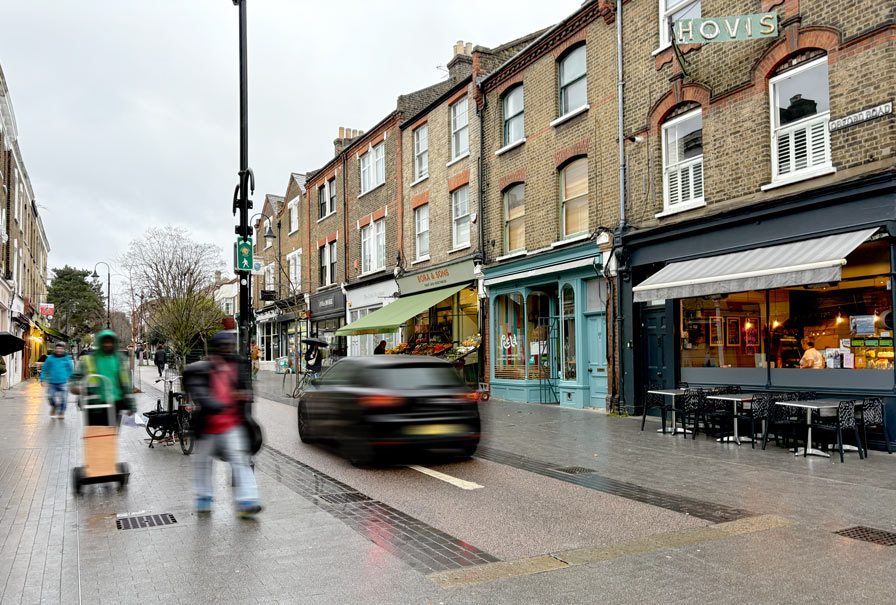 In London, a health perspective has been incorporated into citywide urban redevelopment. The photo shows an existing residential area where street design was implemented as part of the “Low Traffic Neighborhoods” initiative (taken in January 2026 during Shino Miura’s site visit).
Miura: That’s exactly right. I think it may be helpful to think of health and well-being as the outcomes we seek to achieve, with walkability providing the foundation of the urban environment where we can achieve them.
And as we discussed at the beginning, walkability consists of two elements: physically moving through space and feeling comfortable in that space. One idea is that if it is easy to get around, people are more likely to want to go out. At the same time, having places where people can stop and spend time makes it possible to walk at a more leisurely pace and stop to linger along the way. When both of these aspects are considered together, they create opportunities for people to be active, which in turn can enhance well-being.
Okumori: The COVID-19 pandemic prompted many people to reassess the value of nearby parks and public spaces. With restrictions on mobility, many people came to realize how walking and relaxing in places close to home can contribute to their health and quality of life.
Miura: One issue we need to consider going forward is heat. If conditions like those we have experienced in recent summers continue, we may reach a point where it won’t be feasible to talk about walkability.
Heatstroke in outdoor spaces is also becoming a major concern. This means it’s important to consider how to provide shade and where to introduce greenery when we think about expanding pedestrian spaces.
In Barcelona, pedestrian spaces have been connected through initiatives such as the Superblock program, which incorporates more existing shaded green spaces into pedestrian space. In Japan, too, I think we need to move beyond creating walkable spaces as isolated points and instead think about creating a network of connected greenery and shaded areas.
Configuring "Initial Settings" for Continual Change
Miura: I would like to see mechanisms put in place that allow cities to keep evolving. In some projects overseas, a space is described not as “complete,” but as “matured.” The idea is that opening a space to the public is not the end point; rather, it continues to change and develop through use. Instead of simply making use of a space as it was designed, it is important that local people are able to “edit” how it is used over time. In other words, the space should remain flexible enough to accommodate changing patterns of use. To make that possible, we need to think from the outset about the basic decisions—the “initial settings”: who will be involved, how the space will be managed, and how it can be adapted in the future.
In some countries, government agencies put such systems in place from the outset, while organizations dedicated to conserving local resources, such as natural and historical assets, might also take on such roles. In Japan, however, it’s still unclear who should propose these “initial settings.” As a leader in both design and management, I hope you will propose these kinds of mechanisms as part of your work with local governments and communities.
Okumori: That very much reflects our own thinking—rather than seeing completion of a project as its end, we need to learn from how the space is actually used and feed those lessons back into the basic decisions on future projects. As society shifts from an era of growth to one of maturity, simply providing more space is no longer enough. Learning from the projects we work on, we need to consider, from the outset of planning and design, how spaces will be used and mature over time; how to create frameworks that enable cities to keep on generating value in the process. I believe adopting this broader view of the city will become increasingly important.
Miura: I would like to see cities where people can start by experimenting. In some projects overseas, once there is a certain level of support, they begin by launching an experiment and continue testing it over an extended period to encourage changes in people’s behavior.
Rather than deciding to achieve a final form from the outset, the idea is to start on the condition that they can stop the experiment if things aren’t working out. In the meantime, the behavior of the people using the space may change, and the way it is evaluated may change as well. I believe creating systems that allow such experimentation to continue is essential for Japan to transform its cities.
Okumori: With the understanding that these are experiments, it’s important not to place the risks on any one party, but to share them across the community. Otherwise, people may ultimately decide it’s safer not to do anything at all.
Until recently, even basic information like sidewalk widths could be difficult to work with using GIS. But as we accumulate more detailed, human-centered data at the neighborhood scale through technologies like image analysis, it will become easier to examine in detail what might happen if we make a particular change.
Okumori: Looking ahead, we could use digital twins to simulate scenarios digitally and then turn those simulations into practical real-world experiments. We could then feed the results of those experiments back into the data. If we can create this kind of cycle, it could become a force for accelerating urban change.
I hope we can see more of these kinds of trials being actively pursued in different places, which will lead to changes in the value of walkable spaces and create a positive cycle that will enable us to generate new forms of value.
Miura: Yes, I hope we can accomplish such a thing.
Interview photos by: Ryota Atarashi