
To Shibuya, a city where creativity shines brightly.
Diverse public spaces will drive its future.
SCROLL DOWN
The Tokyu Group is promoting a large-scale development project centered around Shibuya Station, with the goal of realizing “Entertainment City SHIBUYA” as a stage for showcasing new businesses and cultures that lead the world.
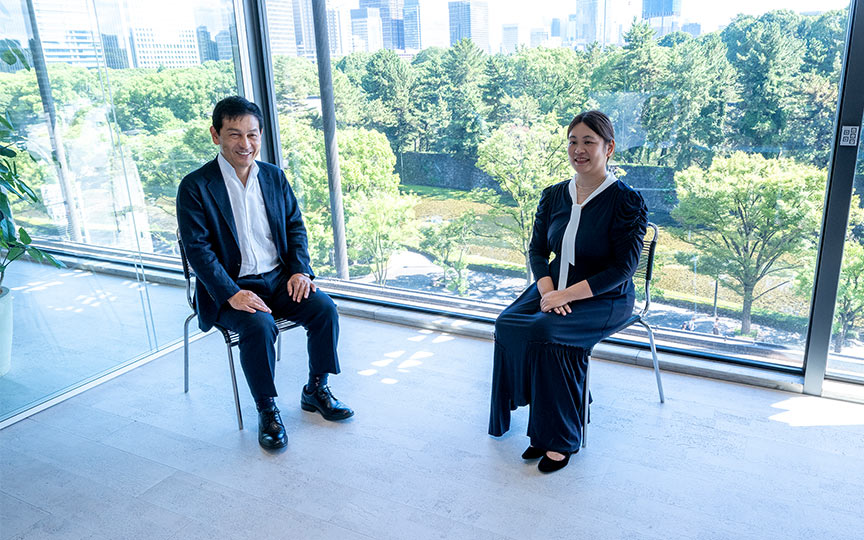
Nikken Sekkei has been deeply involved in this development since the urban planning stage, bringing to Shibuya the experience and expertise gained from working on over 25,000 projects across 50 countries worldwide.In light of this, Tadao Kamei, Representative Director of Nikken Sekkei (President and CEO), spoke with Hirofumi Nomoto, Representative Director of Tokyu (Chairman), about the future of Shibuya as it undergoes significant transformation.



Shibuya to become "Japan's most desirable city to visit": A major transformation
- What prompted you to proceed with this once-in-a-century transformation of Shibuya?
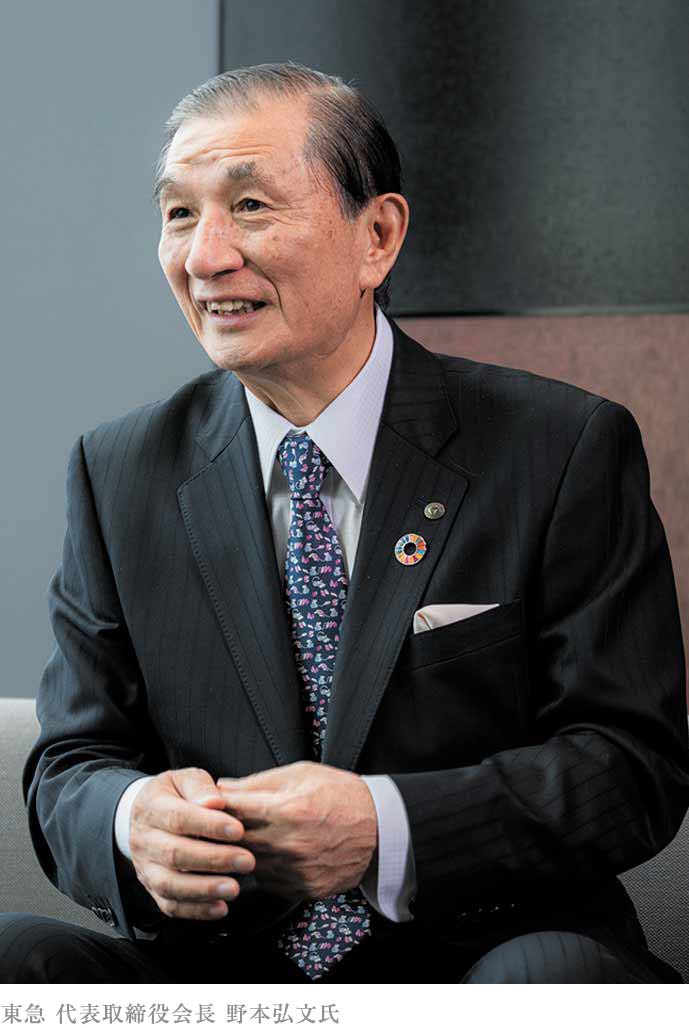
Nomoto Chairman (hereinafter referred to as Nomoto): Given its location in a “valley,” Shibuya has always had a natural limitation on how much it can expand, and the short amount of time people spent in the area was a problem. In 2007, when I became involved in Shibuya’s urban development, I realized we had to bring out the district’s unique characteristics. To that end, we launched the concept of “Japan’s Most Desirable City to Visit.”Shibuya is home to NHK and Tokyu Bunka Mura, and it ranked first in Japan in terms of the number of concert halls, live music venues, and movie theater seats. Building on that foundation, we set our sights on creating “Entertainment City SHIBUYA.”
Kamei President and CEO (hereinafter referred to as Kamei): Starting around 2000, I had the opportunity to participate in the major redevelopment of Shibuya. With the number of Shibuya Station users increasing significantly and the station’s capacity reaching its limit, it was necessary to transform the area into a place where visitors could enjoy a comfortable and stress-free experience.As part of this effort, I was responsible for the design of “Shibuya Hikarie,” which was completed in 2012. Within that site, we developed a public space called the “Urban Core,” designed to facilitate the smooth movement of people from the underground transportation hub to the surface.This became a model for the overall Shibuya development and led to the completion of Phase 1 of “Shibuya Scramble Square the First Phase (East Tower)” last November. During the planning phase for “Shibuya Scramble Square the First Phase (East Tower),” Chairman Nomoto joined a design workshop conducted with architects Kengo Kuma and Kazuyo Sejima, where he shared his passionate vision.
Kamei President and CEO (hereinafter referred to as Kamei): Starting around 2000, I had the opportunity to participate in the major redevelopment of Shibuya. With the number of Shibuya Station users increasing significantly and the station’s capacity reaching its limit, it was necessary to transform the area into a place where visitors could enjoy a comfortable and stress-free experience.As part of this effort, I was responsible for the design of “Shibuya Hikarie,” which was completed in 2012. Within that site, we developed a public space called the “Urban Core,” designed to facilitate the smooth movement of people from the underground transportation hub to the surface.This became a model for the overall Shibuya development and led to the completion of Phase 1 of “Shibuya Scramble Square the First Phase (East Tower)” last November. During the planning phase for “Shibuya Scramble Square the First Phase (East Tower),” Chairman Nomoto joined a design workshop conducted with architects Kengo Kuma and Kazuyo Sejima, where he shared his passionate vision.
Shibuya is developing like a tornado, swirling around its public spaces.
- In what direction do you think Shibuya will develop in the future?
Nomoto: Because Shibuya lies at the bottom of a valley, people and energy well up from the depths and rise upward. Furthermore, on a horizontal plane, they swirl like a tornado and spread throughout the entire city. I believe this pattern of development is well-suited to the topography. As a result, Shibuya is evolving into a place that offers a unique kind of enjoyment unlike anything seen before.We are currently working with Nikken Sekkei to implement in Shibuya the very same urban development approach they have been practicing around the world.
Kamei: Unlike projects on vacant lots overseas, I find it incredibly fascinating to unravel the various historical contexts and constraints in Shibuya.While development is currently concentrated around the station, in terms of the city’s overall growth, we must extend the flow of people to the surrounding areas as well. Shibuya is currently expanding in a radial pattern, but if we strategically place key hubs and connect these radial routes with a ring network, a completely different Shibuya will emerge.
Kamei: Unlike projects on vacant lots overseas, I find it incredibly fascinating to unravel the various historical contexts and constraints in Shibuya.While development is currently concentrated around the station, in terms of the city’s overall growth, we must extend the flow of people to the surrounding areas as well. Shibuya is currently expanding in a radial pattern, but if we strategically place key hubs and connect these radial routes with a ring network, a completely different Shibuya will emerge.
- Public spaces play a significant role in development, don't they?
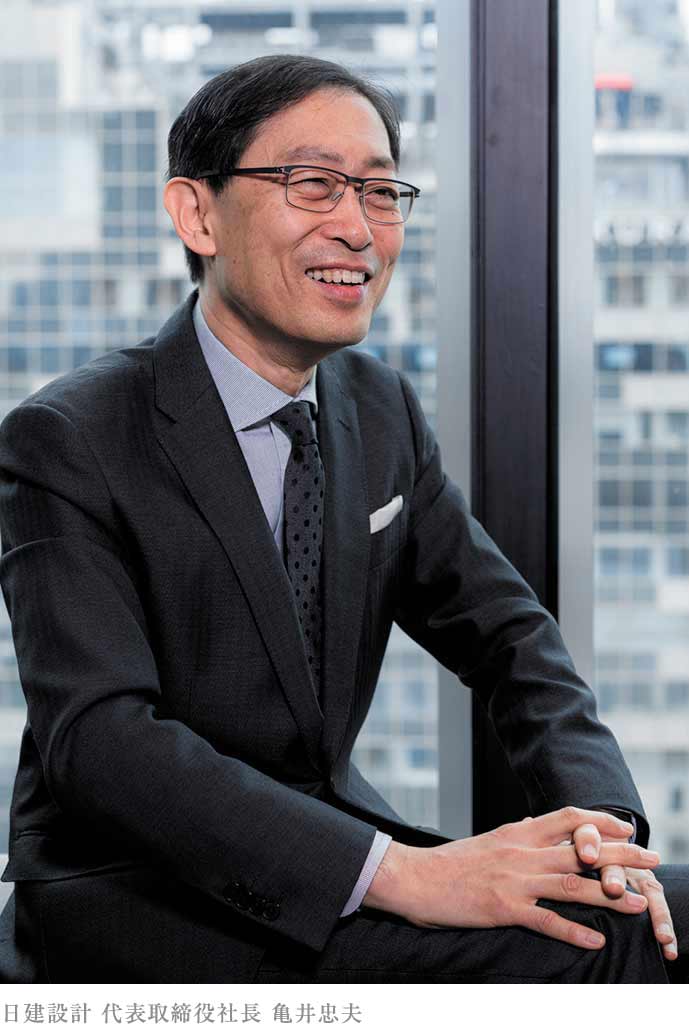
Kamei: At Nikken Sekkei, we assist with urban development projects both in Japan and abroad, and in doing so, we are constantly considering how to create public spaces—just as we are with this major redevelopment of Shibuya.Since 2017, we have adopted “EXPERIENCE, INTEGRATED” as our brand tagline. This expresses our commitment to integrating our own experience with that of our clients to create even more diverse experiences.
Nomoto: Basically, when it comes to urban development, companies have no choice but to pursue maximum profits. However, as we demonstrated in the Futako-Tamagawa development, it is possible to create public spaces. If new public spaces are established in various locations, I believe it will enhance pedestrian flow and help the city expand.
Nomoto: Basically, when it comes to urban development, companies have no choice but to pursue maximum profits. However, as we demonstrated in the Futako-Tamagawa development, it is possible to create public spaces. If new public spaces are established in various locations, I believe it will enhance pedestrian flow and help the city expand.
Towards "Shibuya of the World," where sensibilities are revealed.
—What do you think the future holds for the city of Shibuya?
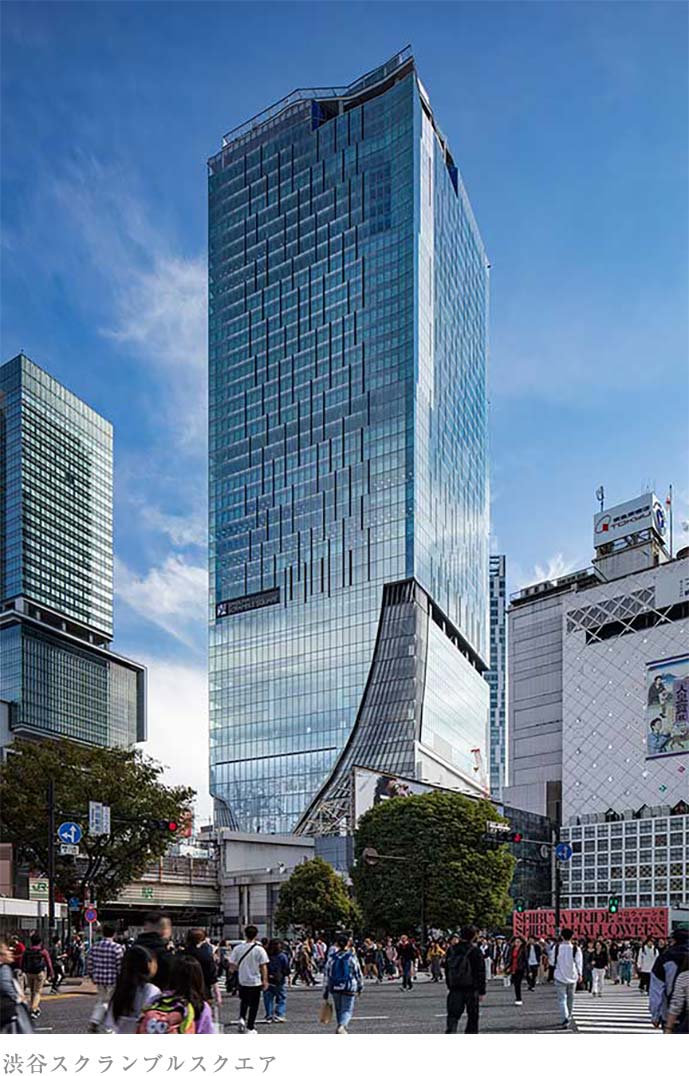
Nomoto: I think many companies want to set up offices in Shibuya because it’s a neighborhood where they can easily connect with trend-conscious consumers, especially those in the IT industry.I’ve dubbed Shibuya “a city where sensibility comes to life.” Within “Shibuya Scramble Square the First Phase (East Tower),” we’ve created a space called “ASOVIVA” that offers three types of play areas: a place to shop, a place to spend time, and a place to gather. “Play” is the origin of culture. If this spirit can spread and permeate the entire city of Shibuya, it can become “Shibuya of the World.”
Kamei"Shibuya Scramble Square the First Phase (East Tower)" on the 15th floor is home to "Shibuya Q's," a space conceived as a "crossroads of possibilities reaching out from Shibuya to the world." It serves as a hub for people who gather and carry out activities in Shibuya. It has the feel of a "third place," characterized by a space where the line between work and play is blurred.
Nomoto: This truly embodies Nikken Sekkei’s “EXPERIENCE, INTEGRATED” philosophy. New sensibilities are born in a city only when existing sensibilities have a chance to settle and take root.When I visited Silicon Valley some time ago, I saw many open spaces where people gathered and interacted. I believe Japan needs places like that as well. We’ve created numerous communal spaces at “Futako Tamagawa Rise,” “Shibuya Cast,” and “Shibuya Hikarie.”
Kamei: To date, our company has worked on projects such as Tokyo SkytreeⓇ, Queen's Square Yokohama, and Tokyo Station Yaesu Development.Internationally, as part of the renovation of the “Camp Nou” stadium in Spain (FC Barcelona), we are planning to remove the exterior walls so that spectators standing in the concourse become part of the cityscape themselves. “Shibuya Scramble Square the First Phase (East Tower)” is also part of this context of development that prioritizes public spaces.
Kamei"Shibuya Scramble Square the First Phase (East Tower)" on the 15th floor is home to "Shibuya Q's," a space conceived as a "crossroads of possibilities reaching out from Shibuya to the world." It serves as a hub for people who gather and carry out activities in Shibuya. It has the feel of a "third place," characterized by a space where the line between work and play is blurred.
Nomoto: This truly embodies Nikken Sekkei’s “EXPERIENCE, INTEGRATED” philosophy. New sensibilities are born in a city only when existing sensibilities have a chance to settle and take root.When I visited Silicon Valley some time ago, I saw many open spaces where people gathered and interacted. I believe Japan needs places like that as well. We’ve created numerous communal spaces at “Futako Tamagawa Rise,” “Shibuya Cast,” and “Shibuya Hikarie.”
Kamei: To date, our company has worked on projects such as Tokyo SkytreeⓇ, Queen's Square Yokohama, and Tokyo Station Yaesu Development.Internationally, as part of the renovation of the “Camp Nou” stadium in Spain (FC Barcelona), we are planning to remove the exterior walls so that spectators standing in the concourse become part of the cityscape themselves. “Shibuya Scramble Square the First Phase (East Tower)” is also part of this context of development that prioritizes public spaces.
"Shibuya Sky" is truly a facility worthy of being called a new landmark.
Kamei"Shibuya Sky," the observation deck located approximately 230 meters above ground level at "Shibuya Scramble Square the First Phase (East Tower)," is a viewing space that stimulates the senses.
Nomoto: Shibuya had only two tourist attractions: the Scramble Crossing and Hachiko. So I wanted to create something that was the best in the world right there in Shibuya. That’s why I had the rooftop helipad designed in the shape of a pyramid.
Kamei: I think the creation of a public space in the sky is extremely significant. It has connected the ground—including the scramble intersection and Hachiko—with “Shibuya Sky” up above. This will encourage people to linger longer.
Nomoto: The city must continue to evolve. We must strive to create a city where “sensibility is visible” and “sensibility lingers.” I hope to make the Shibuya of the future a city rich in such sensibility.
Nomoto: Shibuya had only two tourist attractions: the Scramble Crossing and Hachiko. So I wanted to create something that was the best in the world right there in Shibuya. That’s why I had the rooftop helipad designed in the shape of a pyramid.
Kamei: I think the creation of a public space in the sky is extremely significant. It has connected the ground—including the scramble intersection and Hachiko—with “Shibuya Sky” up above. This will encourage people to linger longer.
Nomoto: The city must continue to evolve. We must strive to create a city where “sensibility is visible” and “sensibility lingers.” I hope to make the Shibuya of the future a city rich in such sensibility.