
Untold Proposals for the Future – Nikken Sekkei's Professional Services
Part 3: Seeking a Rational Relationship Between Architectural Form and Forces (Part 2)
SCROLL DOWN
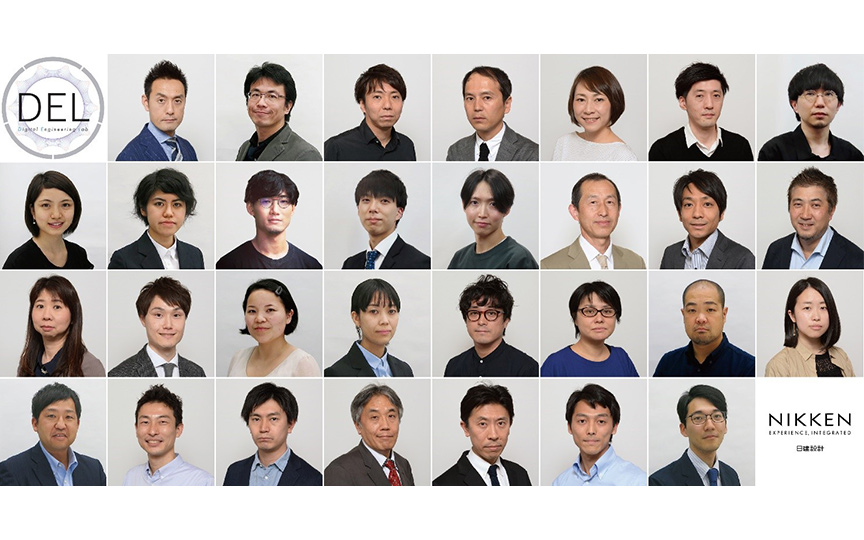
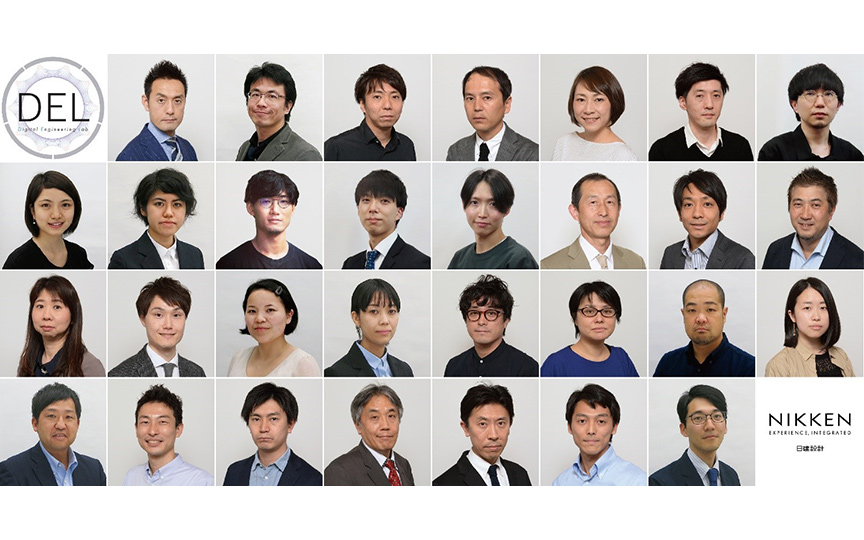
Developing rational forms and structural systems that adapt to the various conditions required in architectural design—this may seem obvious, but in reality, it's not easy. Nikken Sekkei's Digital Engineering Lab (DEL) tackles this challenge using digital technology with its "Structural Form Creation" service. Leveraging its extensive design experience and high level of expertise, DEL is a group of engineers that provides technical proposals and architectural design support. What exactly is Structural Form Creation?



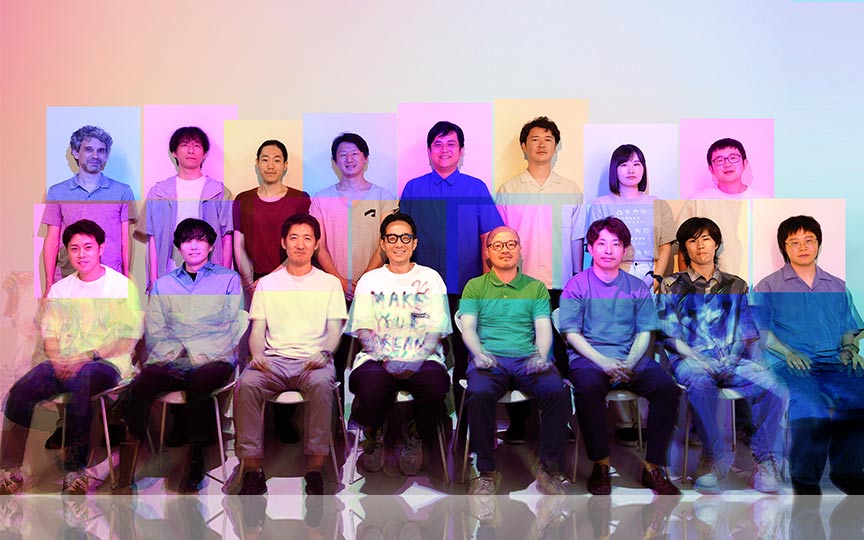
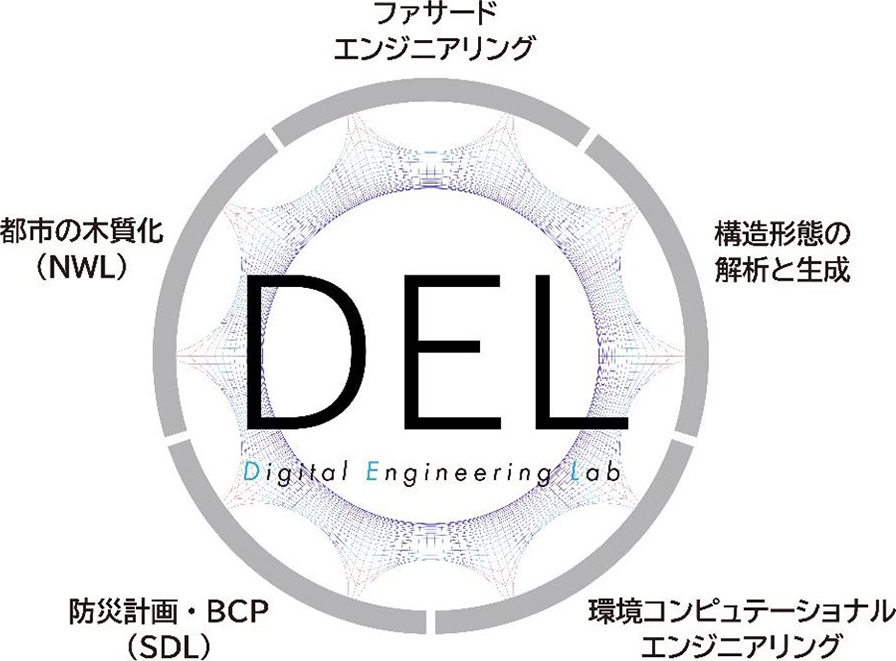 At DEL, five specialized teams provide technical proposals and design support for new and interdisciplinary design technologies required in modern architectural design and urban planning. © Nikken Sekkei
Contribute to resource conservation through optimization and enhance economic efficiency
First, I’ll introduce examples from the natural world that offer insights for architectural optimization.
For example, unlike most fish that swim vertically, flounder—perhaps because they need strong bones to lift the weight of the water while lying on the seafloor—surprisingly have a shape identical to that of H-shaped steel beams, which, like building materials, maximize bending rigidity with the minimum amount of steel.
Furthermore, the interior of cacti living in arid desert regions consists of a mesh-like network of tubes that efficiently supports the plant’s body while storing water. This is based on the same concept as the tubular structure used in the former World Trade Center in New York, and a further evolution of this—the diagrid tube structure—can also be seen in recent high-rise building designs.The star-shaped cross-sections visible on the outer skin may also help reduce wind loads. These are examples of how living organisms have optimized their shapes to adapt to harsh natural environments characterized by gravity, wind, and high temperatures and dryness.
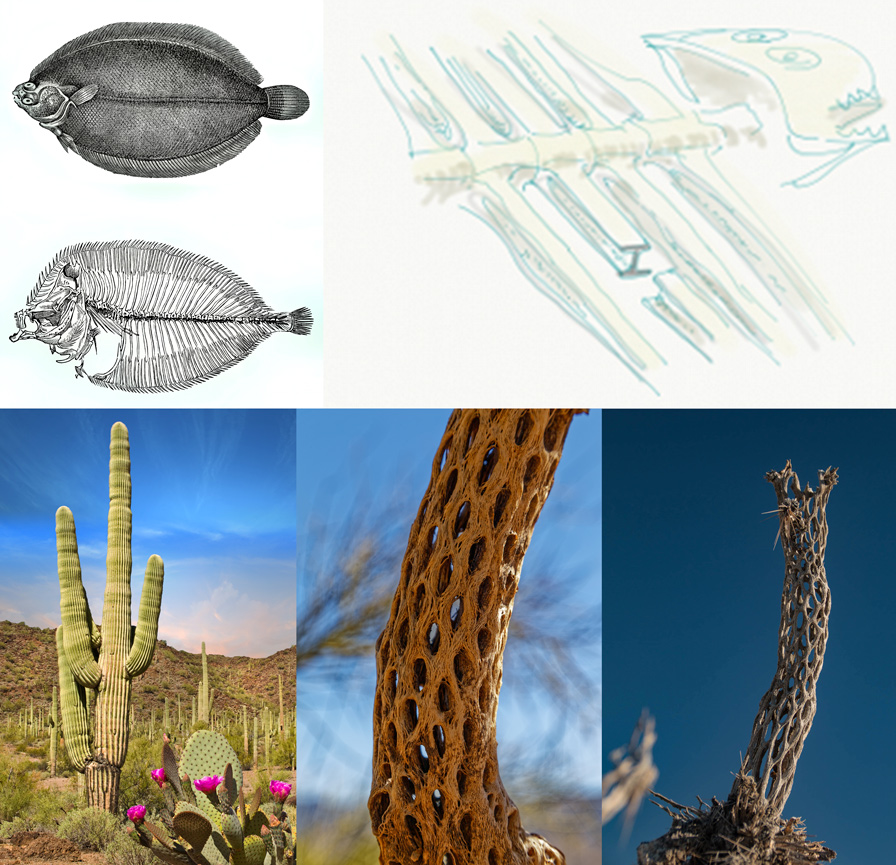 To withstand water pressure, the bones of a flounder (top) are shaped like an H-beam to maximize strength. The water-storing tissues of the cactus (bottom) have a hollow, mesh-like structure that efficiently provides bending stiffness and strength. 🄫 mikroman6 (top left), Nikken Sekkei (top right), Charles Harker (bottom left), Moelyn Photos (bottom center), MWCPhoto (bottom right)
In architecture, for example, the targets for minimization include the amount of structural materials, cost, and structural displacement.While these are two sides of the same coin, cost-effectiveness and strength are targets for maximization. We define the problem based on the values and priorities of each project, determining what to prioritize. For example, minimizing deformation within given constraints—including the total amount of material—is a common approach in structural optimization.
Just as with form-finding, Nikken Sekkei’s proprietary optimization program, NSOpt—developed primarily by Tamai—plays a key role here as well. Since it was developed in-house, its strength lies in the ability to freely configure which architectural conditions to treat as variables and which to optimize. We can also select the optimization method best suited to a project’s requirements and choose the analysis programs to integrate with it.Generally speaking, an optimization method is a computational process that involves the steps of 〈modifying design variables〉 → 〈(structural) analysis〉 → 〈evaluation of results〉, in which variables are adjusted to achieve better results. Eventually, when a point known as an “extreme value” is reached, a combination of variable values is determined where the results can no longer be improved in the vicinity of that point.This is known as the optimal solution. By making full use of NSOpt in this way, DEL’s Structural Form Generation Team proposes the optimal structural designs and construction systems for each project.
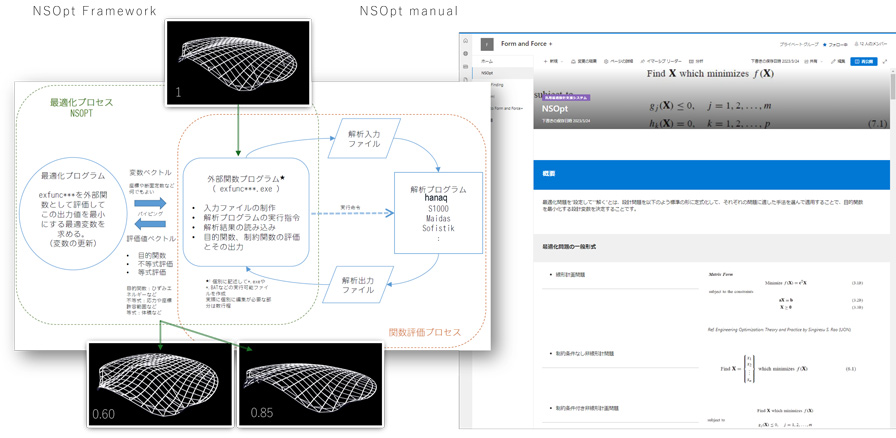 NSOpt: The optimization process performed in DEL. It allows for the visualization and evaluation of structural changes. 🄫 Nikken Sekkei
There are three main approaches to structural optimization: the optimal allocation of member cross-sections for a given geometry, topological optimization of the structure, and geometric optimization.The figure below shows the initial solution, the optimal solution, and a suboptimal solution for each method for comparison. These methods can also be used in combination. At DEL, we explore optimization paths by combining these methods as needed.
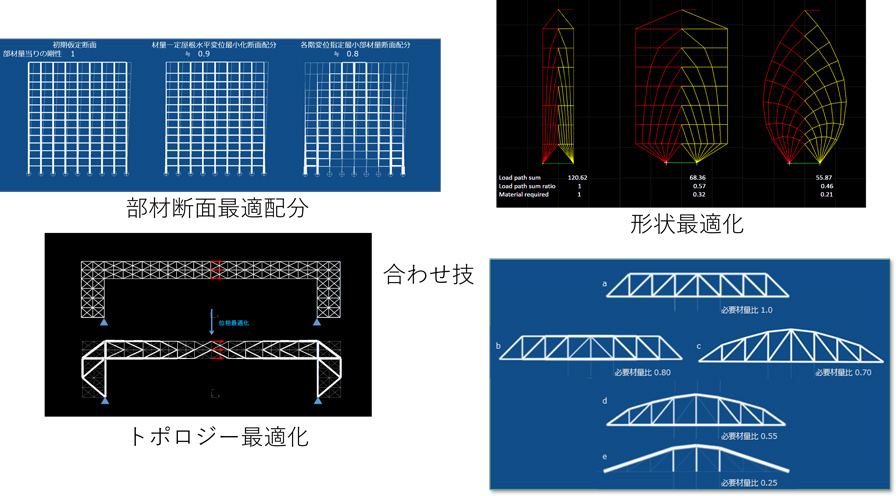 In the member cross-section optimization shown in the upper left, the cross-section size was minimized as much as possible while remaining within acceptable deformation limits. In the topology optimization shown in the lower left, a fixed amount of material is used to maximize stiffness by thinning—or, in extreme cases, removing—members with little effect, while using thicker members in effective areas. The shape optimization in the upper right seeks a stiffer configuration by altering the coordinates without changing the connections between members. The analysis was conducted with a fixed weight. The figure in the lower right, showing a combined approach, is an example that integrates cross-section optimization and shape optimization. © Nikken Sekkei
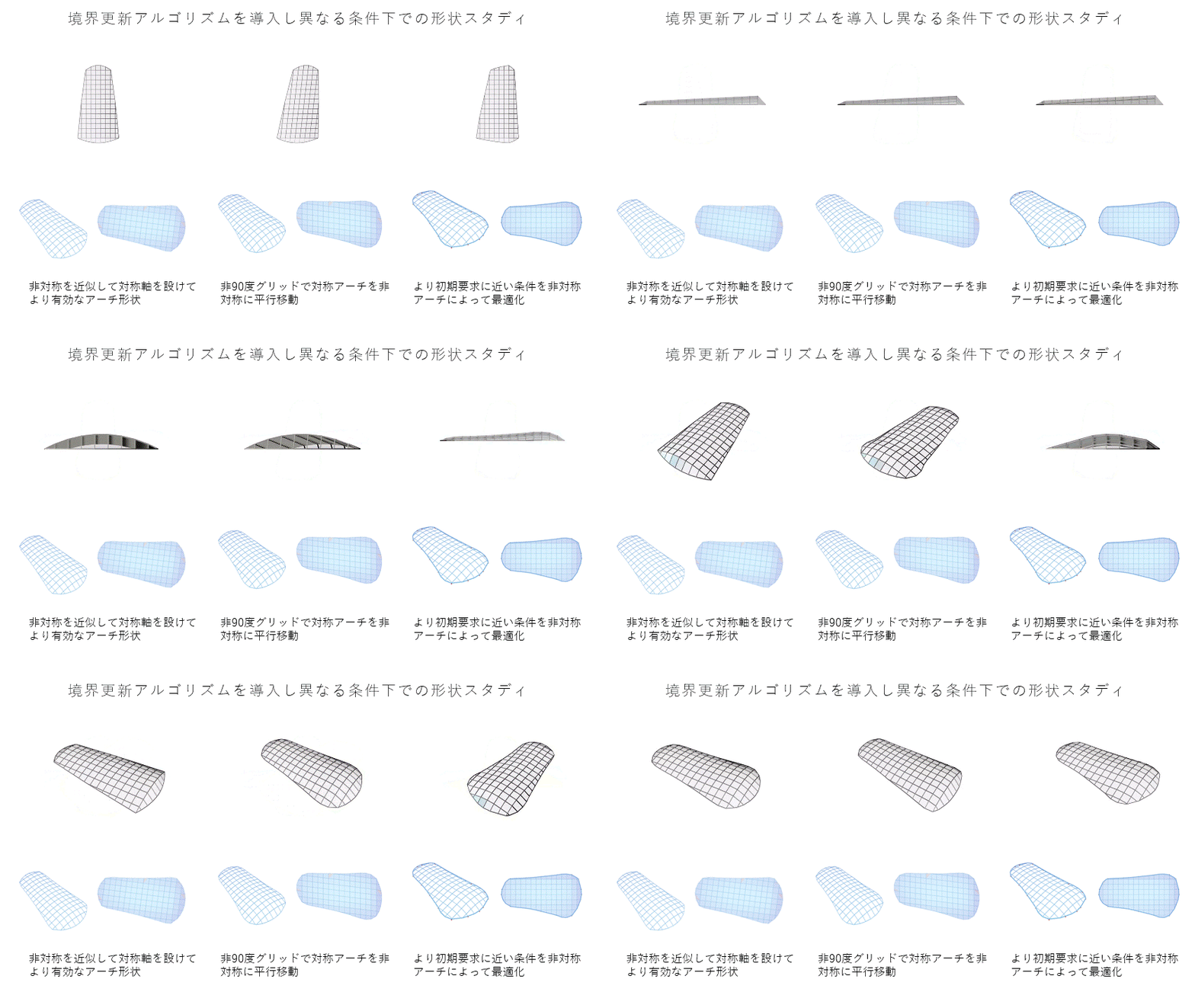 Optimization of grid shells. In this study, we compared and analyzed optimal solutions based on different mesh concepts. By visualizing each optimization calculation process, we can also visually identify solutions in the vicinity of the optimal solution. Left: A more effective arch shape achieved by approximating asymmetry and establishing an axis of symmetry; Center: A symmetric arch shifted asymmetrically using a non-90-degree grid; Optimization using an asymmetric arch to better meet the initial requirements. 🄫 Nikken Sekkei
At DEL, we sometimes perform form-finding and optimization simultaneously. While NSForm and NSOpt are highly sophisticated numerical calculation programs that operate independently, DEL is committed to in-house development; consequently, we are able to enhance computational efficiency by integrating these two programs more closely.
For example, the figure below shows a study conducted to make a membrane roof structure retractable.There is flexibility in the equilibrium shape of the cable network on the grid. However, in order to open the roof, all quadrilaterals enclosed by the points suspending the membrane must satisfy geometric conditions to ensure they are not torn apart when opening along the cables that serve as guide rails for the opening and closing mechanism.Furthermore, while ensuring these conditions are met, we performed an analysis to minimize (optimize) the difference in cable axial forces in order to make the clamps at the cable intersections as small as possible, and proposed a roof opening and closing mechanism. This is the result of extensive computer calculations and modern analytical techniques.
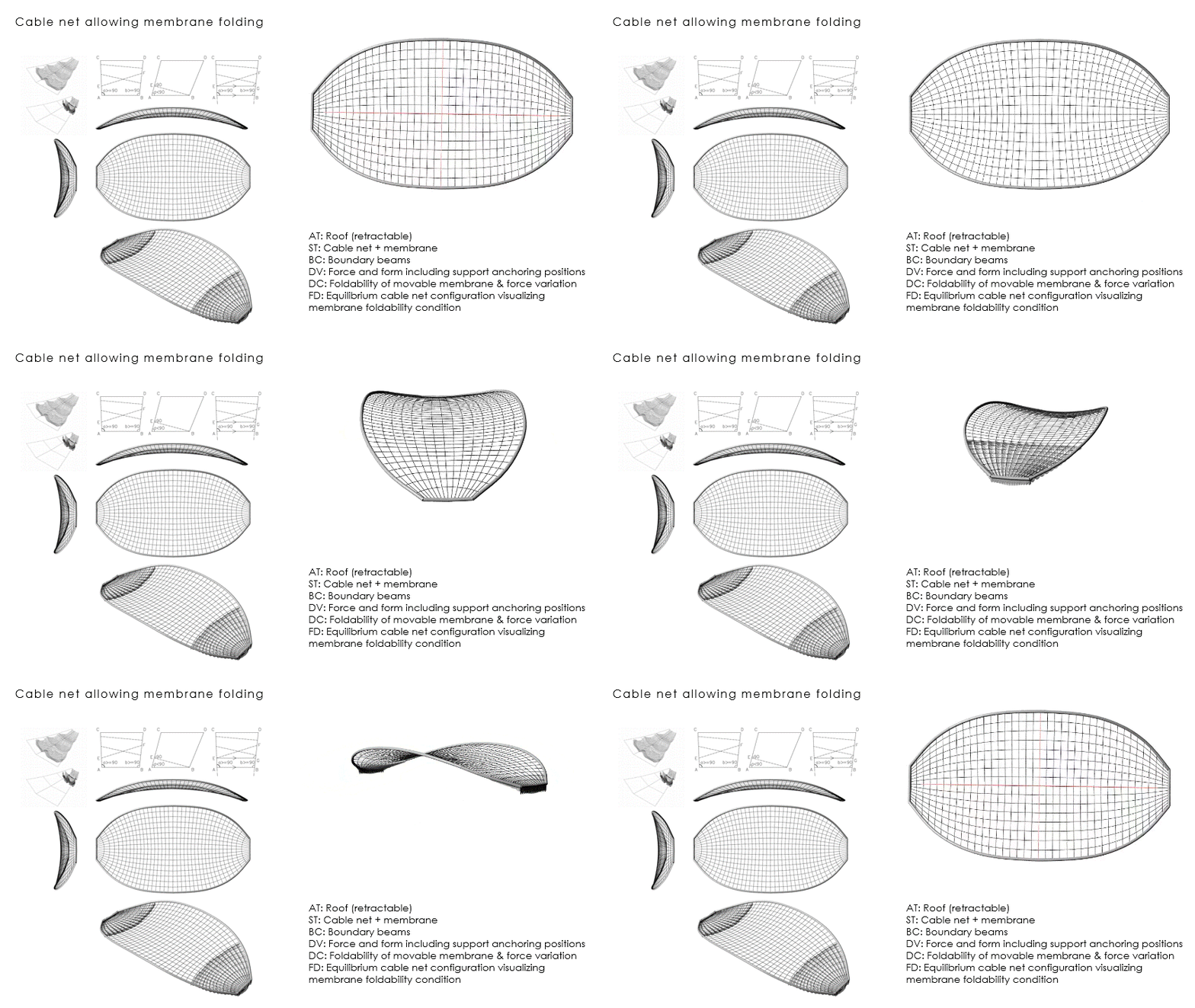 To enable the membrane roof to open and close while streamlining the cable structure, we optimized the roof’s form-finding and cable stresses. © Nikken Sekkei
"By pursuing structural forms and system efficiency,
we contribute to the effective use of the Earth’s limited resources,
enhance the cost-effectiveness of structures,
while simultaneously exploring new forms of architectural expression and the beauty of diverse structural designs.”
Drawing on the wisdom found in nature, we pursue new and beautiful architecture using cutting-edge digital technology. Structural Form Creation—which fuses this “learning from the past to innovate for the future” approach with digital technology—is one of the areas where DEL truly excels.