
The future opened up by flying cars
—Advanced Air Mobility is coming to the city—
SCROLL DOWN
"Flying cars," also known as Advanced Air Mobility (AAM), are expected to become an important mode of transportation that will open up the future of urban development by making "air travel" more accessible through vertical takeoff and landing, quiet operation, electrification, and automation. Overseas, preparations are underway for the launch of air taxi services. In Japan, manned test flights using actual aircraft under development have also begun.
As "Vertiport," a landing and takeoff space for flying cars, integrates with urban development and architectural plans, and connects with flight networks across the country, it will create new, sustainable, and exciting value in our lives.



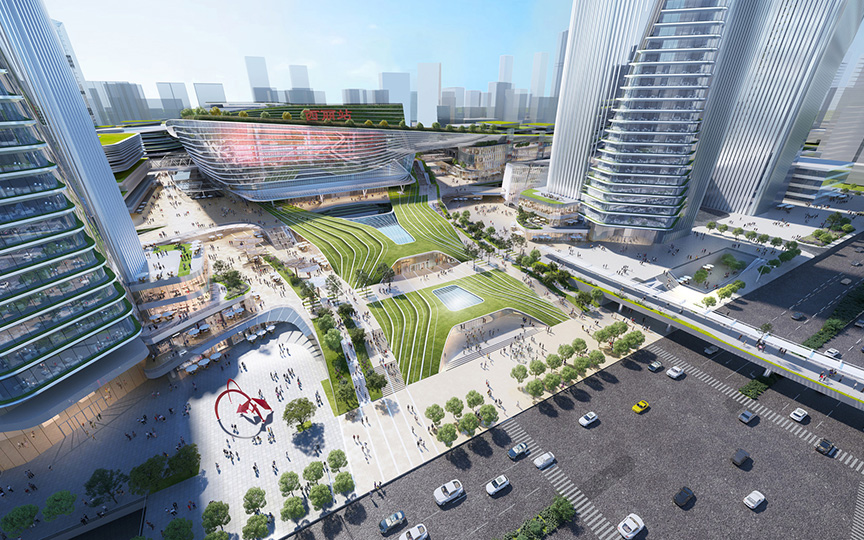
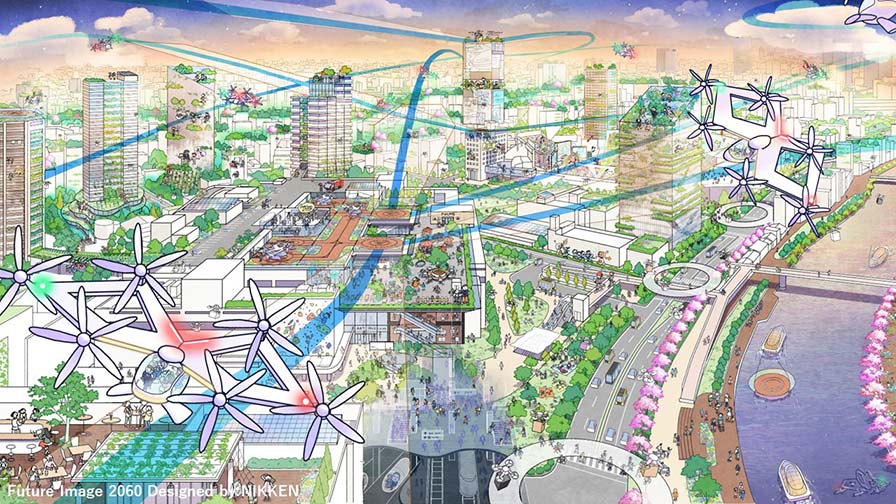 A near-future and long-term outlook on future urban design that anticipates the flight paths of flying cars. As ground traffic decreases, roads will revert to greenery. New perspectives and approaches from the air will emerge, leading to the evolution of cities and architecture into more three-dimensional structures.
Until now, when people thought of air travel, they might have imagined going to an airport to board a plane with a crowd of other passengers, or envisioned its use in medical emergencies—such as with doctor helicopters—or for disaster relief.
But what if, just like taking a taxi with Private or with your family, you could travel directly to your destination by air?
Life would be completely transformed. At the same time, various social challenges facing the ground might be solved from the sky.
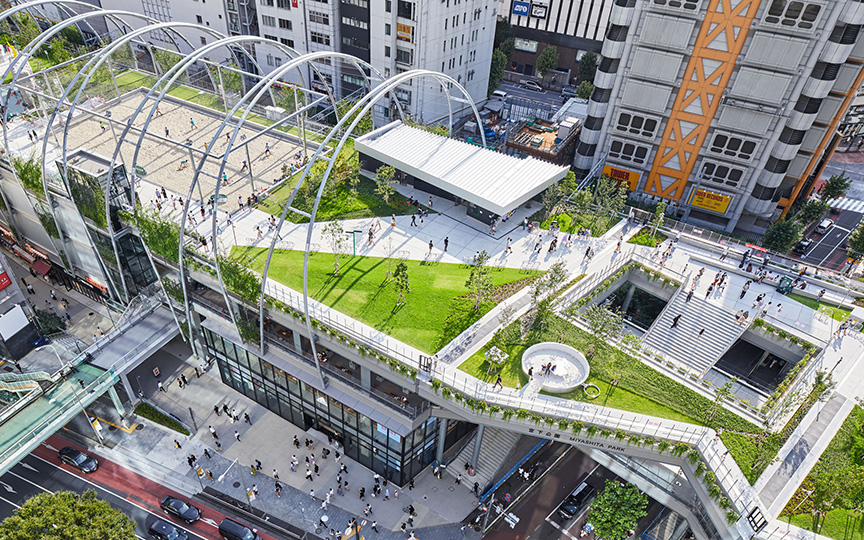
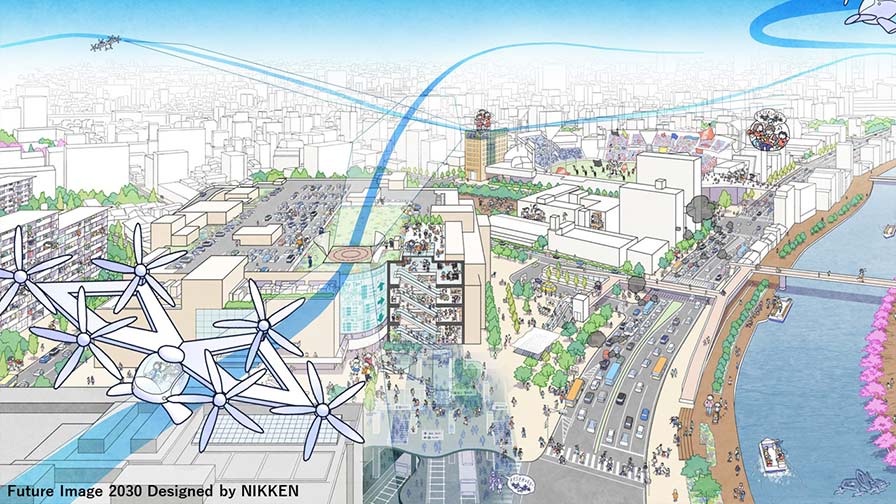 For example, imagine installing a vertiport on the roof of a shopping mall, a familiar part of everyday life, where people can board and disembark from flying cars. People arriving at the mall by car or train could then easily transfer to a flying car and travel to another city for fun.
As more places become accessible by air, not only will people's movements shift, but the logistics of goods will also move to the air.
As flying cars become a part of transportation, urban areas will have more free space in the road network and other transportation networks that previously occupied a significant portion of the land. This free space will open up new possibilities, and if parks, sports facilities, vegetable gardens, and forests are created there, it will lead to improvements in urban self-governance and quality of life.
Starting the future of flying
—From proposal to implementation—
In 2023, the Ministry of Land, Infrastructure, Transport and Tourism issued guidelines for the development of vertiports, making it possible to conduct concrete studies on installing vertiports in cities and buildings, and we began to be involved in projects targeting actual sites. Here are two examples.
* The Landing and Takeoff Site Working Group of the "Public-Private Council for the Air Mobility Revolution" by the Ministry of Land, Infrastructure, Transport and Tourism and the Ministry of Economy, Trade and Industry.
Example 1: Increasing the number of people involved with flying cars
Determining the dimensions and structure required for landing and takeoff fields based on aircraft performance evaluations. How to actually install them in the current urban landscape. How to introduce them in a way that makes the lives of users more enjoyable and convenient.
We have also carefully considered ways to communicate highly specialized and complex research in an easily understandable manner.
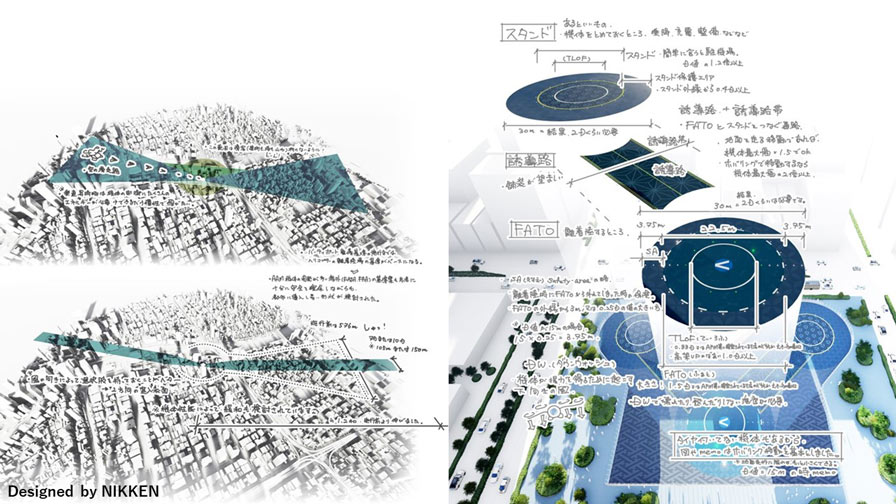 Specialized information, such as considerations for introducing the system into urban landscapes and dimensions of vertiports, is visualized in an easy-to-understand manner.
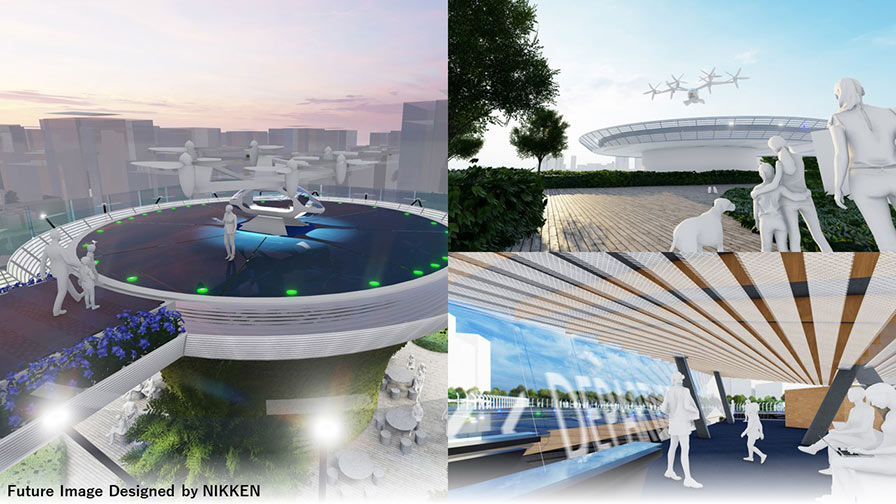 Designing a Vertiport space where everyday life and cutting-edge technology merge.
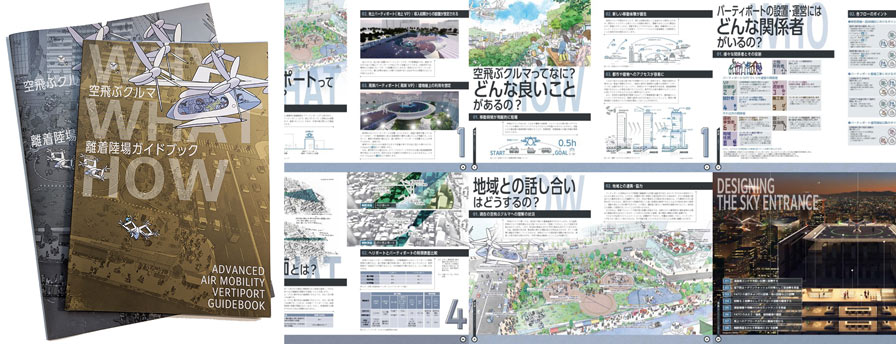 Flying Car Landing and Takeoff Site Guidebook: This guide provides an easy-to-understand explanation of the Ministry of Land, Infrastructure, Transport and Tourism's guidelines for developing vertiports.
Example 2: Next-generation transportation hub - Fusion of flying cars and existing urban transportation facilities
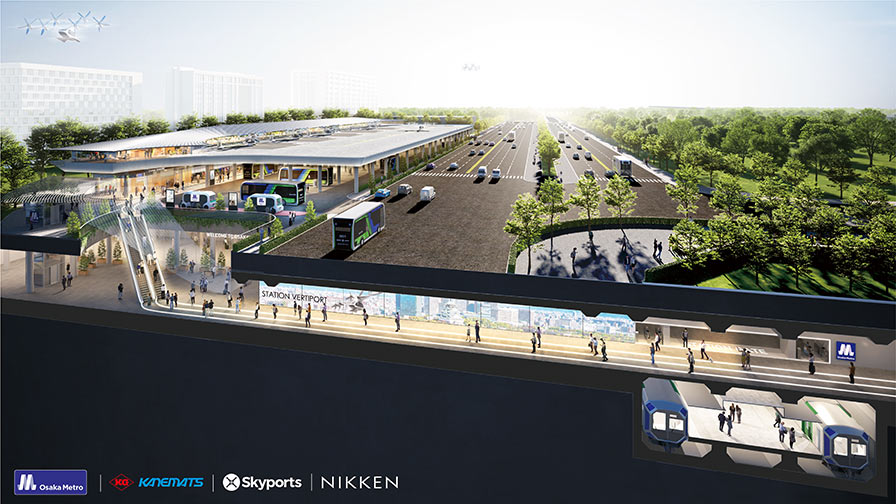 Next-generation transportation hub: A prototype image of Vertiport, which integrates with transportation terminals in front of stations such as subway stations and bus terminals.
Plans tailored to each individual challenge and condition
—The next solution created by vertices and networks connecting land, sea, and air.
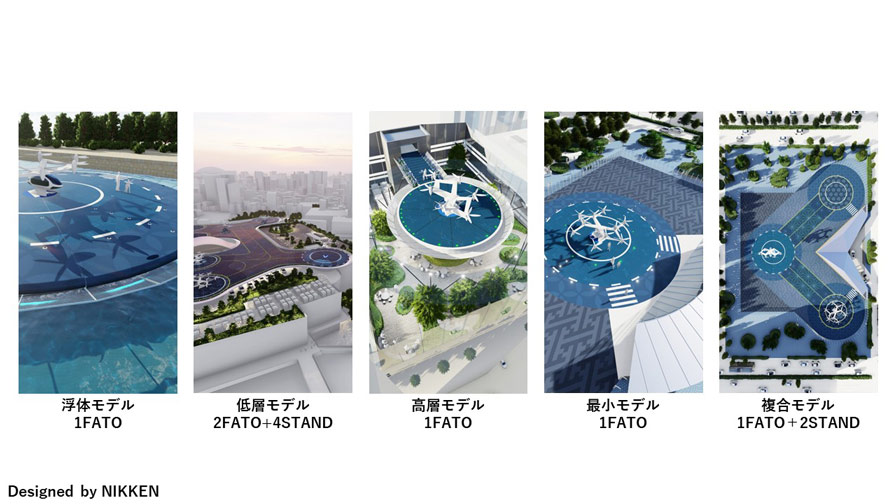 Vertiport patterns that can be selected to suit the environment
For example, during the initial implementation of flying cars, waterfront areas where air routes are easily secured might be considered as potential locations for vertiports. How about considering them as mobile, floating vertiports? In Japan, an island nation, there are many places that are more easily accessible by water routes than by land routes.
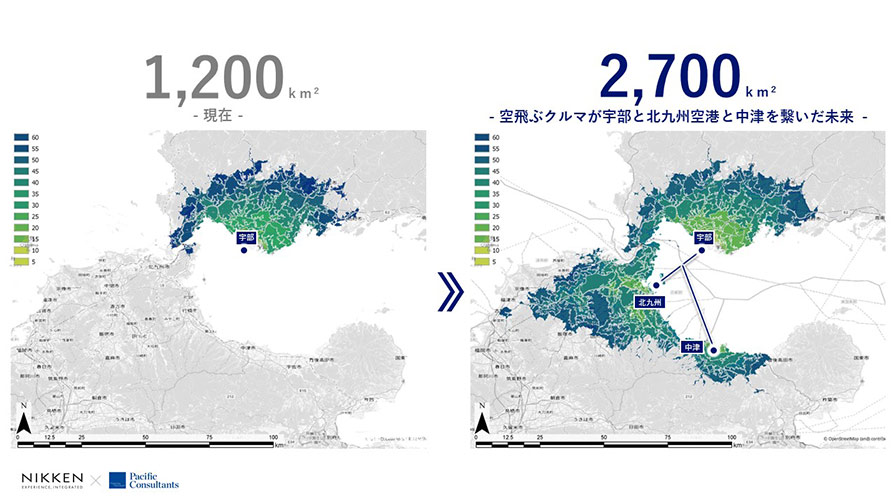 A case study connecting nearby yet distant locations, such as Kyushu and Honshu separated by an inland sea, using flying cars. The data compares the current one-hour travel time with the potential impact of flying cars. While achieving shorter travel times is certainly a benefit, considering the development of land routes and the CO2 emissions during such travel, it becomes clear that flying cars are an environmentally friendly mode of transportation. *(Source) Nikken Sekkei/Pacific Consultants Co-creation WG "CROSS OVER" Study Group Materials on Future Visions
This is a unique way of connecting cities by air, something only possible in island nation Japan.
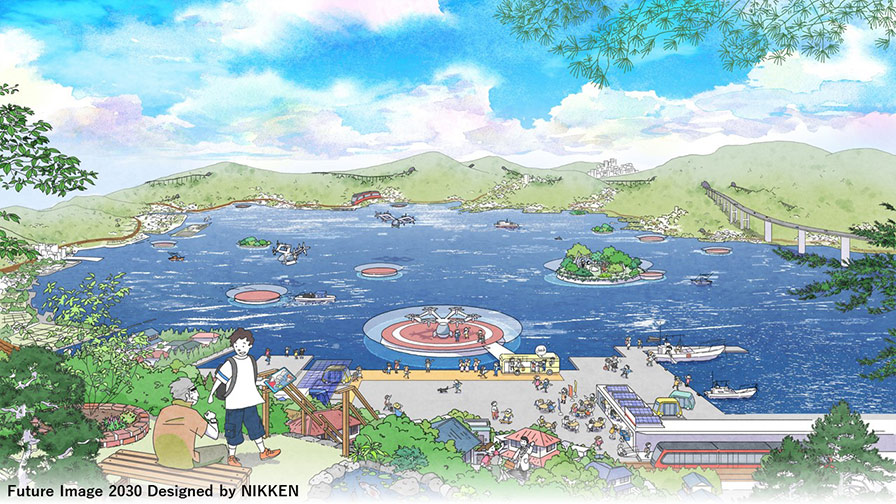 Imagine a revolution in air travel, connecting bays with floating vertiports. If you could cross the sea in a flying car, places that would be time-consuming and long-distance travel by land might become much easier for grandchildren to visit their grandparents.
Establishment of the Skyscape Design Lab Department
~Revolutionizing air travel to solve social problems on the ground~
And in order to realize that future more concretely and reliably, we established the new Skyscape Design Lab in 2024.
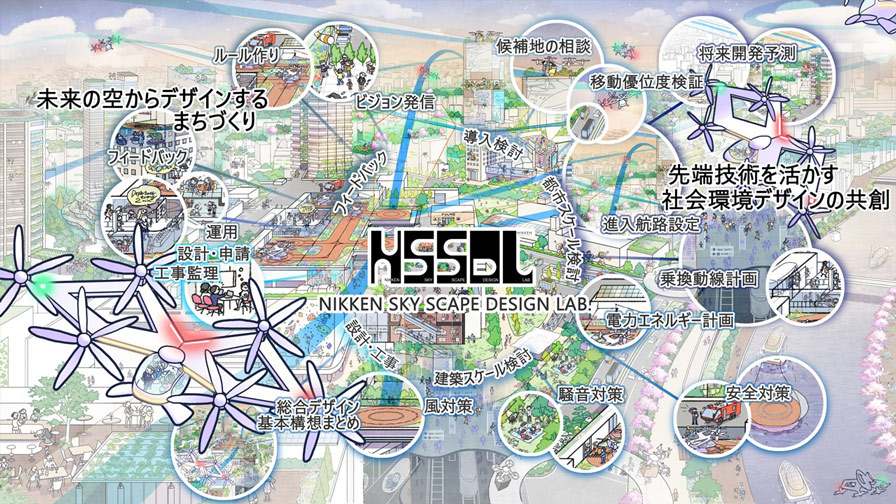 This is an overview of the scope of work for the Skyscape Design Lab. Beyond traditional design work, we consider urban development and the future of cities through total design, including participation in rule-making and implementation considerations for the social deployment of flying cars, as well as energy and environmental planning.
In a world where economic viability alone is insufficient, and where coexistence with the Earth and a new kind of prosperity are sought, flying cars have the potential to "open up an exciting future for society." Let's think together about "a revolution in air mobility for everyone."