
Seeing is believing! “SYNCVR,” a virtual earthquake simulation system that intuitively conveys seismic performance
SCROLL DOWN
overview
SYNCVR is a system that uses virtual reality (hereinafter “VR”) to provide a realistic simulation of how a building sways during an earthquake, enabling users to communicate about a building’s seismic performance with a tangible sense of its characteristics.
This system makes it easy to generate VR footage tailored to the site’s ground conditions, building height, floor plan, structure, and number of stories.For example, users can freely create simulations to see how a room on the 10th floor of a 10-story reinforced concrete building would shake during a magnitude 7 earthquake, what the extent of damage would be, and how the building would shake differently based on structural characteristics—such as seismic resistance, vibration control, or seismic isolation—even if the building is the same height. An immersive experience using VR headsets is also possible.
Previously, VR videos required manual creation of CG animations, which was time-consuming and costly, and limited users to pre-made, model-based disaster simulations. However, since SYNCVR uses actual data to generate visuals, it enables users to experience the unique spatial characteristics of specific buildings.



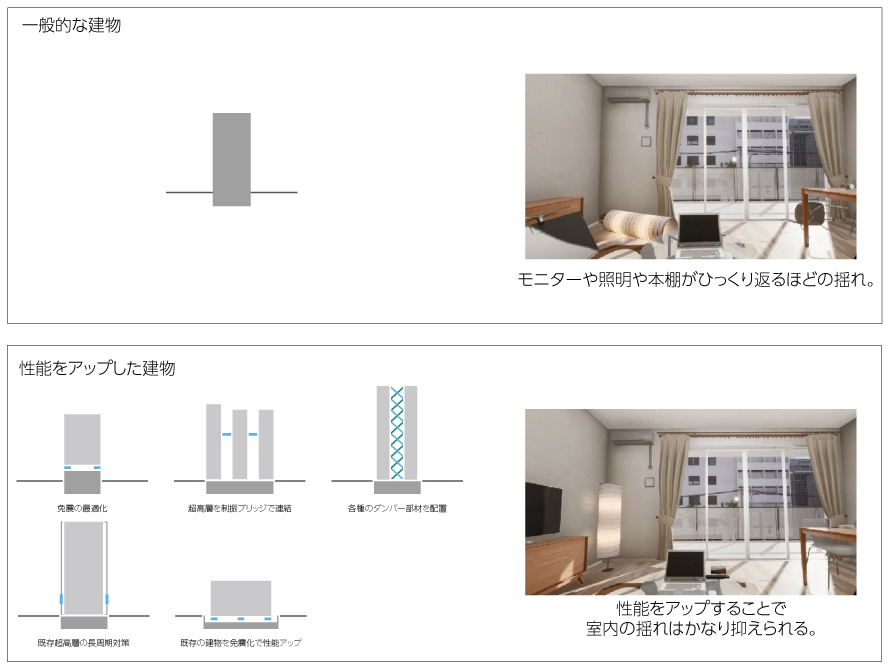 By selecting different structural designs, you can compare the extent of indoor damage between “buildings with enhanced performance” and “standard buildings.” Earthquake damage depicted in the VR environment may differ from reality.
360° VR of an Office on the 7th Floor of a Typical Building
Input Earthquake Motion: Simulated South Kanto Earthquake (Construction Site: Roppongi) (Click the VR button in the lower right corner to enter full-screen mode. To exit full-screen mode, press the Esc key on your PC. If viewing on a smartphone, you may need to wait a moment for playback to begin, depending on your network connection.)
360° VR Tour of the 7th-Floor Office in a Building with Enhanced Performance
Input Earthquake Motion: Simulated South Kanto Earthquake (Construction Site: Roppongi) (Click the VR button in the lower right corner to enter full-screen mode. To exit full-screen mode, press the Esc key on your PC. If viewing on a smartphone, you may need to wait a moment for playback to begin, depending on your network connection.)
Key Features
- As long as we have the seismic waveform data for the floor where you want to experience the earthquake, we can provide a simulated earthquake experience.
- By using seismic waveform data from buildings currently in the planning stages or existing buildings, it is possible to create damage simulations for individual buildings.
- Since new damage simulation footage can be generated instantly simply by changing the seismic waveform data, the additional cost of content can be significantly reduced even when comparing multiple scenarios.
- We have CG models of general-purpose office buildings and apartment buildings available.
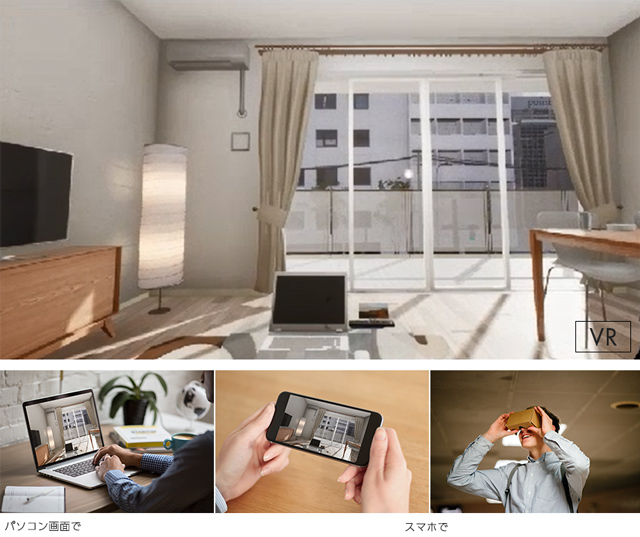
Development Background
Furthermore, there was a demand for experiential content that would allow for a comparative analysis of the specific damage patterns of a building based on its structural system.
In response to these needs, SYNCVR was developed jointly by Nikken Sekkei and Geo Creates Co., Ltd. as a system to assist building owners in their decision-making.
To provide a more realistic earthquake experience
① Combine with an earthquake-proof cushion
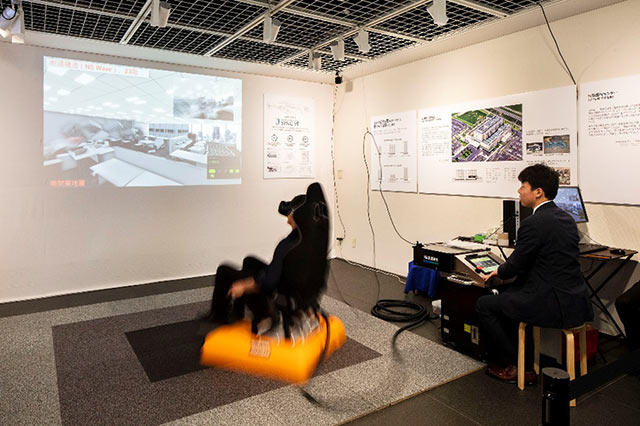 It offers a highly immersive virtual earthquake experience with unprecedented ease.
② Combine it with emotion sensing.
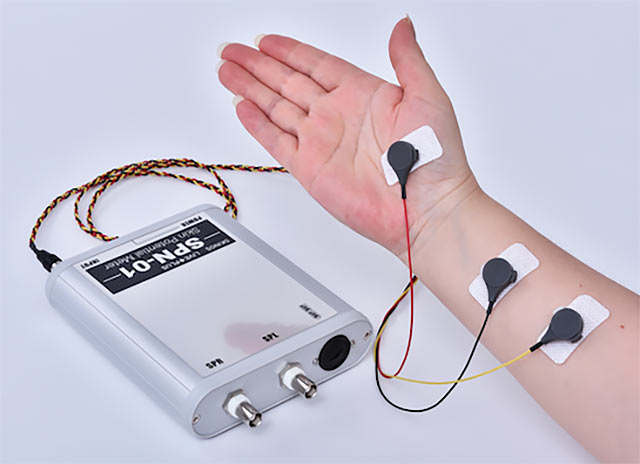
Future developments
■ Setting seismic safety targets and determining structural systems during building planning (designer ⇔ client)
■ Promoting seismic performance when purchasing a home (homebuilder ⇔ buyer)
■ Promoting seismic performance in office leasing (building owner ⇔ tenant)
■ Promoting the performance of seismic isolation and damping devices (manufacturers ⇔ building owners)
■ Social contributions such as disaster prevention education and sharing lessons learned from past earthquakes (local governments, insurance companies ⇔ the general public)
*SYNCVR is a registered trademark of Nikken Sekkei Ltd. and Geo Creates Co., Ltd.