
Significantly reduces vertical vibrations during concerts.
~Just like a trampoline!? What is a vertical vibration isolation frame?~
SCROLL DOWN
In large-scale multi-purpose facilities and live music venues, the vertical swaying of the audience can cause significant shaking in surrounding buildings. When such vibrations occur, facility operators are required to take measures such as prohibiting events by artists whose performances are expected to involve vertical swaying, or limiting the type of music performed, which poses a major challenge for the concert industry. Therefore, Nikken Sekkei has devised a "vertical swaying vibration isolation frame (Patent No. 7088664)" to reduce the vibrations caused by vertical swaying.
We aim to contribute to urban development by creating facilities where people can enjoy a wide range of entertainment.



The effect of "vertical vibration isolation frame"
Why do surrounding buildings shake when people move?
~The cause is resonance~
Buildings that resonate due to vertical vibrations and buildings that do not resonate
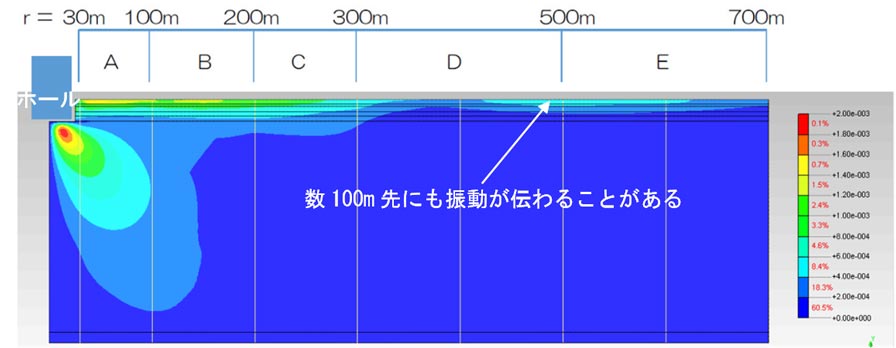 Simulation results of ground vibration propagation during longitudinal vibration in a certain type of ground.
(Horizontal displacement diagram of the ground cross-section)
The mechanism of the "vertical vibration isolation frame"
~Reducing vertical vibrations with "soft, heavy" beams~
To achieve the above performance, the beams are made of H-SA700, an ultra-high-strength steel material with about twice the strength of commonly used steel frames, and the weights are made of electric furnace oxidized slag aggregate, which has a higher specific gravity than ordinary sand or aggregate and is cheaper than concrete.
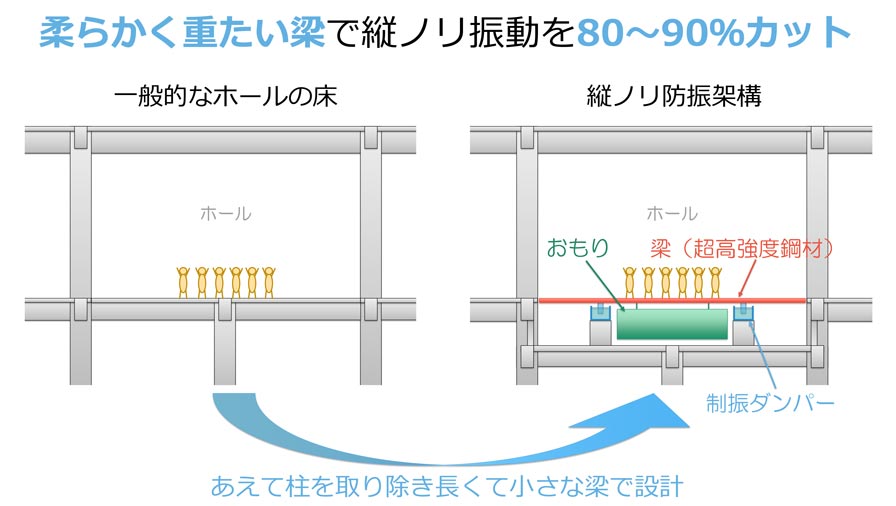 Differences between a typical hall and a vertical vibration isolation frame
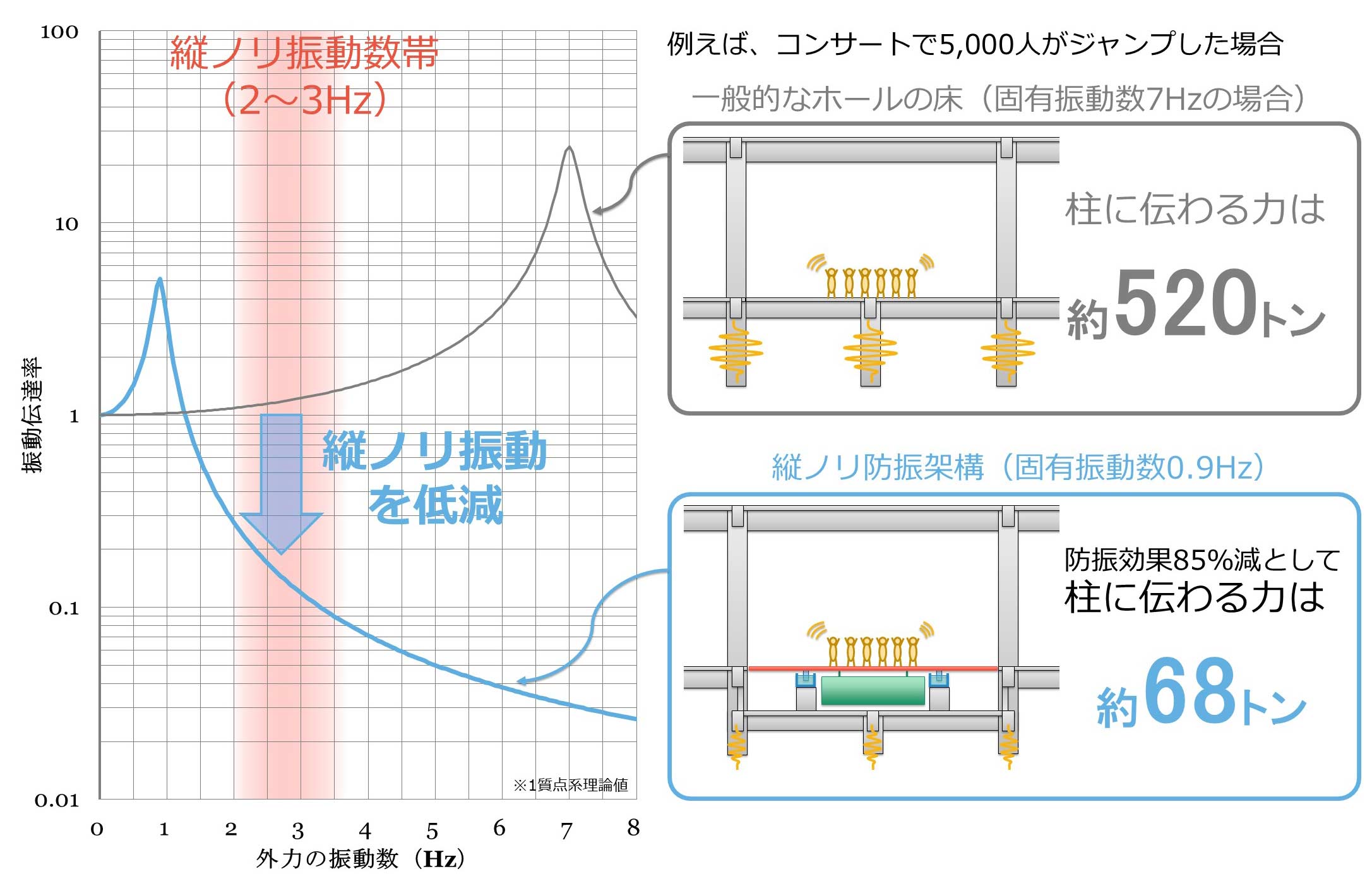 Vibration reduction effect of vertical vibration isolation frame
Demonstration experiment
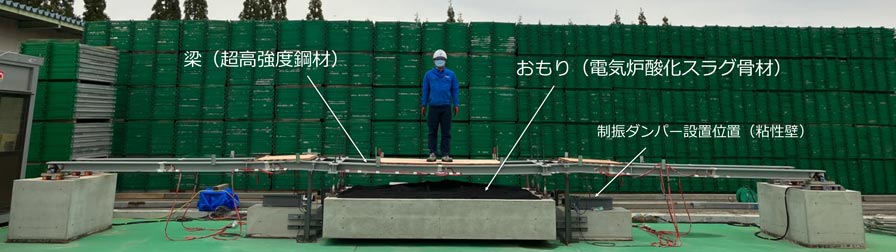 Test specimen
Experimental scene
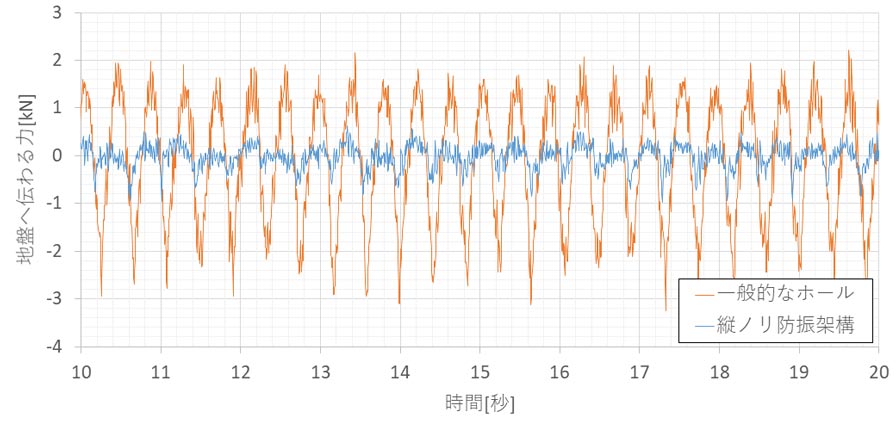 Vibration reduction effect
Development history and future prospects
This technology features a simple structure using a common building element, the beam, and is characterized by its high reliability as a vibration isolation system. Moving forward, we will leverage the knowledge gained from experiments to develop a vertical vibration isolation frame with even greater vibration reduction effectiveness, and propose it for various building applications both domestically and internationally.
* Research related to this technology
1. Research on controlling vertical vibrations occurring in facilities that attract crowds and evaluating discomfort considering the dynamic response of the human body (Abstracts of the Architectural Institute of Japan Annual Meeting, September 2020, Ozawa, Asahi, Fukuwa, Komazawa)
2. Vibration characteristics of a large-mass, low-rigidity vibration-isolating frame to reduce excitation force caused by human movement (Abstracts of the Architectural Institute of Japan Annual Meeting, September 2021, Ozawa, Asahi, Fukuwa)