"NS Wave®": Custom-Designed Simulated Earthquake Motion for Structural Safety Verification

SCROLL DOWN

Japan is one of the world’s most earthquake-prone countries. Because buildings are directly exposed to earthquakes, legislative amendments revising building codes have been enacted whenever major earthquakes have caused significant damage. At Nikken Sekkei, to ensure the safety of our clients and the users of their buildings, we have sought to develop new insights and methodologies in structural engineering, and have consistently implemented our own unique seismic countermeasures in advance of such legislative changes.

Looking back over the past thirty years or so, various types of extremely large earthquakes have occurred throughout Japan, including long-period earthquakes that cause buildings to sway for extended periods and inland direct-hit earthquakes that subject buildings to instantaneous impact forces.When people think of earthquakes, they are likely familiar with the “seismic intensity” scale; however, various other indicators—not just “seismic intensity”—are used to verify building safety. Here, we introduce NS Wave®, a simulated seismic motion model developed independently by Nikken Sekkei for use in structural design.

What Are Design Earthquake Motions?

Before explaining NS Wave®, we’ll first explain what design-based simulated seismic motion actually is.
In the seismic design of buildings, computer-based vibration simulations are performed to verify the building’s behavior during an earthquake. The simulated seismic motions created for this verification purpose are referred to as “design reference seismic motions.” Furthermore, the seismic motions used for verification—including both design reference seismic motions and observed seismic motions—are collectively referred to as “design input seismic motions.”

What is NS Wave® (Nikken Site Wave)?

NS Wave® is a design earthquake motion model developed by Nikken Sekkei. While the design earthquake motion models specified in the regulations for super-high-rise buildings are uniform nationwide, regardless of the site location or seismic conditions, NS Wave® is designed to simulate the earthquake motions that could actually occur at the planned site.
The process by which seismic motion causes a building to shake can be explained as follows.
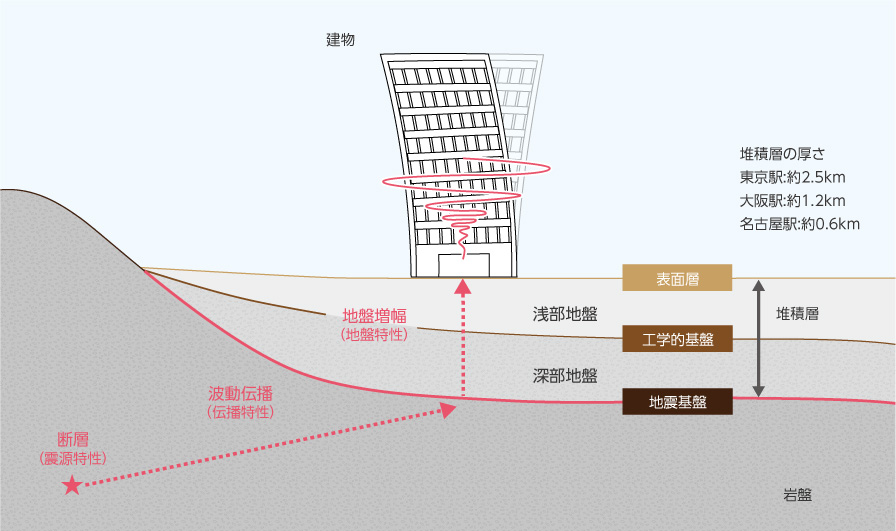
An earthquake occurs due to the rupture of a fault at the epicenter, and the resulting shaking travels through the hard rock layer known as the Earth’s crust. Because this shaking propagates as waves, it is called a seismic wave.Eventually, these seismic waves reach a depth of several kilometers beneath the project site, where they are amplified within the soft sedimentary layers and travel upward to the point directly beneath the building’s foundation. The seismic motion at this point directly beneath the foundation causes the building to shake, and the building’s occupants feel the shaking.
NS Wave® is a simulated seismic motion for design purposes that captures the characteristics of seismic motion—as it travels from the epicenter to directly beneath the foundation—in three stages: epicenter characteristics, propagation characteristics, and ground characteristics, and establishes design conditions for each site at each stage.

Until the seismic waves reach the building

NS Wave® was developed by combining widely recognized theories in the field of seismology with proprietary waveform theories, and its approach is grounded in insights from seismology and earthquake engineering. The parameters required to generate design-grade simulated ground motion for each planned site are based on values published by government agencies and data obtained through site-specific surveys.These parameters consist of only a limited number of factors that take into account both the earthquake and the site-specific conditions, and the seismic motion generation method itself is designed to be easily understood intuitively by structural designers. Because this method incorporates a series of such thoughtful design elements, NS Wave® ensures that those involved in building design can fully understand the process and rely on data that is objectively sound.
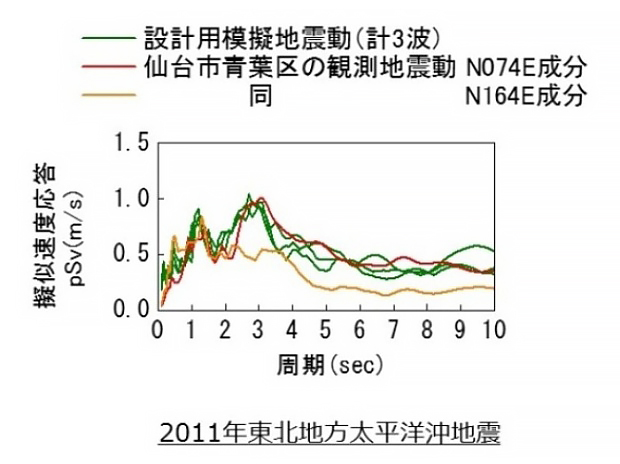
Since it is crucial to determine whether NS Wave®, a simulation method for design purposes, “can capture real-world phenomena,” we present an example here. We compared the observed waveforms from the actual 2011 Tohoku-Pacific Ocean Earthquake with the NS Wave® ground motion generated under the assumption that the earthquake occurred along the assumed fault.As shown in the figure below, the intensity of the ground motion, expressed for each periodic component, exhibited trends very similar to those in the observed records. Thus, it can be said that NS Wave® is a method capable of generating ground motion that captures the trends of actual phenomena.

NS Wave® と東日本大震災の観測記録の比較
※仙台市の観測記録は国立研究開発法人建築研究所の強震観測で得られたものを使用しています。
引用元:鹿嶋俊英, 小山信, 大川出: 平成23年(2011年)東北地方太平洋沖地震における建物の強震観測記録, 建築研究資料 No.135,国立研究開発法人建築研究所, 2012年3月

The Evolution of Nikken Sekkei’s Proprietary Method for Design Input Earthquake Motions

Nikken Sekkei has consistently pioneered seismic design while staying ahead of building codes, which are revised after every earthquake.
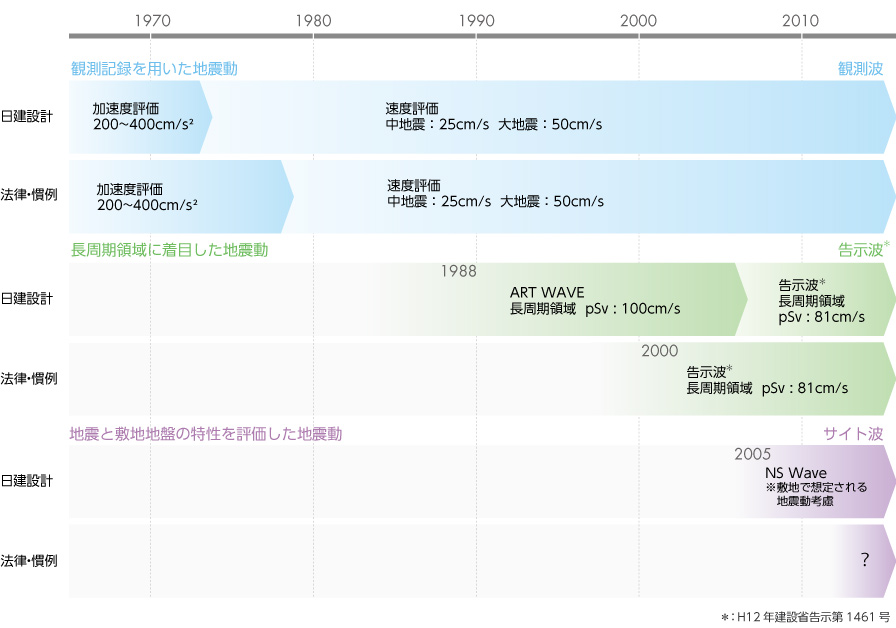
In the late 1960s, during the early days of skyscraper design, building vibration simulations were conducted using only a few types of seismic motion that had actually been observed at that time.Typical examples include the seismic records from El Centro, California, during the 1940 Imperial Valley earthquake and the ground motion observed in Hachinohe, Aomori Prefecture, during the 1968 Tokachi-oki earthquake. In other words, seismic data observed at locations unrelated to the planned construction site were used for design purposes.Since these seismic motions were not strong enough to represent the long-period seismic motions—which are believed to have a significant impact on buildings of 30 stories or more—there was a concern that the shaking would be underestimated.
Initially, it was standard practice to evaluate ground surface acceleration when discussing the magnitude of seismic motion. At Nikken Sekkei, we were among the first to adopt the evaluation of ground surface velocity—which correlates more strongly with building damage than acceleration—and have been using it to determine design input seismic motions.
In 1988, we independently developed a simulated design earthquake motion (ART WAVE) that adequately incorporated long-period vibration components, and have been using it for structural analyses of super-high-rise buildings.In 2000, 12 years after the development of ART WAVE, a revision to the law led to the Ministry of Construction issuing a notification specifying the intensity of seismic motion—including long-period seismic motion—that must be considered in the design of super-high-rise buildings and similar structures. Seismic motion data created in accordance with this regulation is sometimes referred to as “notification waves.”However, neither ART WAVE nor the design simulation seismic motion specified in the notification fully reflected the characteristics of individual earthquakes or the site-specific ground conditions of the planned construction site.
Following the 1995 Hyogo Prefecture Government Southern Japan Earthquake, the national earthquake monitoring system was rapidly established, and earthquake-related research in Japan advanced by leaps and bounds, resulting in the accumulation of extensive knowledge in fields such as seismology, earthquake engineering, and seismic resistance engineering.Based on this knowledge, Nikken Sekkei spent six years starting in 1999 developing NS Wave® to incorporate seismic motions that simulate the actual phenomena expected at the project site into structural design, and has been using NS Wave® for structural design since 2005.Subsequently, in 2016, the Ministry of Land, Infrastructure, Transport and Tourism (MLIT) published simulated seismic motions for design purposes—referred to as “long-period notification”—based on the assumed Nankai Trough earthquake.These seismic motions, known as “Site-Specific Seismic Motions,” are tailored to account for the specific conditions of the project site. Nikken Sekkei has once again taken the lead in adopting seismic motions that account for such site-specific conditions, even before relevant regulations were established.
I believe that the reason we have consistently been ahead of changes in the law is that, rather than simply adhering to revised regulations, we have continued to conduct structural design by considering—in light of the times—what is truly important for buildings, building owners, and the users of those buildings, and by developing the new technologies necessary to achieve that.


History of Design Input Earthquake Motions
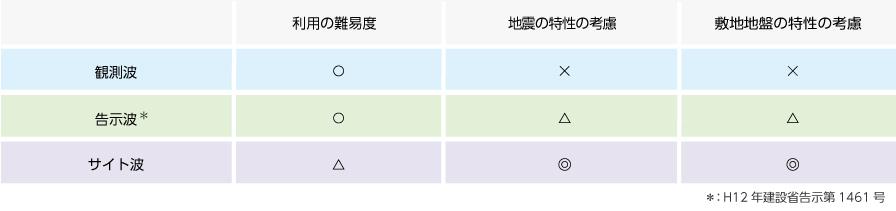
Comparison of Design Input Earthquake Motions
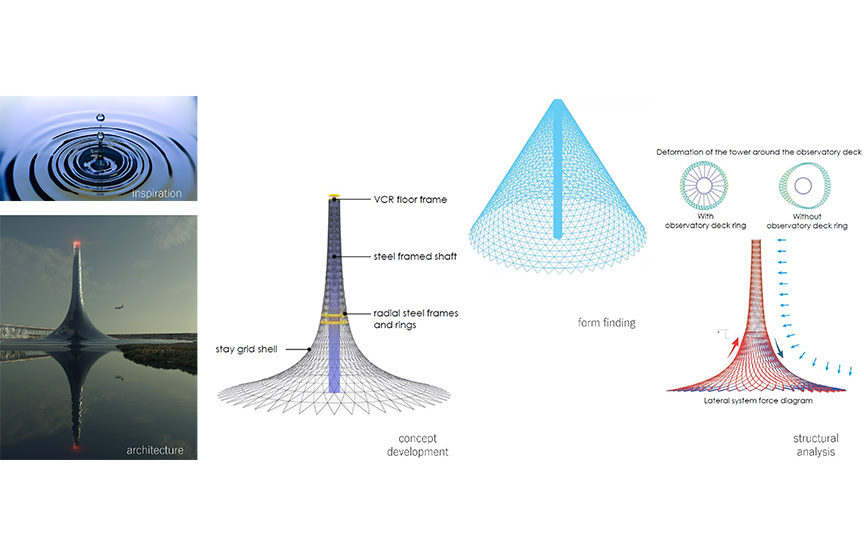
Considering the design input seismic motion is the first step in structural design.

Buildings are essentially one-of-a-kind; no two sites, clients, or users are exactly alike. Consequently, the performance requirements for each building differ, and designs must be tailored to meet the specific needs of each individual building.
Furthermore, when it comes to seismic design, the seismic conditions and the seismic performance requirements for a building are always unique. NS Wave® provides customized simulation earthquake motions that can be tailored in various ways based on these conditions. Considering seismic motions for design purposes is the first step toward constructing safe buildings.
Through extensive communication with all parties involved in the project, Nikken Sekkei’s approach to structural design involves designing buildings based on design-stage simulated seismic motions generated by NS Wave®, while setting seismic performance requirements that take into account the building’s use and the client’s requests.

This site uses cookies. By continuing to use this website, you consent to the use of cookies.Our policy.